
The RBT Task List, Decoded: What All 43 Tasks Mean for Your Exam
Updated October 2026. Every task below comes from the BACB’s RBT Test Content Outline (3rd ed.), the official list used for the RBT exam starting in 2026. We explain each one in plain English.
The RBT task list is the BACB’s official list of what a Registered Behavior Technician must know and do. Every question on the RBT exam is written from it. If you know what each task means, you know exactly what you’re studying for.
Most guides list the tasks and stop there. This one explains every task in plain English, shows how many exam questions each domain is worth, and tells you which tasks carry the most weight.
Quick answer
The RBT task list (3rd edition) has 43 tasks in 6 domains. The BACB now calls it the RBT Test Content Outline. The exam has 85 questions: 75 scored and 10 unscored. Behavior Acquisition has the most scored questions (19), and Behavior Assessment has the fewest (8).
What Is the RBT Task List?
It describes the skills an entry-level behavior technician needs. The BACB built the 3rd edition from a job task analysis, which is a study of what RBTs actually do at work.
In 2026, the BACB started calling it the RBT Test Content Outline (3rd ed.). “Task list” and “test content outline” mean the same document. It does two jobs:
- It sets the exam content. All 75 scored questions come from these 43 tasks.
- It shapes your training. The BACB’s 2026 40-hour training curriculum marks which of its topics also appear in the test content outline.
The 6 Domains at a Glance
Here’s every domain, its number of tasks, and its scored questions. The last column is our own math: scored questions divided by tasks. The BACB doesn’t publish questions per task, but the average shows where each task carries more weight.
| Domain | Tasks | Scored questions | Share of exam | Questions per task (our math) |
|---|---|---|---|---|
| A. Data Collection and Graphing | 8 | 13 | 17% | 1.6 |
| B. Behavior Assessment | 3 | 8 | 11% | 2.7 |
| C. Behavior Acquisition | 11 | 19 | 25% | 1.7 |
| D. Behavior Reduction | 7 | 14 | 19% | 2.0 |
| E. Documentation and Reporting | 4 | 10 | 13% | 2.5 |
| F. Ethics | 10 | 11 | 15% | 1.1 |
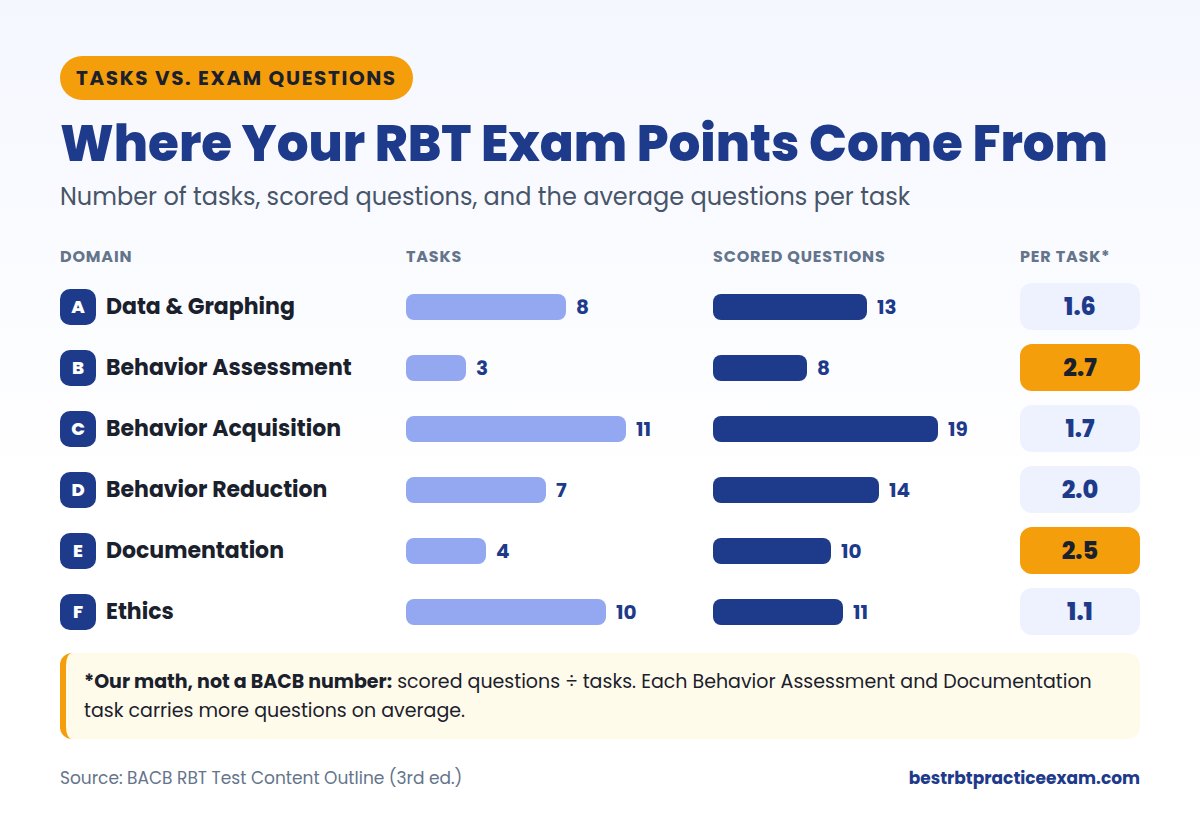
What this means for you: Behavior Assessment has only 3 tasks, but they share 8 questions. Documentation has 4 tasks sharing 10 questions. On average, each of these tasks covers more questions than an Ethics task. In our opinion, that makes domains B and E some of the easiest places to pick up points.
All 43 RBT Tasks in Plain English
Each task code below matches the BACB’s official outline. The bold part is the task in short. The rest explains what it looks like in a real session.
Domain A: Data Collection and Graphing
- A-1 Continuous measurement. Record every time a behavior happens: frequency (how many times), duration (how long), latency (time from instruction to start) and interresponse time (time between responses).
- A-2 Discontinuous measurement. Record only during set intervals: partial interval (did it happen at any point?), whole interval (did it last the whole time?) and momentary time sampling (is it happening right when the interval ends?).
- A-3 Permanent product recording. Measure what the behavior leaves behind, like the number of worksheet problems finished.
- A-4 Enter data and update graphs. Put session data into the system and keep graphs current so your supervisor can see progress.
- A-5 Observable and measurable terms. Write “hit the table with an open hand,” not “was angry.”
- A-6 Calculate and summarize data. Turn raw data into rate, mean duration or percentage. Example: 12 responses in 30 minutes is a rate of 0.4 per minute.
- A-7 Identify trends. Read a graph and tell whether a behavior is going up, going down or staying flat.
- A-8 Risks of unreliable data. Know that bad data or skipped steps can lead your team to the wrong treatment decision.
Domain B: Behavior Assessment
- B-1 Preference assessments. Find out what a client likes using multiple stimulus, paired stimulus or free operant formats, so you know what can work as a reinforcer.
- B-2 Skill assessments. Help with curriculum-based, developmental and social skills assessments that show strengths and gaps.
- B-3 Functional assessment. Take part in descriptive assessments (like ABC data) and functional analyses that help find why a behavior happens.
Domain C: Behavior Acquisition
- C-1 Reinforcement. Use positive and negative reinforcement correctly: right away, only after the target behavior, on the planned schedule, and adjusted in size, intensity and variety.
- C-2 Conditioned reinforcers. Pair things like praise or tokens with existing reinforcers so they become reinforcing too.
- C-3 Discrete-trial teaching. Run short, structured teaching trials: instruction, response, consequence.
- C-4 Naturalistic teaching. Teach during play and daily routines, using the client’s interests (incidental teaching, natural environment training).
- C-5 Chaining. Teach multi-step skills like handwashing with forward, backward or total task chaining.
- C-6 Discrimination training. Teach the client to respond differently to different cues, like touching “cup” and not “spoon.”
- C-7 Prompting and fading. Use prompts such as errorless, least-to-most, stimulus fading and time delay, then fade them out.
- C-8 Generalization. Practice skills across different settings, people and materials.
- C-9 Maintenance vs. acquisition. Know the difference between teaching a new skill and keeping an old one strong.
- C-10 Shaping. Reinforce steps that get closer and closer to the target behavior.
- C-11 Token economies. Give tokens for target behavior and let the client trade them for backup reinforcers.
Take the Behavior Acquisition quiz Study Behavior Acquisition
Domain D: Behavior Reduction
- D-1 Functions of behavior. Recognize common reasons behavior happens, like getting attention, getting an item, escaping a task, or because it feels good.
- D-2 Antecedent interventions. Change things before behavior happens, using noncontingent reinforcement (NCR), high-probability request sequences or demand fading.
- D-3 Differential reinforcement. Reinforce a better behavior instead of the problem behavior: DRO, DRA, DRI, DRL and functional communication training (FCT).
- D-4 Extinction. Stop giving the reinforcer that has been keeping a problem behavior going.
- D-5 Punishment. Carry out positive and negative punishment procedures in the plan, such as time-out.
- D-6 Side effects. Expect extinction bursts, response variation, resurgence and emotional responses, plus escape and avoidance with punishment.
- D-7 Crisis procedures. Follow the crisis or emergency plan when safety is at risk.
Domain E: Documentation and Reporting
- E-1 Share team concerns. Pass on concerns and ideas from caregivers, teachers and other providers to your supervisor quickly.
- E-2 Ask for clinical direction. Go to your supervisor about training needs or odd data, and follow the chain of command.
- E-3 Report what affects progress. Document things like illness, medication or schedule changes in a timely way.
- E-4 Objective session notes. Write what actually happened in the session, following legal, regulatory and workplace rules.
Domain F: Ethics
- F-1 Core ethics principles. Apply the principles behind the RBT ethics code: benefit others, treat people with compassion, dignity and respect, and act with integrity.
- F-2 Competence first. Only provide services after you’ve shown you can do them correctly.
- F-3 Supervision. Only work under ongoing supervision from a supervisor who meets BACB requirements.
- F-4 Effective supervision. Know what good supervision looks like: instructions, modeling, rehearsal, feedback and being observed while you work.
- F-5 Confidentiality. Follow the rules for collecting, using, storing, protecting and sharing client information.
- F-6 Public statements. Be careful what you say about your work, including on social media, and never misrepresent your credential.
- F-7 Multiple relationships. Know the risks of having more than one relationship with a client or family, and how to lower them when it can’t be avoided.
- F-8 Gifts. Follow the gift rules in the RBT ethics code.
- F-9 Professional skills. Accept feedback, listen actively, ask for input and work as part of the team.
- F-10 Cultural humility. Keep checking your own biases and respond to each client’s culture and needs.
What Changed From the 2nd Edition?
The RBT Task List (2nd ed.) had 37 tasks. The 3rd edition has 43. If you study from an older guide, you could miss whole topics. Here are the biggest differences:
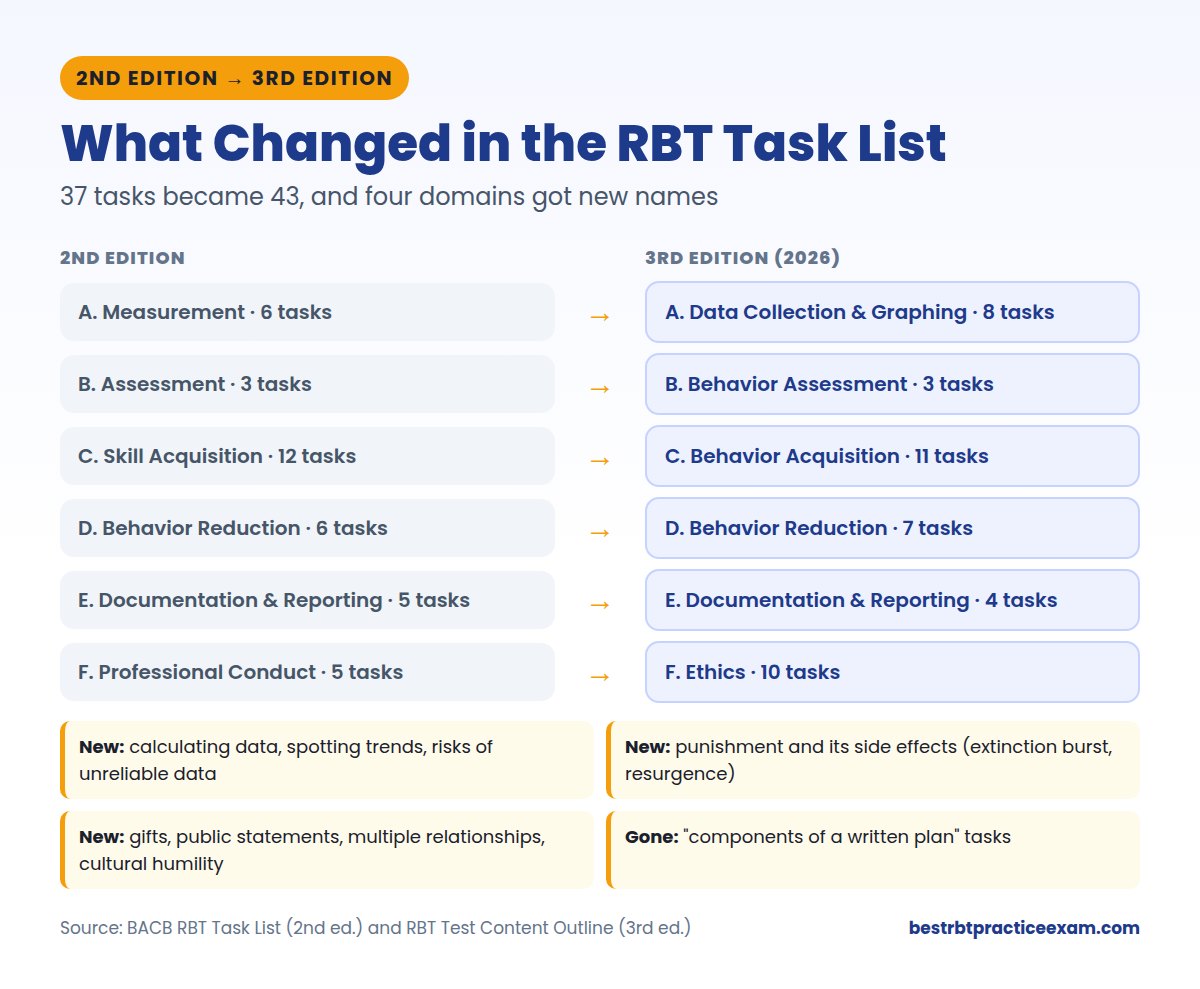
- New names. Measurement became Data Collection and Graphing. Assessment became Behavior Assessment. Skill Acquisition became Behavior Acquisition. Professional Conduct and Scope of Practice became Ethics.
- More data skills. Calculating and summarizing data, spotting trends, and the risks of unreliable data are now separate tasks.
- Punishment is in. Domain D now includes punishment procedures and their side effects, such as extinction bursts and resurgence.
- Ethics doubled. Domain F grew from 5 to 10 tasks, adding gifts, public statements, multiple relationships, confidentiality and cultural humility.
- Plan components are out. The old tasks about identifying the parts of a written skill acquisition or behavior reduction plan are gone.
How to Study the RBT Task List: Our 4-Step Plan
This is our suggested approach, not a BACB rule. It puts your study time where the exam puts its questions.
- Start with Behavior Acquisition. It has the most scored questions (19), so it deserves the most time.
- Don’t skip the small domains. Behavior Assessment and Documentation have few tasks, but each task carries more questions on average.
- Learn each task as an action. The task list says “implement,” “identify” and “describe.” Picture yourself doing each task in a session, not just defining it.
- Test yourself by domain, then all at once. Take one domain quiz at a time, then sit a full timed exam to see your score for every domain.
How the Task List Connects to Your Training and Competency Assessment
These tasks aren’t only for the exam. The same skills show up at every step of becoming an RBT:
- 40-hour training. The BACB’s 2026 training curriculum has 8 sections, and it marks which topics also appear in the test content outline. Our guide to the 40-hour RBT training shows all 8 sections and their hours.
- Competency assessment. After training, a BCBA or BCaBA checks 19 hands-on tasks in measurement, assessment, skill acquisition and behavior reduction, and professionalism. Our RBT competency assessment guide explains how it works.
- The exam. All 75 scored questions come from the 43 tasks above. See how many questions are on the RBT exam for the full breakdown.
Know the tasks? Prove it. Take a full, timed practice exam built on all 43 tasks and see your score for each domain.
Frequently Asked Questions
Is the RBT task list the same as the RBT test content outline?
Yes. The 3rd edition is officially called the RBT Test Content Outline (3rd ed.), but people still call it the RBT task list. Both names mean the document that lists the 43 tasks the exam is built on.
How many tasks are on the RBT task list?
The 3rd edition has 43 tasks in 6 domains: Data Collection and Graphing (8), Behavior Assessment (3), Behavior Acquisition (11), Behavior Reduction (7), Documentation and Reporting (4) and Ethics (10). The older 2nd edition had 37.
Which domain has the most questions on the RBT exam?
Behavior Acquisition has the most, with 19 of the 75 scored questions. Behavior Reduction has 14, Data Collection and Graphing has 13, Ethics has 11, Documentation and Reporting has 10, and Behavior Assessment has 8.
Do I need to memorize the task codes like A-1 or C-7?
The codes help you organize your studying, but the exam is about the skills behind them. In our opinion, it’s better to know what each task looks like in a real session than to memorize the codes.
Is the 2nd edition RBT task list still used?
Not for the current exam. The 3rd edition test content outline is used for the RBT exam starting in 2026. If your study guide still uses “Measurement” or “Skill Acquisition” as domain names, it’s based on the old list.