
RBT Behavior Reduction Study Guide (Domain D, 2026)
RBT behavior reduction (Domain D) is how you help a client do less of a problem behavior, safely and as the plan says. It covers 7 tasks: functions of behavior, antecedent interventions, differential reinforcement, extinction, punishment, the side effects of extinction and punishment, and crisis procedures. It has 14 of the 75 scored questions on the RBT exam.
- 1D.1Find the whyFunction of behavior
- 2D.2Prevent itAntecedent interventions
- 3D.3Teach a better wayDifferential reinforcement
- 4D.4 to D.7Respond safelyExtinction, punishment, crisis
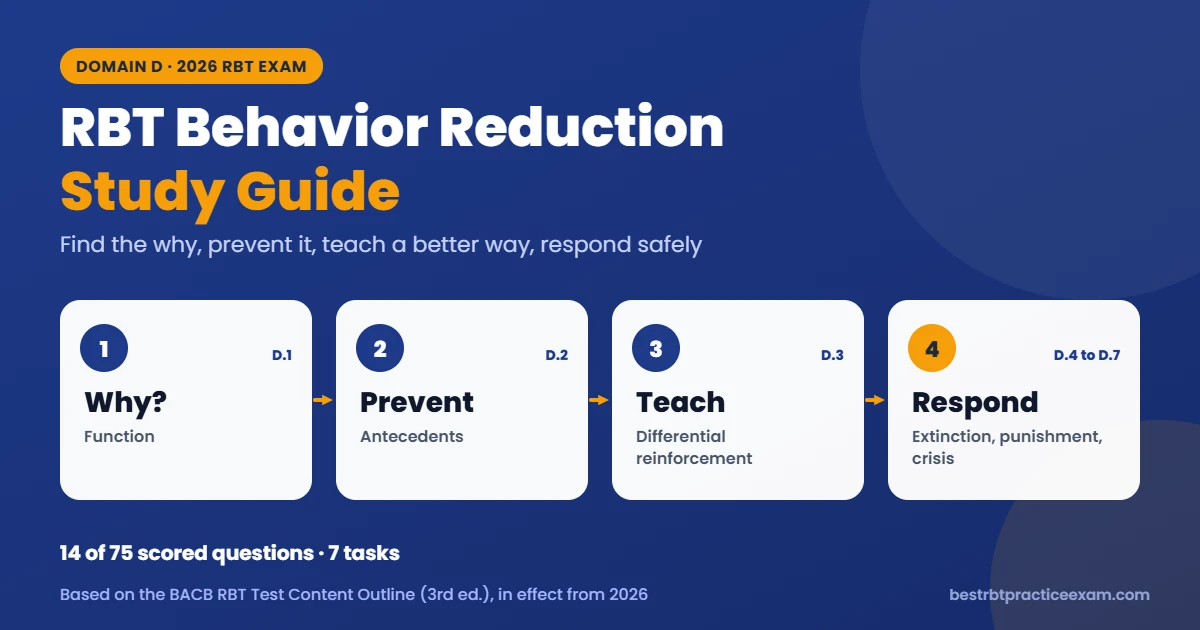
Here is what I tell every new RBT on day one: you are not trying to stop a behavior. You are trying to understand it, then give the client a better way to get the same need met. Once that clicks, RBT behavior reduction stops being a list of scary terms. This guide follows the same four steps your supervisor uses, so each task makes sense in order.
The Behavior Reduction Plan: Your Map in Every Session
Every RBT behavior reduction task happens inside a written behavior reduction plan (often called a behavior intervention plan, or BIP). Your supervisor, a BCBA or BCaBA, writes it after an assessment. You carry it out exactly as written.
- Target behavior, defined so anyone can see and count it
- Function, the best guess about why it happens
- Antecedent strategies, to prevent it
- Replacement behavior, what to teach instead
- Consequence strategies, how to respond when it happens
- Crisis plan, what to do if anyone is in danger
- Data collection, what to record each time
- Review dates, when the supervisor checks progress
Behavior reduction data is summarized on a graph. Your supervisor looks at the trend, level and variability to decide if the plan is working. Your job is accurate data every session. The data collection and graphing guide covers how to record it well.
Exam trap: If a plan seems to be failing, the RBT reports it with data. Changing the plan, adding a new consequence or stopping a procedure is the supervisor’s decision.
D.1 Functions of Behavior: Why the Behavior Happens
BACB task D.1: “Identify common functions of behavior.”
Behavior keeps happening because it works for the client. The job it does is called its function. There are four common functions, and an easy way to remember them is SEAT: sensory, escape, attention and tangible.
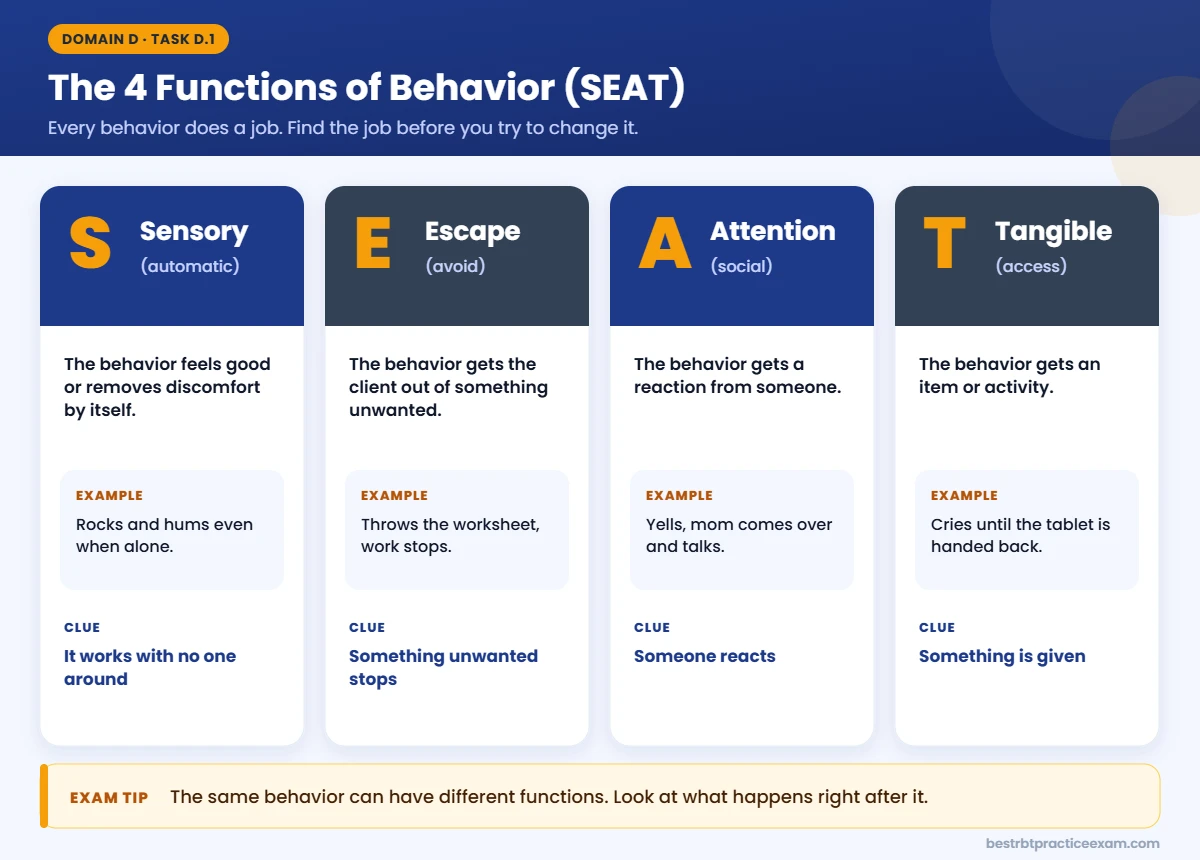
Sensory is also called automatic reinforcement, because the behavior works with no one else involved. The other three are social, because another person gives or removes something. Your supervisor confirms the function through a functional assessment, which you may help with as covered in the behavior assessment guide.
Same behavior, four different reasons
This is the idea that trips up most test takers. Two clients can do the exact same thing for completely different reasons, so the plan for each one is different.
| Client hits the table when… | What happens right after | Likely function |
|---|---|---|
| Mom is on the phone | Mom hangs up and says “Stop that!” | Attention |
| A worksheet is placed in front of them | The worksheet is taken away | Escape |
| The tablet is put away | The tablet is handed back | Tangible |
| Alone in the room, often | Nothing changes around them | Sensory (automatic) |
Exam trap: Focus on the function, not the form. “He hits” tells you what the behavior looks like. It does not tell you why it happens.
D.2 Antecedent Interventions: Stopping Behavior Before It Starts
BACB task D.2: “Implement antecedent interventions (e.g., NCR, high-probability request sequences, demand fading).”
Antecedent interventions change what happens before the behavior, so the client has less reason to do it. They are proactive, which makes them some of the most useful tools in RBT behavior reduction.
Give the reinforcer on a time schedule, no matter what the client is doing. If attention comes every 2 minutes for free, there is less need to misbehave for it.
Key word: time-basedGive 3 to 5 quick, easy requests the client almost always follows, then the harder one. The momentum carries into the hard task.
Key word: easy, easy, easy, hardLower the demands for a while, then add them back slowly as the client succeeds. Often used when the function is escape.
Key word: gradualPlans may also include choices, visual schedules, warnings before transitions and priming. Use only the ones in the plan, the way the plan describes them.
Your client often screams when asked to clean up. Before the clean-up request, you ask: “High five!”, “Touch your nose!”, “Clap with me!” She does all three and earns praise each time. Then you say “Toys in the bin,” and she starts cleaning. That was a high-probability request sequence.
Exam trap: NCR is given on a schedule, not after a behavior. If the reinforcer only comes after the client does something, it is not NCR.
D.3 Differential Reinforcement: Reward the Behavior You Want
BACB task D.3: “Implement differential reinforcement procedures (e.g., DRO, DRA, DRI, DRL, FCT).”
Differential reinforcement means reinforcing one behavior and not another. It is the heart of RBT behavior reduction, because it teaches the client something to do instead, not just something to stop. If you need a refresher on reinforcement itself, see the behavior acquisition guide.
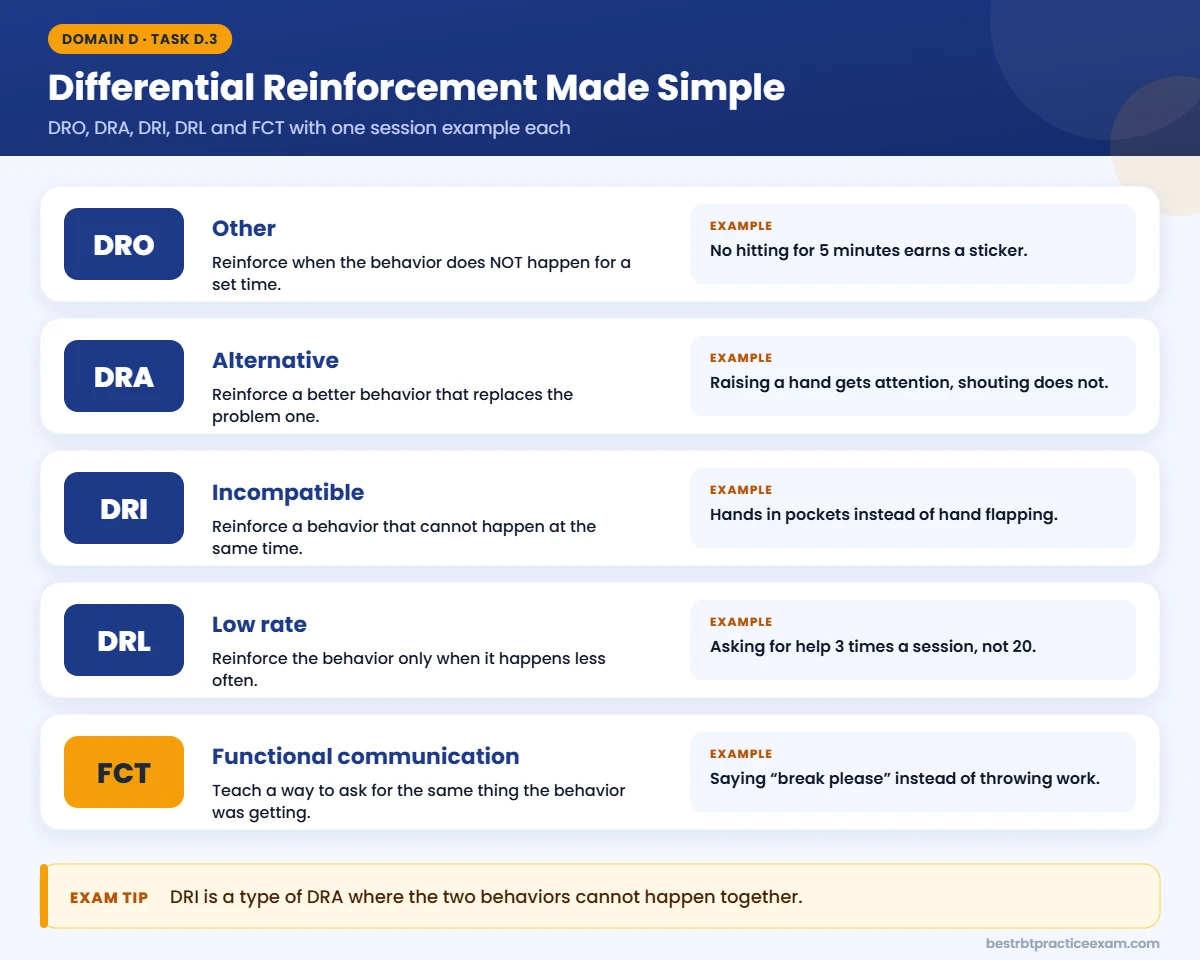
Reinforce any better behavior that replaces the problem. Example: raising a hand instead of shouting.
Reinforce a behavior that physically cannot happen at the same time. Example: hands on the table instead of hitting.
FCT (functional communication training) is a special kind of DRA. The new behavior is a way to communicate, and it gets the exact same reinforcer the problem behavior was getting. That is why it works so well.
Your client throws his worksheet to escape work. The plan uses FCT. You teach him to hand you a “break” card. Each time he uses it, he gets a one-minute break right away. Within two weeks, the card has almost fully replaced throwing. Same function, much safer behavior.
Exam trap: DRO reinforces the absence of a behavior for a set time. DRL does not aim for zero. It reinforces the behavior when it happens less often, for behaviors that are fine in small amounts.
D.4 to D.7: Extinction, Punishment and Crisis Procedures
The last part is how you respond when the behavior happens anyway. This is where following the plan exactly matters most, because a wrong response can make the behavior stronger.
D.4 Extinction: Stop Paying Off the Behavior
BACB task D.4: “Implement extinction procedures.”
Extinction means the reinforcer that kept the behavior going no longer follows it. It is not the same as “ignoring.” What you withhold depends on the function.
| Function | Extinction looks like |
|---|---|
| Attention | Planned ignoring: no eye contact, no comments, while keeping everyone safe |
| Escape | The task continues. The client does not get out of it by misbehaving |
| Tangible | The item is withheld every time the behavior happens |
| Sensory | Blocking or reducing the sensory result, as the plan describes |
Exam trap: Extinction must be consistent. Giving in “just this once” puts the behavior on an intermittent schedule, which makes it even harder to reduce.
D.6 Side Effects of Extinction and Punishment
BACB task D.6: “Describe secondary effects of extinction (e.g., extinction burst, response variation, resurgence, emotional responding) and punishment (e.g., emotional responses, escape and avoidance).”
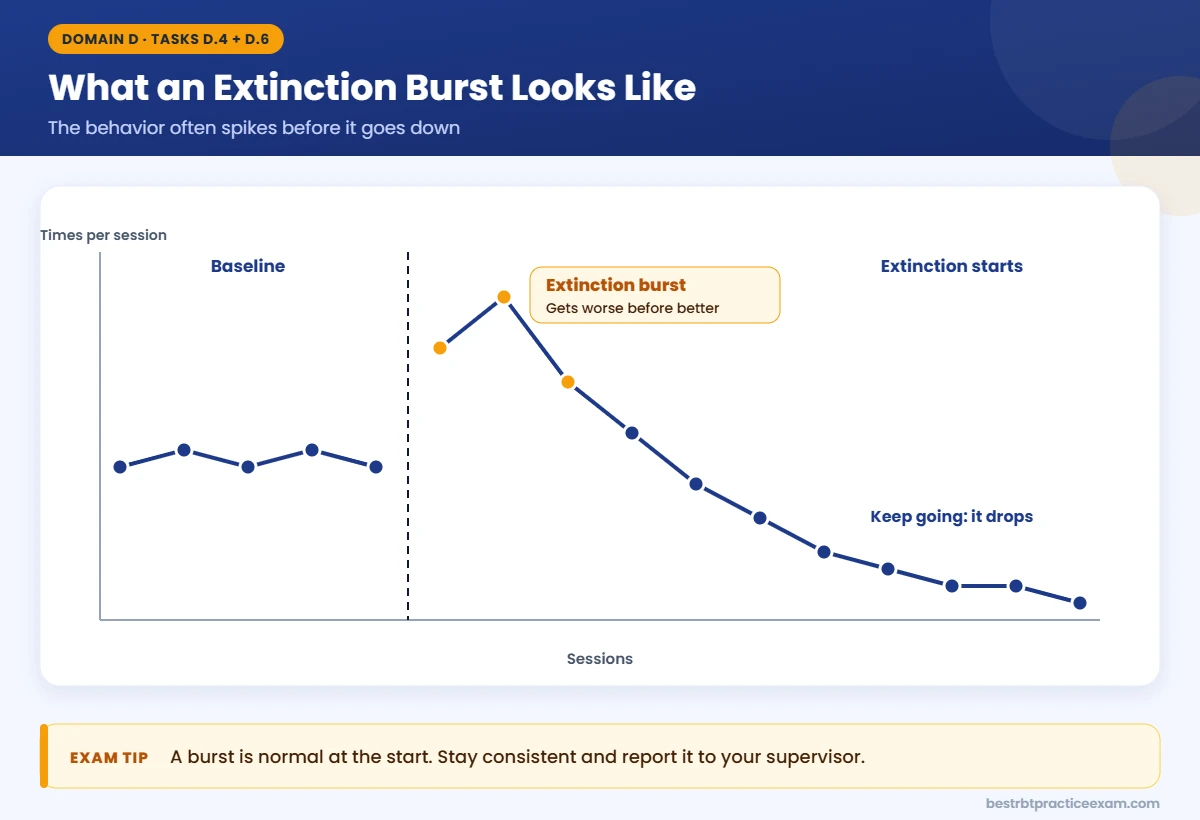
| Side effect | What it looks like |
|---|---|
| Extinction burst | The behavior gets more frequent, louder or longer for a short time |
| Response variation | The client tries new forms, such as kicking instead of hitting |
| Resurgence | An old behavior that used to work comes back |
| Emotional responding | Crying, anger or aggression when the reinforcer stops coming |
| After punishment | Emotional responses, and escape or avoidance of the person or place linked to it |
If you see any of these, keep following the plan and report it to your supervisor the same day, with data.
D.5 Positive and Negative Punishment
BACB task D.5: “Implement positive and negative punishment procedures (e.g., time-out).”
Punishment is anything that follows a behavior and makes it happen less. Positive means something is added. Negative means something is taken away.
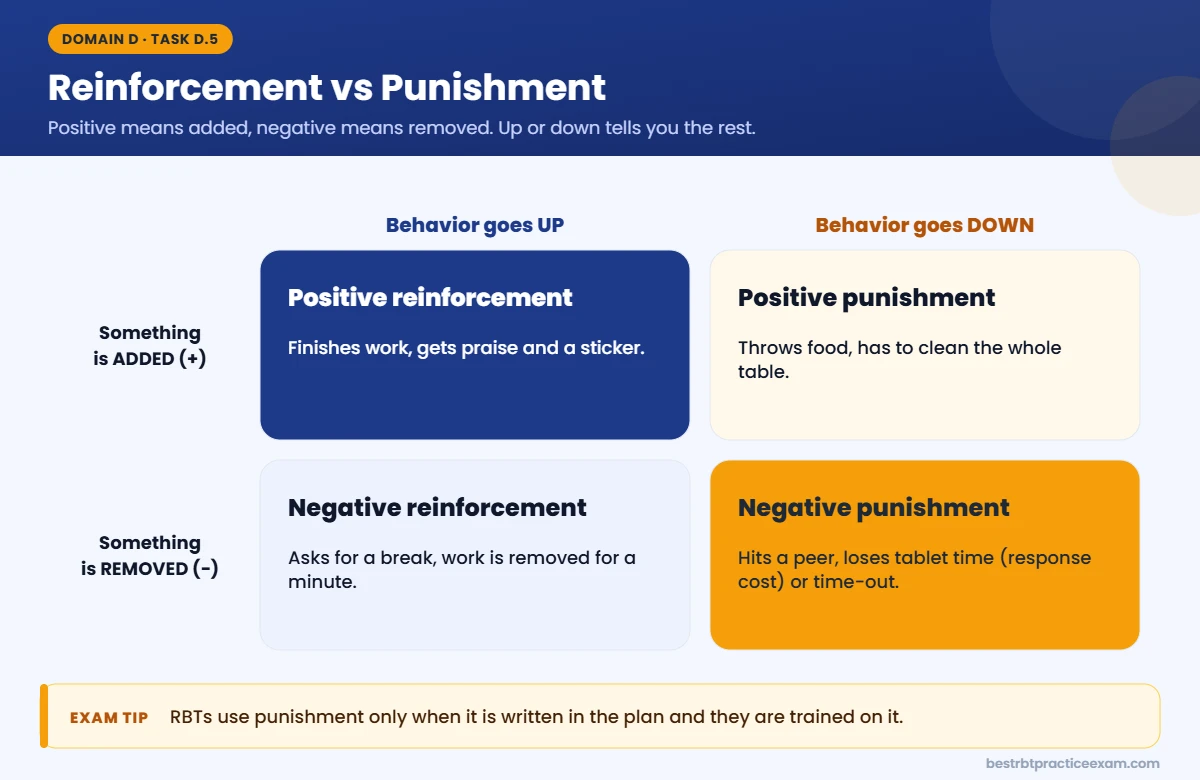
Time-out from positive reinforcement and response cost (losing tokens) are both forms of negative punishment. Plans use punishment only after less intrusive options, and only when the supervisor has written it into the plan and trained you on it. The ethics guide explains why client dignity always comes first.
Exam trap: Negative punishment and negative reinforcement are opposites. Both remove something, but punishment makes behavior go down and reinforcement makes it go up.
D.7 Crisis and Emergency Procedures
BACB task D.7: “Implement crisis/emergency procedures.”
A crisis is any moment when the client or someone else could get hurt. In a crisis, safety comes before every teaching goal.
- Stay calm. Use a quiet voice and slow movements.
- Follow the written crisis plan and your agency’s emergency procedures.
- Use only the procedures you are trained and approved to use. Never improvise a physical hold.
- Get help. Contact your supervisor, and call emergency services if anyone is in danger.
- Document and report what happened as soon as everyone is safe. See the documentation and reporting guide.
The first time a client has a big crisis in front of you, your heart will race. That is normal. Breathe, follow the plan you practiced, and call for help early. Nobody expects you to handle a crisis alone, and asking for help is the professional move.
RBT Behavior Reduction Cheat Sheet: Match the Plan to the Function
Most questions in this domain get easier once you match everything to the function. Use this table for a fast review.
| Function | Prevent it with | Teach instead | Extinction looks like |
|---|---|---|---|
| Attention | NCR attention on a schedule | FCT: “Look at me” or a tap on the shoulder | Planned ignoring of the behavior |
| Escape | Demand fading, high-p requests, choices | FCT: “Break please” or “Help please” | The task continues |
| Tangible | Warnings before items end, NCR access | FCT: asking for the item | The item is withheld |
| Sensory | Enriched environment, other sensory activities | DRI or DRA with a matching sensation | Blocking the sensory result |
6 RBT Behavior Reduction Questions Like the Real Exam
These are written the way behavior reduction questions show up on the RBT exam: a short situation, then “what should the RBT do” or “what is this called.” Try each one before you open the answer.
1. A client cries until the tablet is returned. The plan uses extinction. What should the RBT do?
- Give the tablet back after a few minutes
- Withhold the tablet every time the crying happens
- Give the tablet if the client apologizes
- Remove the tablet only sometimes
Show answer and why
B. For a tangible function, extinction means the item is withheld every time. Giving it back even once in a while makes the behavior stronger.
2. Extinction started yesterday. Today the behavior is louder and happens more often. What is this?
- Resurgence
- An extinction burst
- Spontaneous recovery
- Generalization
Show answer and why
B. A short increase right after extinction starts is an extinction burst. Keep following the plan and report it.
3. What should an RBT do during a crisis?
- Stay calm and follow the crisis plan
- Use punishment right away
- Physically restrain the client in every case
- Ignore the situation
Show answer and why
A. Safety first, then the written crisis plan, using only procedures you are trained on.
4. Every 3 minutes, the RBT gives attention no matter what the client is doing. Which procedure is this?
- DRO
- NCR
- Extinction
- DRL
Show answer and why
B. NCR is time-based. The reinforcer does not depend on any behavior.
5. A client hits to escape work. The plan teaches him to say “break please” and gives a short break each time. What is this?
- DRI
- Response cost
- FCT
- Time-out
Show answer and why
C. Functional communication training gives the same reinforcer, a break, for a safer communication response.
6. Which side effect of extinction should an RBT expect and report?
- Faster learning of new skills
- Emotional responding or aggression
- Less need for the replacement behavior
- Instant generalization
Show answer and why
B. Emotional responding, like crying or aggression, is a common side effect. Report it to your supervisor.
Got 5 or more right? The full RBT behavior reduction quiz mixes all 7 tasks in the same style.
RBT Behavior Reduction FAQs
How many behavior reduction questions are on the RBT exam?
RBT behavior reduction (Domain D) has 14 of the 75 scored questions, about 19%. It is the second-largest domain after Behavior Acquisition. The exam also has 10 unscored pilot questions that can come from any domain.
What are the four functions of behavior?
Sensory (automatic), escape, attention and tangible, often remembered as SEAT. The function is what the behavior gets or avoids for the client, and it guides every part of the behavior reduction plan.
What is the difference between DRA and DRI?
DRA reinforces any better behavior that replaces the problem behavior. DRI reinforces a behavior that physically cannot happen at the same time as the problem behavior. DRI is a type of DRA.
Is extinction the same as ignoring?
Not always. Extinction means withholding whatever reinforcer maintained the behavior. For attention-maintained behavior that looks like planned ignoring, but for escape it means continuing the task, and for tangible it means withholding the item.
What should an RBT do during a crisis?
Stay calm, keep everyone safe, follow the written crisis plan and agency procedures, use only procedures they are trained on, contact the supervisor, and document and report the incident as soon as possible.
How this guide was made. Task wording and question counts come from the official BACB outline. Procedures follow established behavior analysis practice, and all session examples are original.
Practice content on this site is independent and not affiliated with or endorsed by the BACB.