
RBT Ethics Study Guide (Domain F, 2026)
This RBT ethics study guide covers Domain F of the RBT exam: staying inside your role, protecting client privacy, keeping professional boundaries and working well with your supervisor and team. It has 10 tasks and 11 of the 75 scored questions. Most questions are short scenarios, and the right answer usually keeps the client safe and your supervisor informed.
- F.1Core principles
- F.2 to F.4Competence and supervision
- F.5 to F.6Privacy and social media
- F.7 to F.10Boundaries and people skills
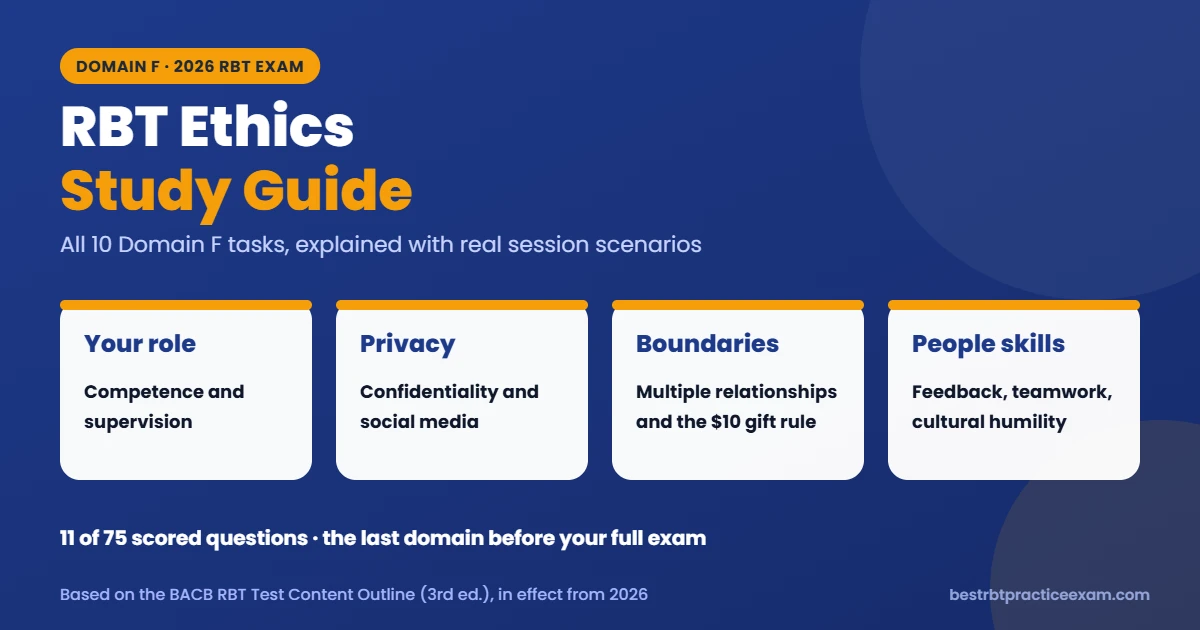
In my years training new RBTs, ethics is the domain people worry about least and miss most. The questions sound like common sense, so test takers pick the answer that feels kind instead of the one that follows the rules. This RBT ethics study guide gives you one simple way to think through any scenario, then walks through all 10 tasks with situations you will actually face in sessions.
F.1 The Core Principles Behind Every Ethics Question
BACB task F.1: “Identify and apply core principles underlying the BACB’s ethics code for RBT certificants (e.g., benefit others; treat others with compassion, dignity, and respect; behave with integrity).”
The BACB’s ethics code for RBTs rests on four core principles. For this RBT ethics study guide, you do not need to memorize standard numbers for the exam, but you do need to recognize these principles inside a story.
Every choice should serve the client’s best interest, not your convenience or a parent’s wish to skip hard work.
Ask: does this help the client?A 14-year-old should not be taught with toddler cartoons. Use age-appropriate materials and give privacy during care routines.
Ask: would this embarrass them?Be truthful with your supervisor, your client’s family and the BACB, and follow through on what you said you would do.
Ask: is this the whole truth?Only do what you have been trained for and your supervisor has confirmed you can do well.
Ask: was I trained on this?Your client is 15 and starts looking away and going quiet when you bring out the cartoon matching cards. That is a dignity issue, not a compliance issue. Note what you saw and ask your supervisor about age-appropriate materials.
A 3-Question Filter for Any RBT Ethics Scenario
This is the most useful tool in this RBT ethics study guide. When two answers both look reasonable, run the scenario through these three questions in order. The first “yes” or “no” that stops you usually points to the right answer.
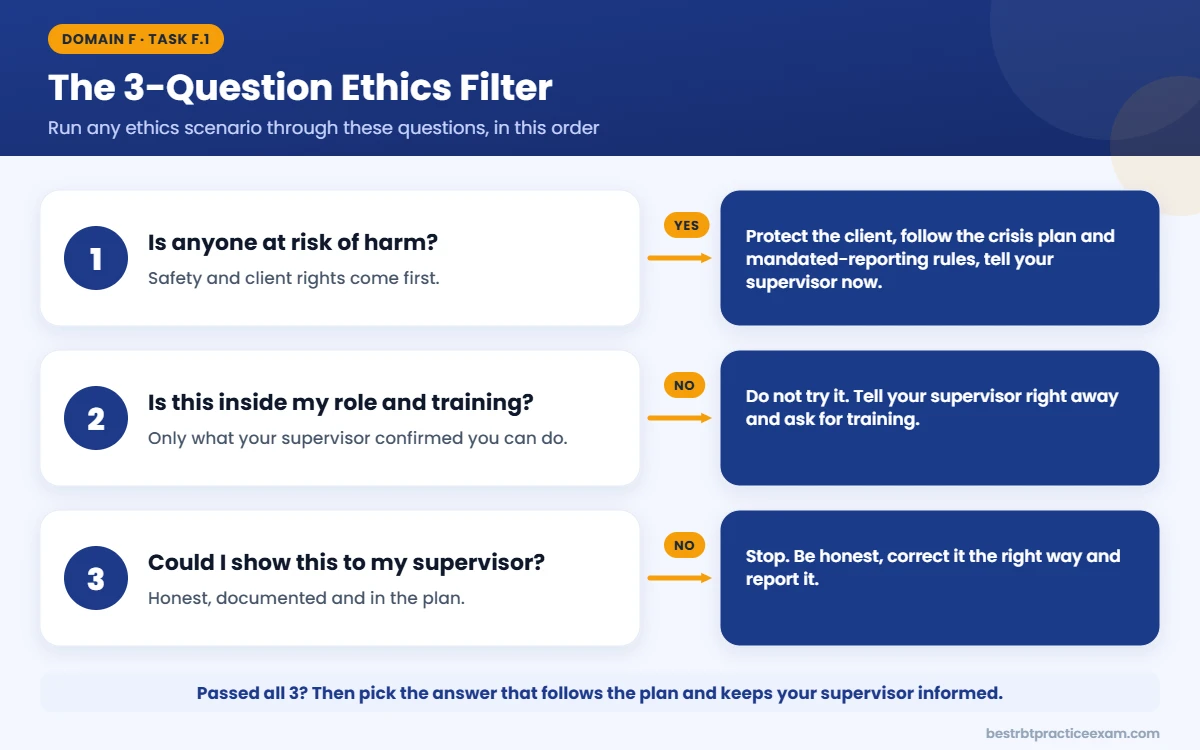
Let’s test it. A parent says, “He’s tired today, can we skip the token board and just play?” No one is at risk, so question 1 passes. Changing the plan is not inside your role, so question 2 stops you. The right move is to say you will check with your supervisor, then run the plan as written until you hear back.
Exam trap: The kindest-sounding answer is often wrong. Agreeing with the parent feels helpful, but it changes the plan without your supervisor.
F.2 and F.3: Competence and Ongoing Supervision
BACB task F.2: “Provide behavioral technician services only after demonstrating competence.”
BACB task F.3: “Provide services only under ongoing supervision from supervisors who meet BACB requirements.”
You start working with clients only after your supervisor confirms you can do the job, through your competency assessment and training. After that, the rule stays the same for every new skill. If you are asked to do something you were never trained on, you tell your supervisor right away. You do not refuse without a reason, and you do not “figure it out” on a live client. Most of this RBT ethics study guide comes back to that one idea.
Your supervisor adds an extinction procedure to the plan, but you have only read about it. Before the next session, you message: “I haven’t been trained on this yet. Can you model it for me before I run it?” That is exactly what task F.2 expects.
The same goes for restrictive or punishment-based procedures. You use them only when they are written into the behavior plan and your supervisor has confirmed you can do them correctly.
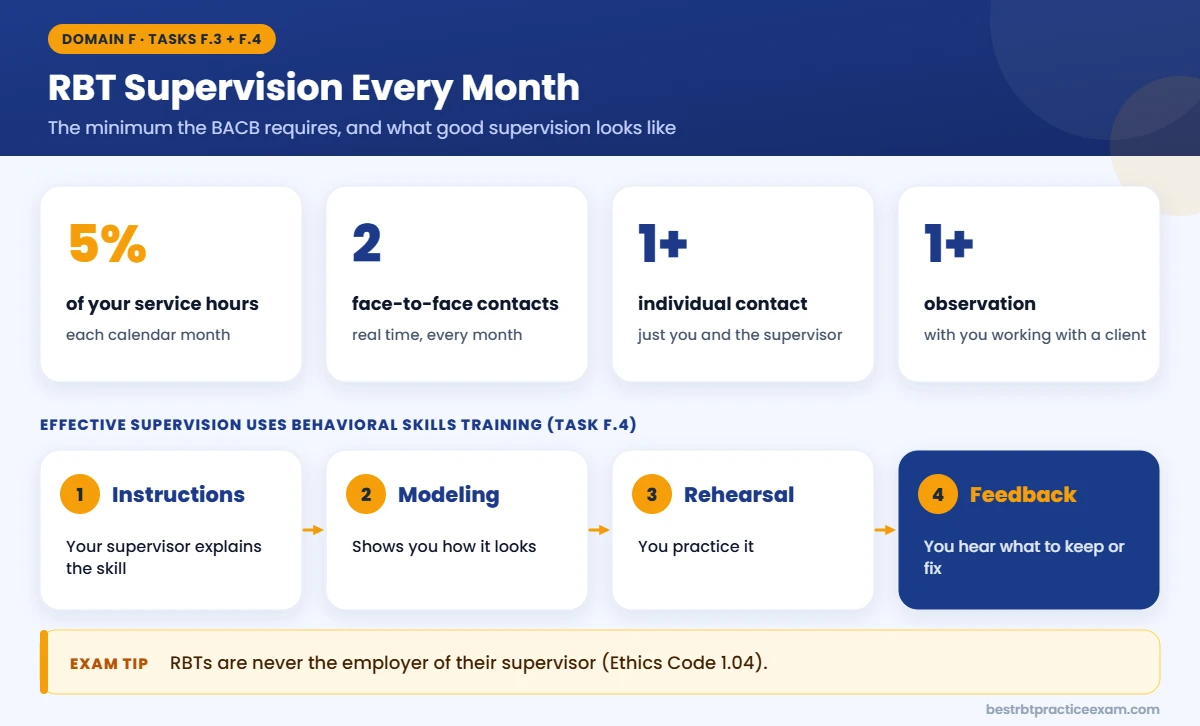
Ongoing supervision means at least 5% of your service hours each month, with at least two real-time, face-to-face contacts. At least one contact is individual, and in at least one your supervisor watches you work with a client, in person or by live video. Your supervisor must be a BCBA or BCaBA, and you can never be your supervisor’s employer.
Exam trap: If your supervisor leaves and no one has been assigned, you cannot keep providing services on your own. Tell your agency right away.
F.4: What Effective Supervision Looks Like
BACB task F.4: “Identify effective supervision practices (e.g., receive training that includes instructions, modeling, rehearsal, and feedback; observation of RBT service delivery).”
Good supervision is not just a monthly signature. It follows behavioral skills training: instructions, modeling, rehearsal and feedback, plus regular observation of you with clients. Your part is to come ready with data, questions and the situations that confused you.
Exam trap: Phone calls and emails do not count as supervision contacts. Live video does, as long as it happens in real time.
F.5: Confidentiality, From Data Sheets to Small Talk
BACB task F.5: “Identify and comply with requirements for collecting, using, storing, protecting, and disclosing confidential information.”
Confidential information is anything that could identify a client or describe their services: name, diagnosis, school, photos, data sheets, even “the boy I work with on Maple Street.” Protect it in every step:
- Collecting: only what the plan asks for
- Storing: locked apps and folders, never a data sheet left in your car
- Using: only for the client’s services
- Sharing: only under your supervisor’s direction, unless the law allows it
At lunch, two coworkers start talking about a client by name in a busy coffee shop. Your first step is a quiet reminder: “Hey, let’s not talk about clients here.” If it keeps happening, tell your supervisor.
If someone outside the team, like a teacher who does not work with the client, asks about progress, keep details private and refer them to your supervisor. The documentation and reporting guide shows how to pass on concerns the right way.
F.6: Public Statements and Social Media
BACB task F.6: “Identify and comply with requirements for making public statements about professional activities (e.g., social media activity; misrepresentation of professional credentials, behavior analysis, and service outcomes).”
Anything you say in public about your work counts, online or in person. Two rules cover most questions: never share identifying client information on social media or websites, and never make your credential or results sound bigger than they are. You are a Registered Behavior Technician, not a behavior analyst, and you cannot promise a family that ABA will “fix” their child.
See the answer
No. Photos and details can still identify a client, and the code bans sharing client photos, videos or written information on social media.
See the answer
No. Even a proud, kind post shares client information without permission.
See the answer
Usually fine, as long as no clients appear and your workplace allows it.
Exam trap: Removing the name does not make a post safe. If someone could recognize the client, it is a confidentiality problem.
F.7: Multiple Relationships
BACB task F.7: “Identify types of and risks associated with multiple relationships, and how to mitigate those risks when they are unavoidable.”
Every RBT ethics study guide spends time here, because a multiple relationship is easy to fall into. It happens when you mix your work role with another role with the same person, like being a client’s RBT and also their babysitter. It risks your judgment and the client’s care, even when everyone means well.
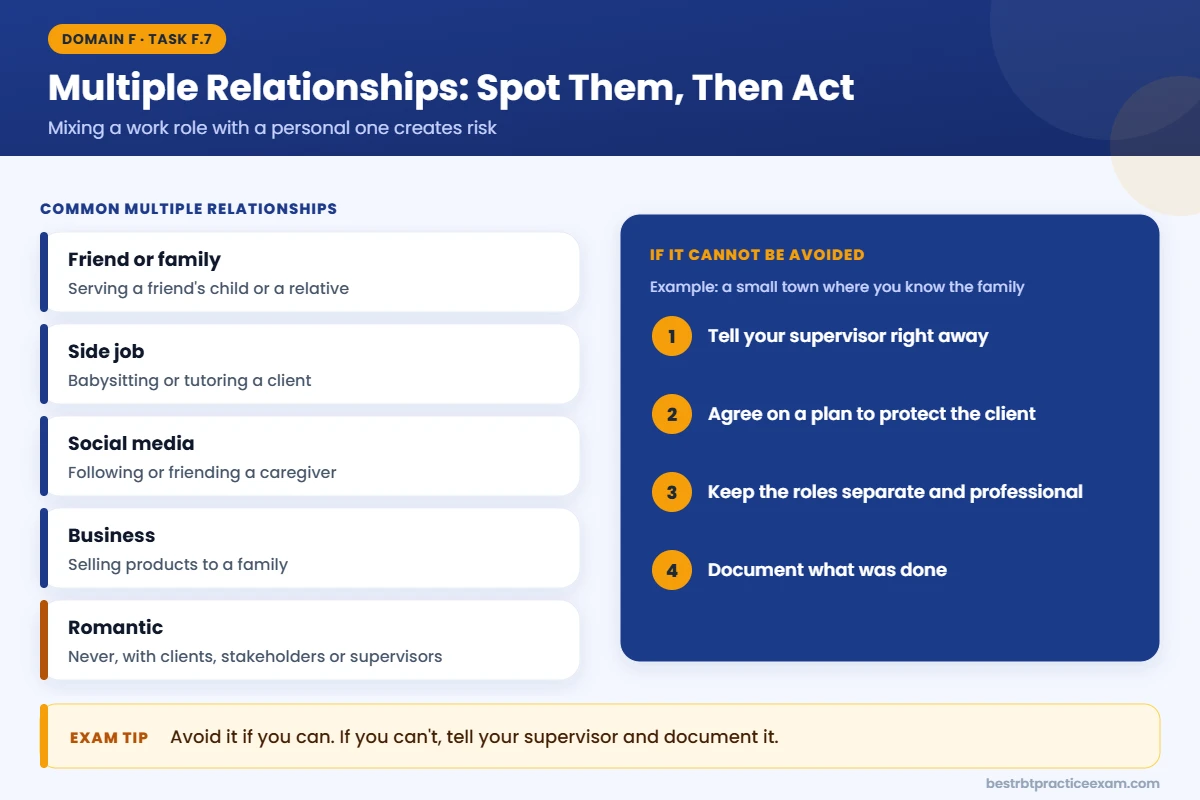
“I really appreciate you trusting me. I can’t work with families outside my RBT role, but I’m happy to ask my supervisor about respite resources.”
Sometimes you cannot avoid it, like in a small town where you already know the family. Then you tell your supervisor right away, agree on a plan, keep the roles separate and document what was done. Romantic or sexual relationships with clients, stakeholders or supervisors are never allowed.
F.8: The Gift Rule
BACB task F.8: “Adhere to the gift giving and receiving guidelines provided by the BACB’s ethics code.”
RBTs do not give or accept gifts worth more than $10. A small gift is fine when it is an occasional thank-you with no real money value to you. Small gifts that keep coming, like a weekly lunch, can add up to a violation. If your employer bans all gifts, the stricter rule wins.
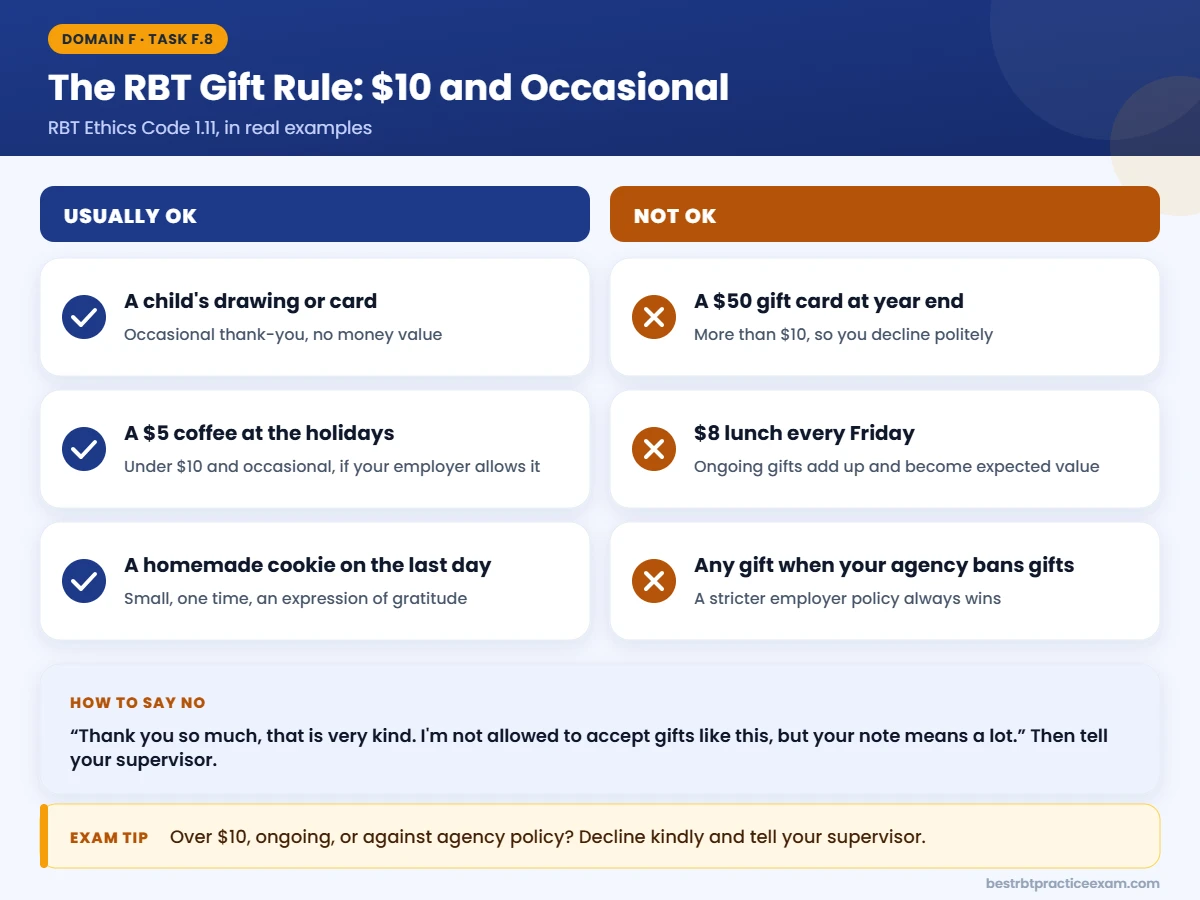
Exam trap: Think about two things: the value (over $10?) and the pattern (one time or regular?). If either one fails, decline kindly and tell your supervisor.
F.9: Interpersonal and Professional Skills
BACB task F.9: “Identify and apply interpersonal and professional skills (e.g., accepting feedback, listening actively, seeking input, collaborating) when representing oneself as an RBT.”
These skills show up every day: how you take feedback, how you listen to a worried parent, how you work with the speech therapist who shares your client. Being on time and keeping your commitments count too. If you cannot make a session, tell your supervisor and the family as early as possible.
- Accept feedback: say thank you, repeat it back, and try it in the next session.
- Listen actively: let the caregiver finish, then summarize what you heard.
- Seek input: ask the teacher or parent what they see at other times.
- Collaborate: share ideas with the team and let your supervisor make the clinical call.
Exam trap: Getting defensive or explaining why the feedback is wrong is never the best answer. Accept it first, then ask questions.
F.10: Cultural Humility and Responsiveness
BACB task F.10: “Engage in ongoing cultural humility and responsiveness (e.g., identify personal biases) in service delivery and professional relationships.”
Of all the tasks in an RBT ethics study guide, this one is the easiest to skip and the hardest to fake. Cultural humility means you keep learning about each family instead of assuming your way is the normal way. Families differ in language, food, bedtime, religion, eye contact and who makes decisions. Notice your own biases and bring them to your supervisor.
A family eats every meal on the floor, and the plan has a target for “sitting at the table.” Instead of judging, you mention it to your supervisor, who adjusts the goal to fit how this family eats.
When You Make a Mistake (or See One)
Honesty questions come up often in Domain F. If you remember one pattern from this RBT ethics study guide, make it this one:
- You made a mistake in session: tell your supervisor right away, even if it seems small
- You made a data or note error: correct it the way your agency’s policy says, never hide or backdate it
- You suspect abuse or neglect: follow mandated-reporting laws and agency policy, and tell your supervisor
- Something happens that the BACB must know: RBTs self-report certain events within 30 days
Every supervisor I know would rather hear about a mistake from you in five minutes than find it in the data next week. Owning it quickly is the ethical choice, and it is also what builds trust with your team.
RBT Ethics Study Guide Cheat Sheet: If This Happens, Do This
Use this table for a fast review the night before. The last column shows which part of the ethics code the answer comes from, in case your course or quiz mentions it.
| If this happens… | The RBT should… | Code |
|---|---|---|
| You made a mistake during a session | Tell your supervisor right away | 1.01, 3.02 |
| Asked to run a procedure you were not trained on | Tell your supervisor and ask for training first | 1.06, 2.04 |
| A parent asks you to change the plan | Say you will check with your supervisor | 2.02, 2.06 |
| Coworkers discuss a client in public | Remind them, then tell your supervisor if it continues | 2.08, 2.10 |
| You want to post a client’s work online | Do not post it | 2.09 |
| A caregiver sends a friend request | Politely decline | 1.10 |
| A family offers a $25 gift card | Decline kindly and tell your supervisor | 1.11 |
| You notice a personal bias | Talk it through with your supervisor | 1.07, 1.09 |
| You suspect a client is being harmed | Follow mandated reporting and tell your supervisor | 2.01, 2.07 |
Try 6 Domain F Scenarios Before the Quiz
These scenarios wrap up the RBT ethics study guide. They come from the situations real test takers search for most. Answer each one in your head before you open it.
1. Which of the following is a key part of demonstrating honesty for an RBT?
- Only sharing positive feedback with a client’s family
- Making sure all communication with supervisors and the BACB is accurate and truthful
- Not reporting minor mistakes to supervisors
- Running interventions without documenting them
Show answer and why
B. RBTs are honest and accurate in all communication with the BACB and their supervisor.
2. What should an RBT do if they make a mistake during a session?
- Tell the supervisor only if the mistake could harm the client
- Tell the supervisor right away
- Document it but do not tell the supervisor
- Ignore it if it is small
Show answer and why
B. Report every mistake to your supervisor promptly, no matter how small.
3. What should an RBT do if asked to perform a task outside their competence?
- Refuse without explanation
- Ignore the request
- Notify the supervisor right away
- Try it without guidance
Show answer and why
C. RBTs tell their supervisor right away when asked to do work beyond their training or competence.
4. An RBT hears coworkers sharing confidential client information in a public space. What should the RBT do first?
- Join the conversation to learn more
- Remind the coworkers not to share confidential information
- Post about it on social media
- Ignore it to avoid conflict
Show answer and why
B. A quiet reminder comes first. If it keeps happening, tell the supervisor.
5. How can an RBT make sure their public statements are ethical?
- Share personal opinions freely
- Ignore ethical considerations
- Make statements without supervisor approval
- Check accuracy and protect confidentiality
Show answer and why
D. Public statements must be accurate, must not exaggerate credentials or results, and must protect client privacy.
6. An RBT realizes they are in a multiple relationship with a client’s family. What should they do?
- Keep it quiet so the family is not upset
- Tell their supervisor right away and work to resolve it
- Stop coming to sessions without notice
- Ask the family to keep it secret
Show answer and why
B. Tell the supervisor, agree on a plan to protect the client, and document the steps taken.
You Finished All 6 Domains: What to Do Next
This RBT ethics study guide is the last of the six domain guides. Many students reach this point and ask the same question: “Am I actually ready?” Check yourself against this list before you book your test date.
- AData Collection and Graphing13 questions
- BBehavior Assessment8 questions
- CBehavior Acquisition19 questions
- DBehavior Reduction14 questions
- EDocumentation and Reporting10 questions
- FEthics11 questions, you are here
- You read all six guides and can explain each task in your own words
- You scored 80% or higher on every domain quiz
- You can say why each wrong answer is wrong, not just which one is right
- Ethics and the other short-scenario domains feel easy to reason through
Not there yet? Go back to the domain with your lowest quiz score, or see every guide in one place on the RBT study guide page.
RBT Ethics Study Guide FAQs
How many ethics questions are on the RBT exam?
Domain F, Ethics, makes up 11 of the 75 scored questions, about 15%. The exam also has 10 unscored pilot questions that can come from any domain.
What is the best way to use an RBT ethics study guide?
Learn the four groups of tasks first (your role, privacy, boundaries and people skills), then practice scenarios. For each one, ask: is anyone at risk, is this inside my role and training, and could I show this to my supervisor? Finish with a full Domain F quiz.
Can an RBT accept a gift from a client’s family?
Only a small, occasional thank-you worth $10 or less that gives no real financial benefit. Gifts that keep coming can still be a problem, and if the employer bans all gifts, the RBT follows that stricter policy.
What should an RBT do if asked to do something outside their competence?
Tell the supervisor right away and ask for training. The RBT should not try the task without training, and should not simply refuse without explaining why.
Did RBT ethics rules change in 2026?
The 2026 BACB changes were to RBT training, recertification and the exam content outline (3rd edition). The ethics rules RBTs follow are the same RBT Ethics Code (2.0) that took effect on January 1, 2022.
How this RBT ethics study guide was made. Task wording and question counts come from the official BACB outline, and rules come from the RBT Ethics Code (2.0) and RBT Handbook. Examples are original and based on common RBT session situations.
Practice content on this site is independent and not affiliated with or endorsed by the BACB.