
RBT Behavior Acquisition Study Guide (Domain C, 2026)
RBT behavior acquisition (Domain C) is how you teach new skills: using reinforcement, running discrete trials and natural teaching, prompting and fading prompts, chaining, shaping, and helping skills last and spread to new places. It has 11 tasks and 19 of the 75 scored questions, which makes it the biggest domain on the RBT exam.
- StartThe skill acquisition plan
- C.1Reinforcement
- C.2Conditioned reinforcers
- C.3Discrete-trial teaching
- C.4Naturalistic teaching
- C.5Chaining
- C.6Discrimination training
- C.7Prompts and fading
- C.8Generalization
- C.9Maintenance vs acquisition
- C.10Shaping
- C.11Token economies
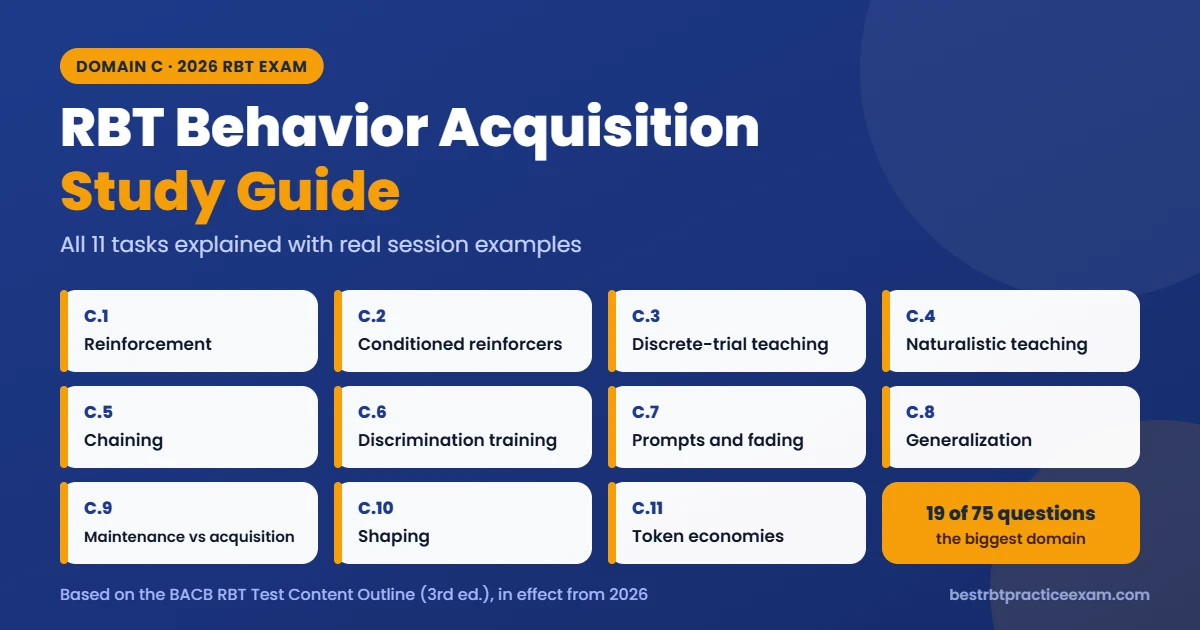
I have trained a lot of new RBTs, and Domain C is where most of them feel lost at first. Not because it is hard, but because the terms sound alike. Prompting, prompt fading, shaping, chaining, generalization, maintenance. This RBT behavior acquisition guide fixes that. Every task gets a plain meaning, a real session example and the exam trap to watch for. Then you can test yourself with the scenario sorter near the end.
Start Here: What a Skill Acquisition Plan Is For
Every RBT behavior acquisition task happens inside a written plan, often called a skill acquisition plan or a behavior acquisition plan. Its purpose is simple: it tells everyone on the team exactly how to teach one new skill, so the client gets the same teaching from every person, every day. Your supervisor (a BCBA or BCaBA) writes it. You follow it.
- Target skill, described in a way anyone can see and count
- Teaching steps, built for this one learner
- Teaching procedure, such as discrete trials or natural teaching
- Prompting and fading plan, so help is removed on purpose
- Reinforcement plan, what to give and how often
- Mastery criteria, the rule for when the skill counts as learned
- Generalization and maintenance steps, so the skill lasts and spreads
- Data collection, what to record each session
Two points come up often on tests. First, teaching steps are always individualized, and they depend on the kind of skill. When the skill is a chain, like washing hands, a task analysis becomes the teaching steps. Second, mastery criteria are written as a clear rule, for example “80% correct or better across 3 sessions in a row, with 2 different people.” Your supervisor sets the exact numbers.
Exam trap: RBTs follow skill acquisition plans as written. If a plan is not working, or a target seems stuck, you report it with data. You do not change the steps on your own. The documentation and reporting guide shows how to report it clearly.
A short history note helps if you are using older study material. In the old RBT Task List (2nd ed.), this area was called “Skill Acquisition” and started with tasks about the written plan and session prep. The 3rd edition outline renamed it Behavior Acquisition and lists 11 tasks, C.1 to C.11, that focus on what you actually do while teaching.
Reinforcement: The Engine Behind All RBT Behavior Acquisition
Every teaching method in this guide depends on one thing. When a correct response is followed by something the client values, that response is more likely to happen again. That is reinforcement, and it is the reason the client keeps working with you.
C.1 Positive and Negative Reinforcement, Done Right
BACB task C.1: “Implement positive and negative reinforcement procedures (e.g., immediately, contingently, according to schedules of reinforcement) along a continuum of dimensions (e.g., magnitude, intensity, variety).”
Both kinds of reinforcement make a behavior increase. The words “positive” and “negative” do not mean good and bad. They mean add and take away.
Something is added after the behavior, and the behavior goes up. The client says “ball” and you hand over the ball.
Something is removed after the behavior, and the behavior goes up. The client says “break please” and the worksheet is taken away for a minute.
Exam trap: negative reinforcement is not punishment. If the behavior goes up, it is reinforcement. Punishment makes behavior go down, and it belongs to the behavior reduction guide.
The task names two delivery rules. Immediately means right after the response, before anything else happens. A delay of even a few seconds can end up reinforcing whatever the client did in between. Contingently means only after the target response, not for free.
It also names three dimensions you can adjust, as your plan directs:
| Dimension | What it means | Session example |
|---|---|---|
| Magnitude | How much reinforcement | Two minutes of tablet for a hard task, thirty seconds for an easy one |
| Intensity | How strong or exciting it is | A big cheer for a first-ever independent answer, a calm “nice” for a known one |
| Variety | Switching between reinforcers | Rotating bubbles, stickers and songs so the client does not get bored (satiation) |
The plan also sets the schedule, which is the rule for how often a correct response earns reinforcement.
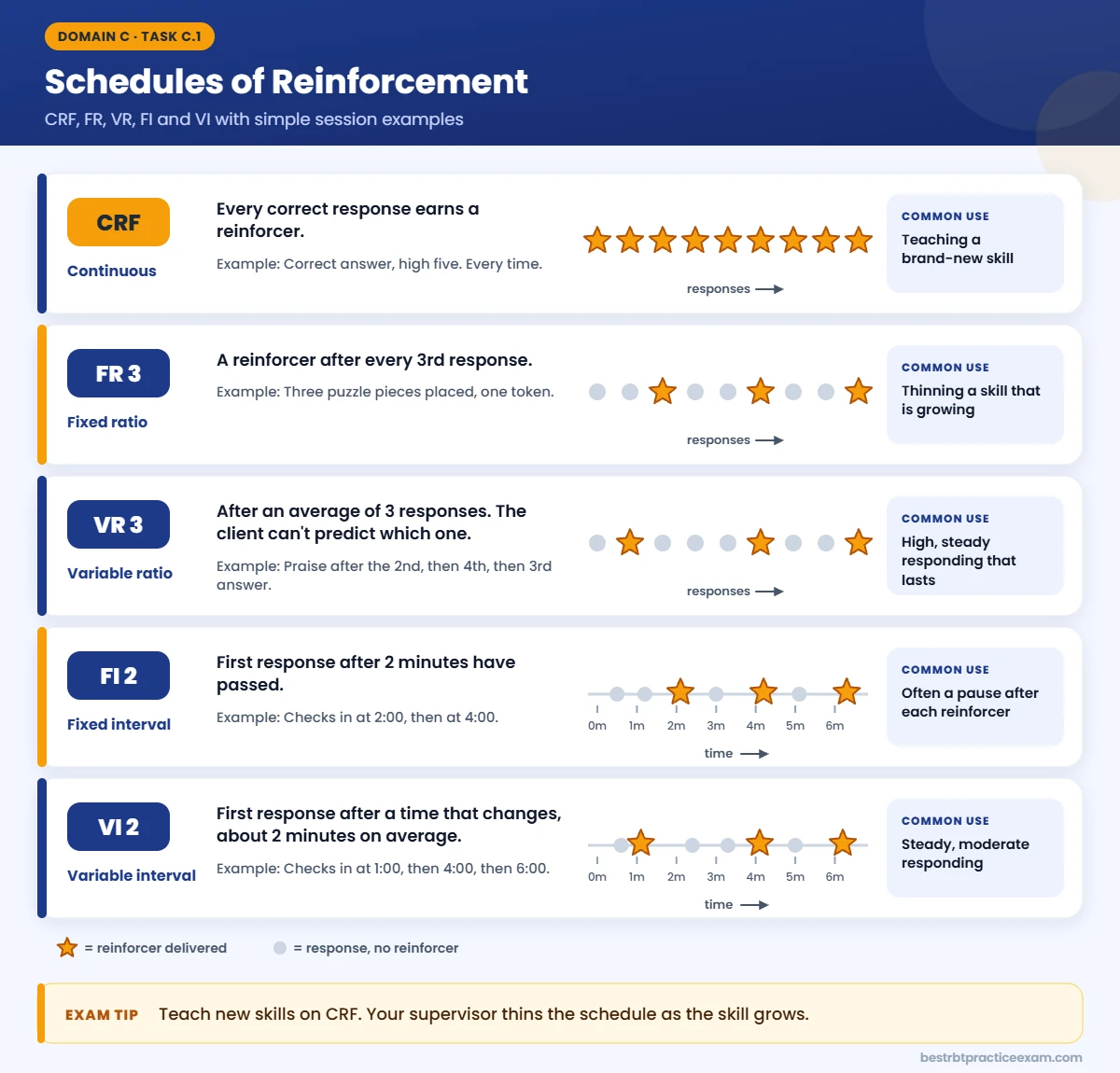
New skills usually start on continuous reinforcement (CRF), where every correct response pays off. As the skill grows, your supervisor “thins” the schedule toward an intermittent one like FR or VR. Variable schedules are the hardest to predict, so behavior on them tends to be steady and lasts longer when reinforcement stops.
Your client is learning to say colors. For the first week, every correct color earns a sticker (CRF). Two weeks later, the plan changes to about every third correct answer, but not always the third exactly (VR 3). He keeps answering at a steady pace, because he can never tell which answer will pay off.
C.2 Conditioned Reinforcers: Teaching Praise to Matter
BACB task C.2: “Implement procedures to establish and use conditioned reinforcers.”
Some reinforcers work without any learning, like food, water or warmth. These are unconditioned (or primary) reinforcers. Others only work because they were paired with something that already worked. Praise, high fives, tokens and stickers are conditioned reinforcers.
You build a conditioned reinforcer by pairing. Say “Great job!” at the same moment as, or just before, you give something that already works, like a favorite snack. After many pairings, the praise starts to work on its own. A reinforcer paired with many different backup reinforcers, like tokens or money, is called a generalized conditioned reinforcer.
Exam trap: for pairing to work, the new stimulus comes right before or with the working reinforcer. Praise given a minute after the snack does not build anything.
C.11 Token Economies: Reinforcement You Can Save Up
BACB task C.11: “Implement token economies.”
A token economy is a system where the client earns tokens for target behaviors, then trades them for a backup reinforcer. Tokens are conditioned reinforcers, which is why C.2 and C.11 sit together here. Tokens bridge the gap when you cannot hand out a big reinforcer after every response.
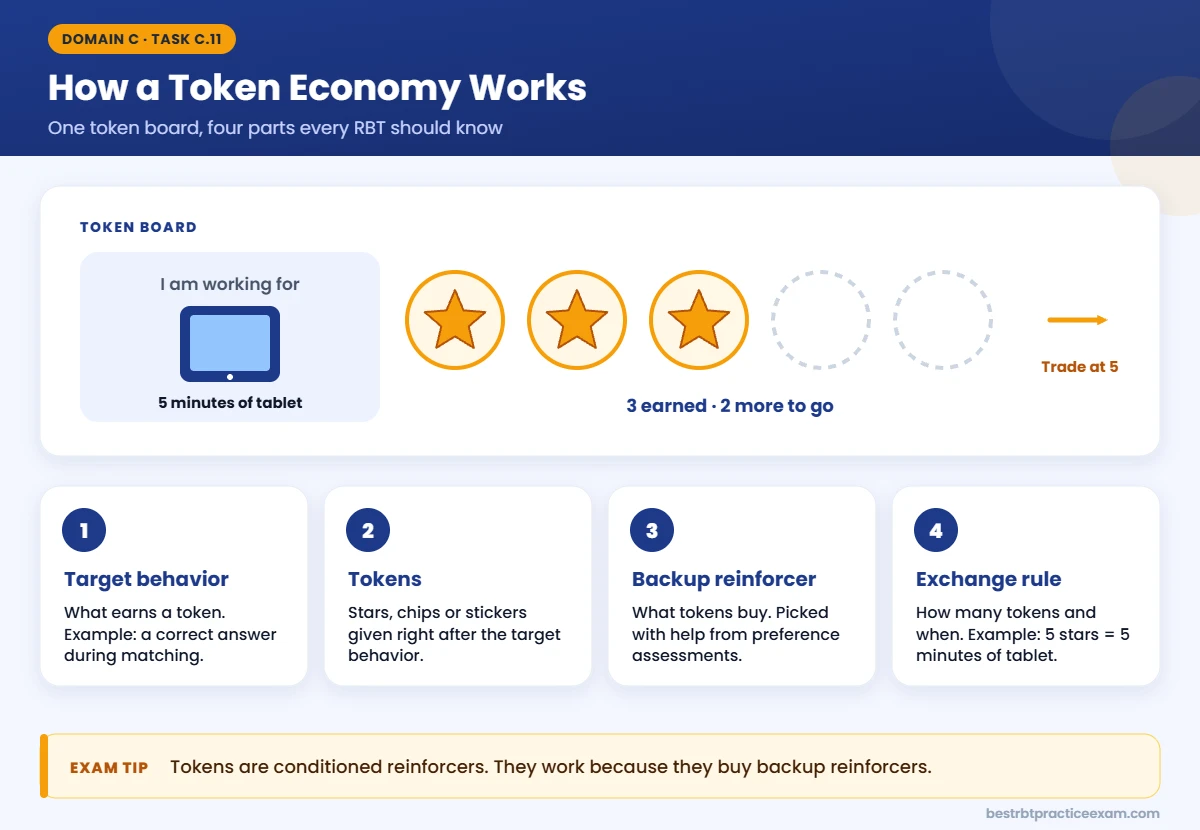
Your part is to follow the system exactly: give tokens right after the target behavior, keep the exchange rule the same every time, and let the client trade as soon as the board is full. Backup reinforcers are usually picked with help from preference assessments. Only take tokens away if the plan clearly says to, because that is a different procedure.
Before a new client starts a token board, I watch for one thing: does the client care about the tokens yet? If tokens were never paired with real reinforcers, the board is just stickers. When a token system seems to stop working, tell your supervisor. Often the backup reinforcer needs refreshing.
Discrete-Trial Teaching vs Naturalistic Teaching
These are the two main RBT behavior acquisition teaching formats you will use. Most clients get both. One is structured and fast. The other follows the client’s interests in everyday moments.
C.3 Discrete-Trial Teaching (DTT)
BACB task C.3: “Implement discrete-trial teaching procedures.”
Discrete-trial teaching breaks a skill into short, repeated learning chances called trials. Each trial has a clear start and a clear end, so you can count it, and that is what “discrete” means.
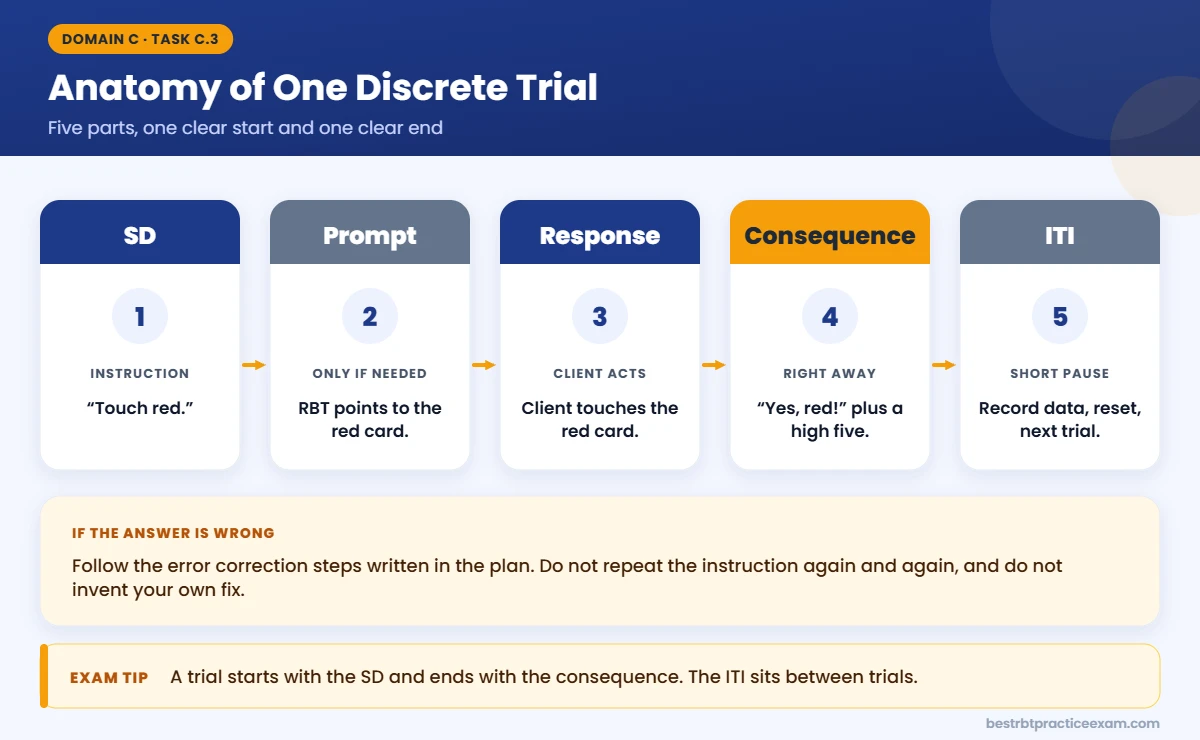
The SD (discriminative stimulus) is the instruction, like “Touch red.” A prompt is extra help, given only if the plan calls for it. The response is what the client does. The consequence is reinforcement for a correct answer, or the plan’s error correction for a wrong one. The inter-trial interval (ITI) is the short pause before the next trial, when you record data. If you want a refresher on trial-by-trial data, see the data collection and graphing guide.
You sit across from your client with three cards: red, blue and green. You say “Touch red” once, clearly. She touches red. You say “Yes, red!” and give a quick tickle, mark a plus on your sheet, mix the cards, and start the next trial. The whole trial takes about ten seconds.
C.4 Naturalistic Teaching: NET and Incidental Teaching
BACB task C.4: “Implement naturalistic teaching procedures (e.g., incidental teaching, natural environment training).”
Naturalistic teaching uses the client’s own interests and everyday routines as the teaching moment. Instead of you leading with an instruction, the client’s motivation starts the chance to learn. The reinforcer is usually the natural one: ask for the swing, get the swing.
Incidental teaching is a common form. You set up the room so the client will want something, wait for them to start, prompt a slightly better response, then give the item. This idea goes back to well-known research by Hart and Risley in the 1970s, and it is still widely used.
You place a favorite toy car on a shelf where your client can see it but cannot reach it. He points at it. You hold it up and model “car.” He says “cah.” You hand him the car right away and play together. That was one naturalistic teaching trial, and he hardly noticed he was working.
| Feature | Discrete-trial teaching | Naturalistic teaching |
|---|---|---|
| Who starts it | The RBT gives the SD | The client’s interest or request |
| Setting | Often a table, few distractions | Play, snack, routines, the community |
| Reinforcer | Chosen ahead of time, may be unrelated | Usually the natural result of the response |
| Strength | Many practice trials in a short time | Skills tend to generalize more easily |
Exam trap: if a question describes the client starting the interaction and getting the item they asked for, the answer is naturalistic (incidental) teaching, not DTT.
Discrimination Training, Prompts and Prompt Fading
Prompting is the part of RBT behavior acquisition you will use in almost every trial, and discrimination training is often where it starts.
C.6 Discrimination Training
BACB task C.6: “Implement discrimination training.”
Discrimination training teaches a client to respond one way when one thing is present, and not when something else is present. The cue that signals “reinforcement is available for this response” is the SD. A cue that signals “not this one” is called the S-delta. You reinforce correct responses to the SD and do not reinforce responses to the S-delta.
You lay out pictures of a dog, a cat and a car and say “Touch dog.” Touching the dog earns praise. Touching the cat earns nothing extra, and the plan’s error correction starts. You move the pictures around every trial, so she learns to look for the dog and not just the left side of the table.
When the client reliably responds to the SD, we say the response is under stimulus control. Matching tasks, like match-to-sample, are a common way to teach discriminations.
C.7 Prompts and Prompt Fading
BACB task C.7: “Implement procedures using stimulus and response prompts that include appropriate fading procedures (e.g., errorless, least-to-most, stimulus fading, time delay).”
A prompt is any extra help that makes a correct response more likely. Prompts are temporary on purpose. The goal is always to move control from your prompt to the real instruction, which is sometimes called transfer of stimulus control.

Help aimed at the person: verbal, gestural, model, partial physical and full physical prompts.
Changes to the materials: moving the correct card closer, making it bigger, or adding color or a picture.
The task lists four ways to fade prompts. Most-to-least starts with the most help and fades down. It keeps errors low, so it is used for errorless teaching of new skills. Least-to-most starts with the least help and adds more only if needed. Time delay starts with the prompt given right with the instruction (0 seconds), then waits a little longer before prompting, giving the client a chance to answer first. Stimulus fading slowly removes the extra cue on the materials.
Your client is learning to hand you a picture card to ask for juice. Day one, you guide her hand fully (full physical). As she gets it, you only touch her elbow (partial physical), then just point (gestural). By the end of the week she hands over the card on her own. That is most-to-least prompt fading.
Exam trap: prompt dependence. If you never fade, the client learns to wait for your help. Exam answers that fade prompts on a planned schedule are almost always better than ones that keep the same prompt.
A habit I teach every new RBT: say the instruction once, then follow the prompt plan. Repeating “Touch red, touch red, touch red” becomes a prompt you did not plan, and it is very hard to fade. Your supervisor will look for this during your RBT competency assessment.
Chaining vs Shaping: Building Bigger Skills
These two get mixed up on the exam more than any other pair in RBT behavior acquisition. Both build skills the client cannot do yet, but they do it in very different ways.
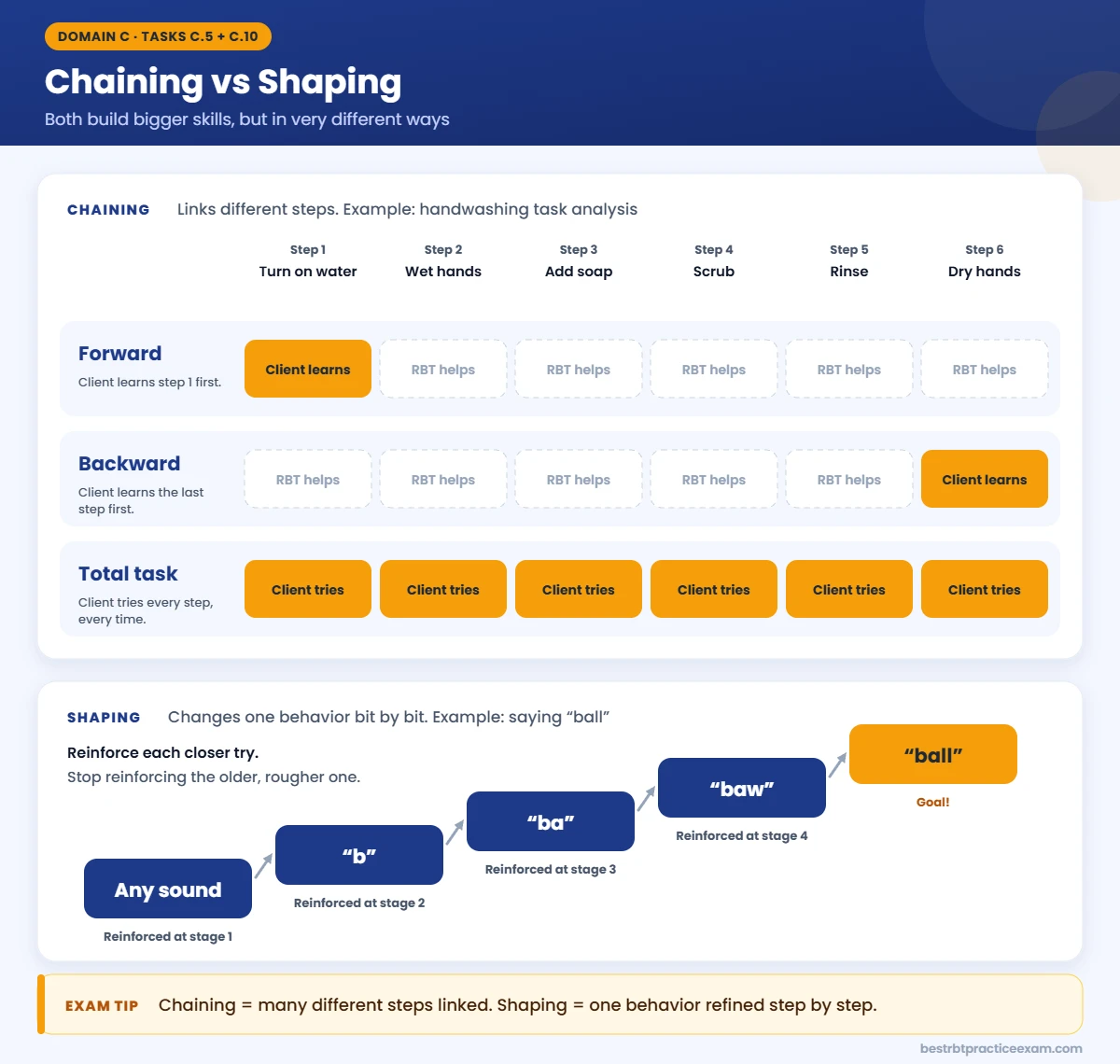
C.5 Task Analysis and Chaining
BACB task C.5: “Implement task analyzed chaining procedures (e.g., forward, backward, total task).”
Many daily skills are behavior chains: a set of different steps done in order, like washing hands or getting dressed. A task analysis breaks the chain into small teachable steps. Then you teach the chain in one of three ways.
| Method | How it works | Reinforcement comes |
|---|---|---|
| Forward chaining | The client learns step 1 first. You help with the rest. Once step 1 is mastered, you add step 2. | After the step being taught |
| Backward chaining | You help with every step except the last one, which the client does alone. Then you work backward. | Right at the end, when the whole task is finished |
| Total task chaining | The client tries every step, every time, with prompts as needed. | After the full chain |
Your client is learning to put on a jacket with backward chaining. You help with every step until the zipper is almost up. He pulls it the last bit himself and gets a high five. Every practice ends with him finishing the job himself, and that success keeps him motivated.
C.10 Shaping
BACB task C.10: “Implement shaping procedures.”
Shaping teaches a new behavior by reinforcing closer and closer tries (successive approximations) and no longer reinforcing the older, rougher tries. It works on one behavior, changing its form, length or strength bit by bit.
A child tolerates the toothbrush in his mouth for 5 seconds. You reinforce 5 seconds today. Once that is easy, only 10 seconds earns the reinforcer, then 20, then a full brushing. That is shaping: the same behavior, a little more each step.
Links different steps into one routine. Example: the six steps of washing hands.
Changes one behavior step by step. Example: “b,” then “ba,” then “ball.”
Generalization, Maintenance and Acquisition
In RBT behavior acquisition, a skill that only shows up at your table, with you, is not finished yet. These last two RBT behavior acquisition tasks are about making learning stick and making it useful in real life.
C.8 Generalization
BACB task C.8: “Implement generalization procedures (e.g., conduct intervention procedures across settings, people, and stimuli).”
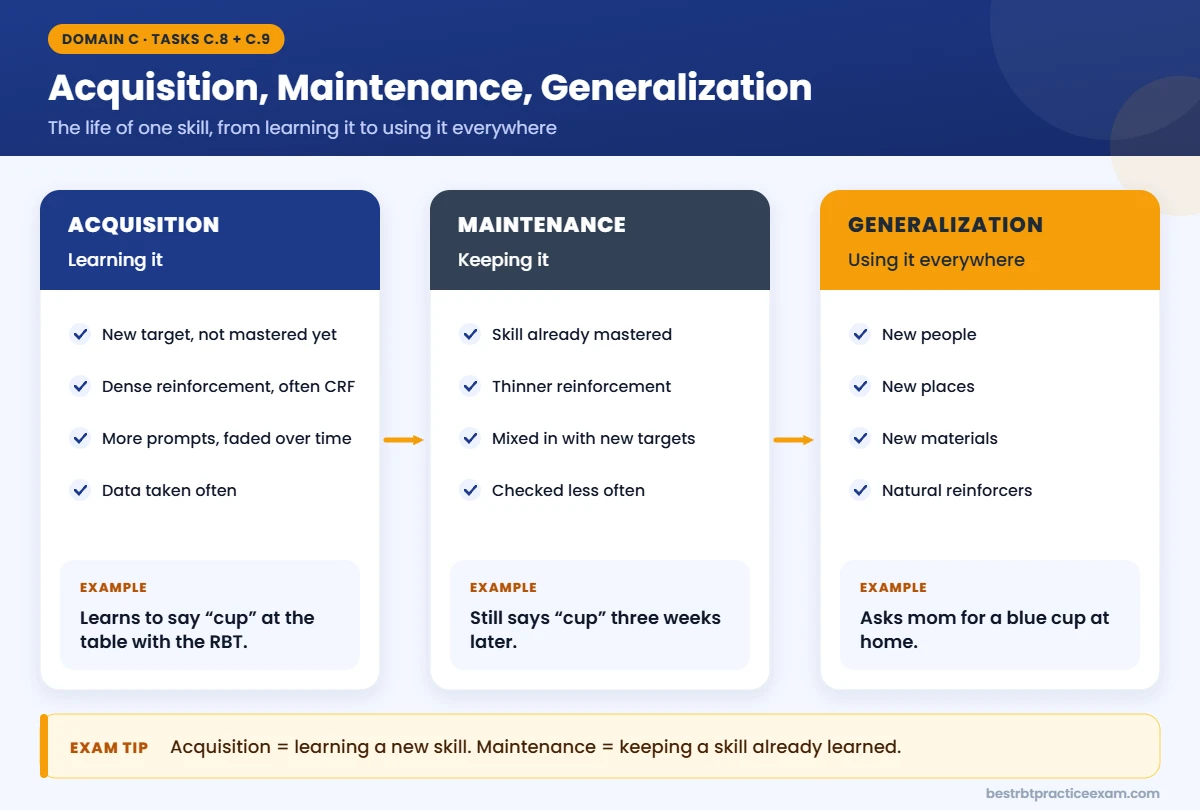
Generalization means a skill shows up beyond the exact teaching setup. Stimulus generalization is using the skill with new people, in new places or with new materials. Response generalization is using a new but similar response for the same purpose, like saying “hi” after learning “hello.”
The plan tells you how to help. Common ways include teaching with many different examples (three different red cups, not one), practicing in different rooms, having different people run the program, and using natural reinforcers. Stokes and Baer’s classic 1977 paper on generalization still guides how teams plan this.
Your client can label “cup” with the blue cup at the table. The plan says to use five different cups this week, and to practice at snack time with his mom. On Friday he asks his mom for “cup” in the kitchen. That is generalization.
C.9 Maintenance vs Acquisition
BACB task C.9: “Distinguish between maintenance and acquisition procedures.”
| Acquisition | Maintenance | |
|---|---|---|
| Goal | Learn a new skill | Keep a skill already mastered |
| Reinforcement | Dense, often every correct response | Thinner, intermittent |
| Prompts | Used and faded on a plan | Rarely needed |
| How often it is practiced | Many times per session | Mixed in with new targets, checked less often |
Systematic prompt fading belongs to the acquisition phase, while the skill is still being learned. Mixing easy maintenance targets in with hard new ones also helps keep the client motivated.
Exam trap: “acquisition” means learning, “maintenance” means keeping. If the question says the skill was mastered months ago and you are checking it, it is maintenance.
Which Procedure Is It? 8 Quick RBT Behavior Acquisition Scenarios
RBT behavior acquisition questions on the exam are mostly short scenarios. The skill being tested is naming the procedure from a description. Read each one, decide, then open the answer.
The client says “break” and gets a short break from the worksheet. He asks for breaks more often after that.
Which procedure is it?
Negative reinforcement (C.1). Something was removed, and the behavior went up.
You say “Good job!” every time you hand over a cracker, so that praise alone will work later.
Which procedure is it?
Establishing a conditioned reinforcer by pairing (C.2).
You do every step of making a sandwich except putting the top slice on, which the client does.
Which procedure is it?
Backward chaining (C.5).
You reinforce “mmm,” then only “ma,” then only “mama.”
Which procedure is it?
Shaping (C.10). One behavior, closer tries.
You place a puzzle piece out of reach. The client reaches and says “piece,” and you give it.
Which procedure is it?
Naturalistic (incidental) teaching (C.4).
You give the prompt with the instruction at first, then wait 2 seconds, then 4 seconds before prompting.
Which procedure is it?
Time delay prompt fading (C.7).
A skill mastered last month is checked once a week with lighter reinforcement.
Which procedure is it?
Maintenance (C.9).
The client learned “jump” with you and now practices it with a new therapist at the park.
Which procedure is it?
Generalization across people and settings (C.8).
Scored 6 or more? You are ready for the full RBT behavior acquisition quiz, which mixes all 11 tasks in exam-style questions.
RBT Behavior Acquisition Cheat Sheet: Look-Alike Pairs
Most wrong RBT behavior acquisition answers come from mixing up two terms that sound alike. Review these pairs the night before your exam.
| Pair | The one-line difference |
|---|---|
| Positive vs negative reinforcement | Add something vs remove something. Both increase behavior. |
| Unconditioned vs conditioned reinforcer | Works without learning vs works because of pairing |
| DTT vs naturalistic teaching | You start the trial vs the client’s interest starts it |
| SD vs S-delta | Reinforcement is available vs it is not |
| Response prompt vs stimulus prompt | Help aimed at the person vs a change to the materials |
| Most-to-least vs least-to-most | Start with most help vs start with least help |
| Forward vs backward chaining | Teach the first step first vs teach the last step first |
| Chaining vs shaping | Many different steps vs one behavior refined |
| Generalization vs maintenance | Using it in new places vs keeping it over time |
| Acquisition vs maintenance | Learning a new skill vs keeping a learned one |
| Ratio vs interval schedule | Counts responses vs counts time |
How I Would Study Domain C in 5 Days
Because RBT behavior acquisition is a quarter of the exam, it deserves its own study block. Here is the order I give the RBTs I mentor. Each day is about 45 minutes.
- Day
1ReinforcementPart 1 of this guide. Say each schedule out loud with your own example.
- Day
2DTT and naturalistic teachingPart 2. Practice naming the five parts of a trial without looking.
- Day
3Prompts and discriminationPart 3. Draw the prompt list from least to most help from memory.
- Day
4Chaining, shaping, generalizationParts 4 and 5, then the scenario sorter above.
- Day
5Test yourselfTake the Domain C quiz, then reread only the parts you missed.
RBT Behavior Acquisition FAQs
How many behavior acquisition questions are on the RBT exam?
RBT behavior acquisition (Domain C) has 19 of the 75 scored questions, about 25%. It is the largest domain on the RBT exam. The exam also has 10 unscored pilot questions that can come from any domain.
Is skill acquisition the same as behavior acquisition?
Yes, they cover the same area. The older RBT Task List (2nd ed.) called it Skill Acquisition. The RBT Test Content Outline (3rd ed.), used for 2026 exams, calls it Behavior Acquisition and lists 11 tasks, C.1 to C.11.
Can an RBT change a skill acquisition plan?
No. RBTs implement the plan exactly as written by their supervisor. If something is not working, the RBT reports it with data, and the supervisor decides whether to change the plan.
What is the difference between shaping and chaining?
Chaining links several different steps into one routine, like the steps of washing hands. Shaping changes one behavior bit by bit by reinforcing closer and closer tries, like going from “b” to “ball.”
What is the difference between acquisition and maintenance?
Acquisition is the phase of learning a new skill, with dense reinforcement and planned prompts. Maintenance is keeping a skill that is already mastered, with thinner reinforcement and less frequent practice.
How this guide was made. Task wording and question counts come from the official BACB outline. Teaching methods follow established behavior analysis research and evidence-based practice reviews. All session examples are original.
Practice content on this site is independent and not affiliated with or endorsed by the BACB.