
RBT Documentation and Reporting Study Guide (Domain E, 2026)
RBT documentation and reporting (Domain E) is about passing the right information to your supervisor at the right time, and writing session notes that only include facts. It has 4 tasks: share team concerns, seek clinical direction, report variables that affect progress, and write objective session notes. It is 10 of the 75 scored questions on the RBT exam.
- BeforeRead firstPrior notes, graphs, updates
- DuringListen and pass onE.1 Team concerns
- AnytimeAsk earlyE.2 Clinical direction, E.3 Variables
- AfterWrite the factsE.4 Objective session notes
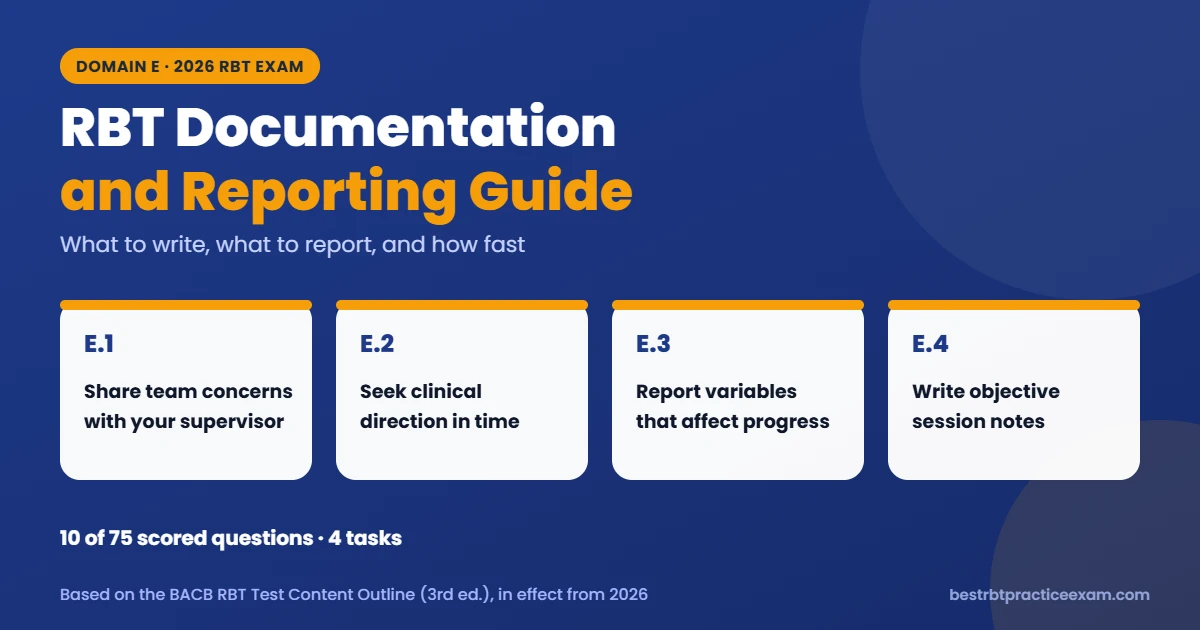
New RBTs often think the “real work” is the teaching, and notes are paperwork. Here is the truth from years of supervising: your supervisor makes every clinical decision from what you report and write. If your notes are vague or late, the plan is built on guesses. This RBT documentation and reporting guide follows one session from start to finish, so you can see where each task fits.
Before the Session: Read First, Then Work
Good RBT documentation and reporting starts before you meet the client. Review the prior session documentation, which means the last session notes and the data graphs, plus any new message or update from your supervisor.
- Last session notes, to see what happened and what changed
- Graphs, to see how each target is trending
- Supervisor updates, such as new targets or a changed procedure
- Caregiver messages, like a sick day or a new medication
Exam trap: If you skip the supervisor’s updates, you may run an old version of the plan. Prior session documentation means session notes and graphs, not just a verbal summary.
E.1 Sharing Concerns and Suggestions From the Team
BACB task E.1: “Communicate concerns and suggestions from the intervention team (e.g., caregivers, teachers, service providers) with a supervisor in a timely manner.”
Parents, teachers, speech therapists and others will tell you things during sessions. “He has been biting his brother.” “Can we work on potty training?” Your job is to listen, write it down, and pass it to your supervisor. You do not answer clinical questions or change the plan yourself.
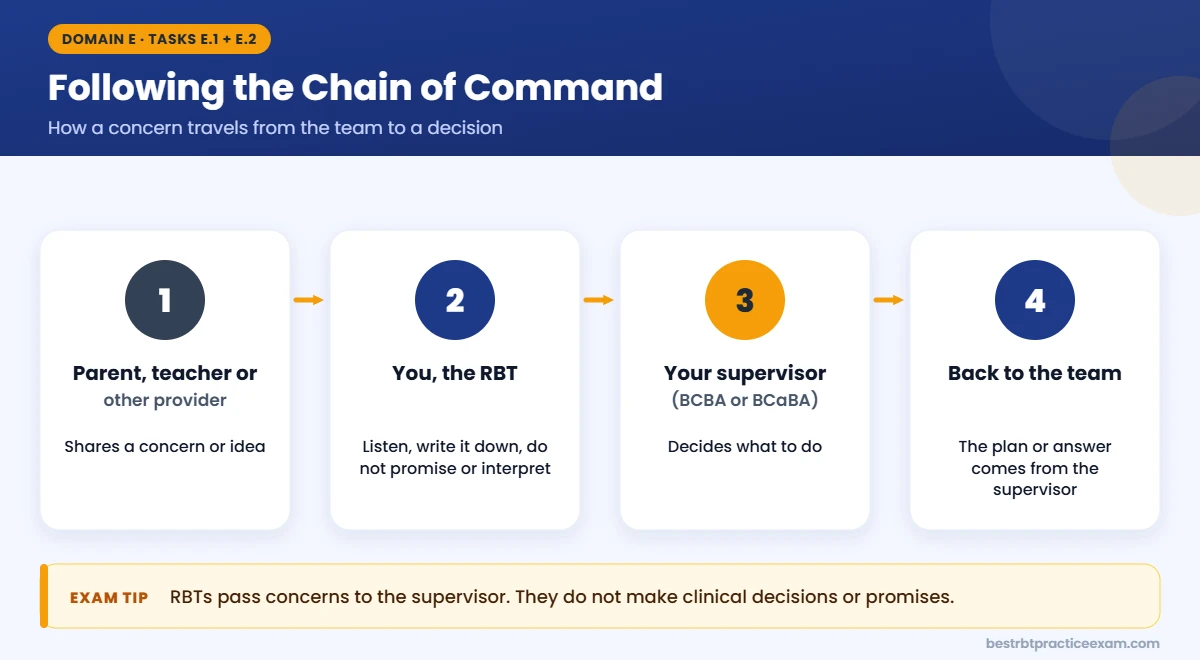
“Thank you for telling me. I am writing that down, and I will share it with my supervisor today so she can follow up with you.”
Be careful with people who are not directly involved in the client’s care. If a teacher who does not work with the client asks about progress, keep the information private and refer them to your supervisor. The ethics guide covers confidentiality in more detail.
Exam trap: Watch for answers where the RBT explains results, promises a change or shares details with someone outside the team. The safe answer is almost always: write it down and tell the supervisor.
E.2 Seeking Clinical Direction in a Timely Manner
BACB task E.2: “Seek and prioritize clinical direction from a supervisor in a timely manner (e.g., training needs, data irregularities, following chain of command).”
Clinical direction is guidance from your supervisor about how to do your job with a client. Asking for it is not a weakness. The BACB lists it as a task you are expected to do. Here are common situations where an RBT should seek clinical direction:
You were never shown how to run a new procedure, or you are not confident doing it.
Ask before you try itData jumps suddenly, or you are unsure how to record something.
Ask, do not guess or leave gapsA procedure seems to make behavior worse, or the client has mastered everything.
Report it with data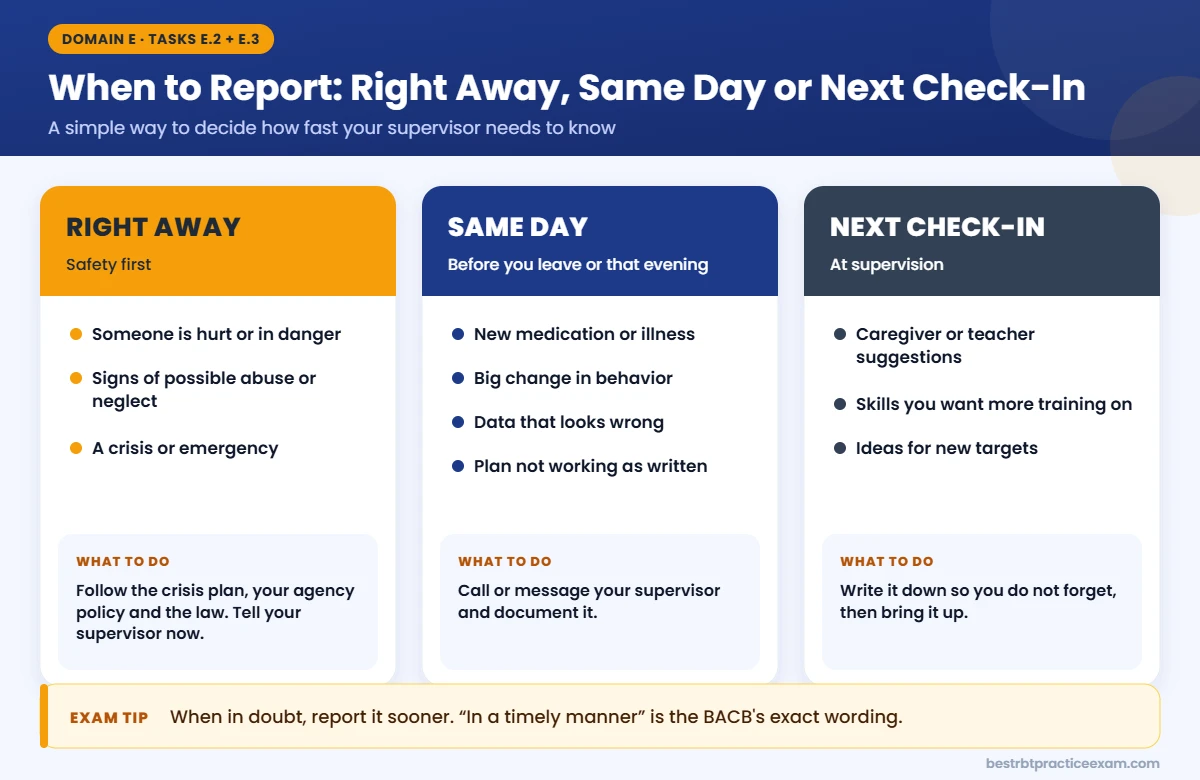
Chain of command means you go to your direct supervisor first, not to a different BCBA, the parent or your friend at work. Following it keeps everyone working from the same plan. Over time, this kind of regular feedback is also how RBTs build sound clinical judgment.
Exam trap: If an RBT is unsure how to document session data, the answer is to ask the supervisor. Filling gaps with general statements, guessing or leaving data out are all wrong.
E.3 Reporting Variables That Affect Client Progress
BACB task E.3: “Report/document variables that might affect client progress in a timely manner (e.g., illness, medication, schedule changes).”
A variable is anything outside the plan that might change how the client behaves or learns. If you do not report it, your supervisor may think the plan stopped working when the real cause was something else. Common variables to report and document:
- Illness
- New or changed medication
- Poor sleep
- Schedule changes
- New school or classroom
- Family events or a move
- Missed meals
- New people in the home
Your client usually hits 2 or 3 times a session. Today it is 11 times. Mom mentions he started a new medication on Monday. You record the data, write “Mother reported a new medication started Monday” in your note, and message your supervisor the same day. You do not guess whether the medicine caused it. That is for the supervisor and the medical team.
Exam trap: Should an RBT document that a client was up late and tired? Yes. Anything that may affect behavior is worth noting, in objective words.
E.4 Writing Objective Session Notes
BACB task E.4: “Communicate objectively what occurred during the session in accordance with applicable legal, regulatory, and workplace requirements.”
Session notes are the heart of RBT documentation and reporting. They are also legal and billing records, which is why they must be accurate, on time and written the way your workplace requires. Each organization has its own note format. The BACB does not require one single template.
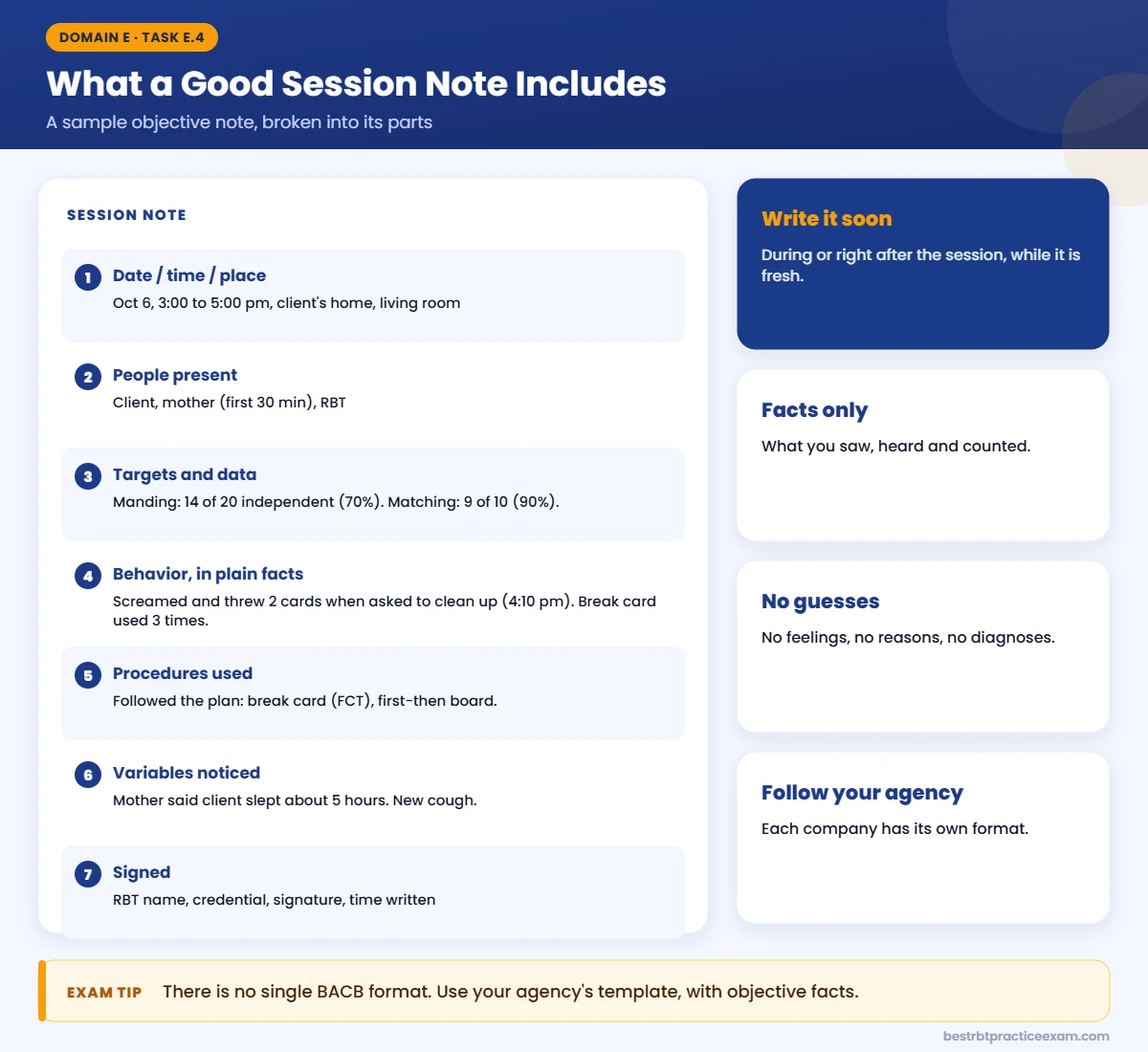
Objective means observable and measurable
Objective language describes what anyone could see, hear or count. It leaves out feelings, guesses and reasons. Compare these:
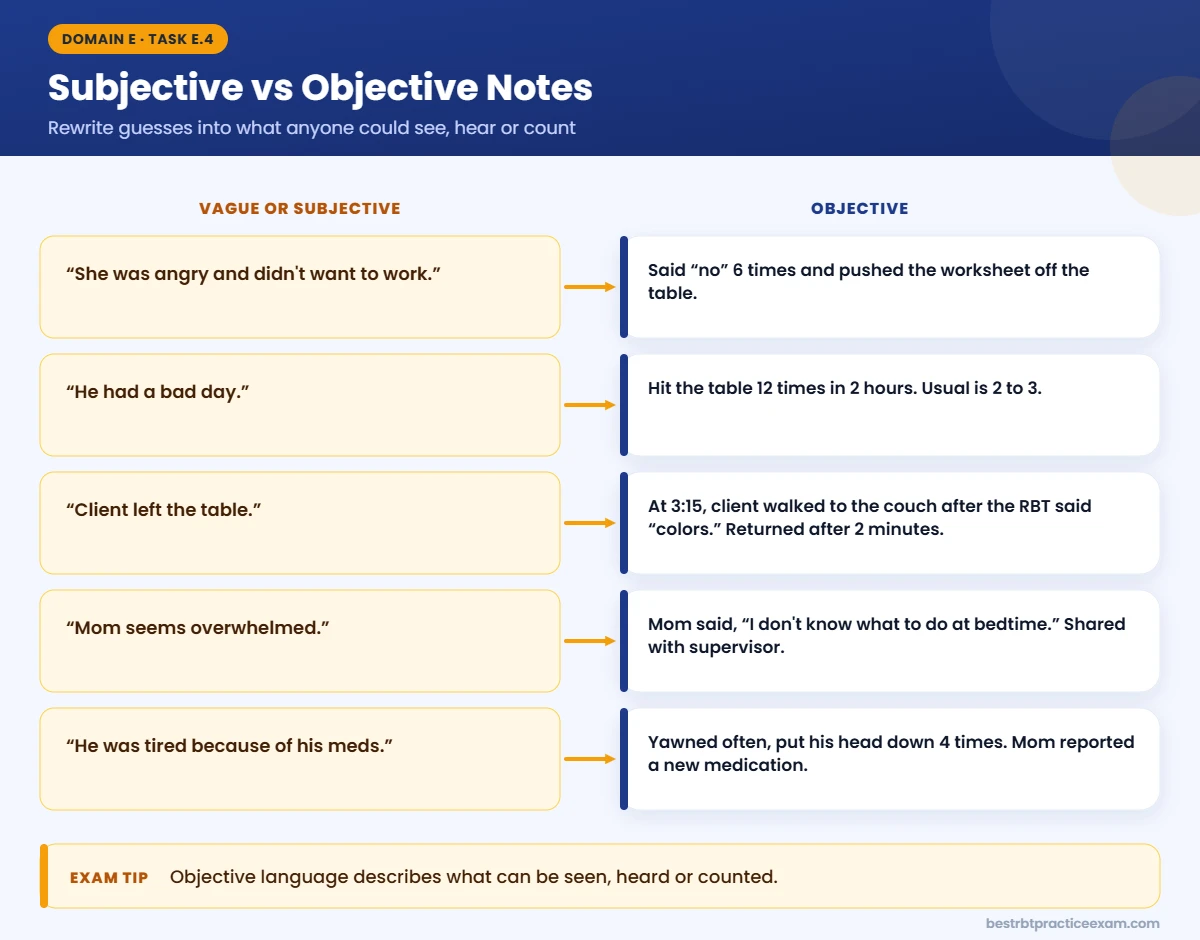
What is missing in “Client left the table”?
This sentence is objective, but it is incomplete. A reader cannot tell when it happened, what happened right before, how long the client was away, or what you did next. Strong notes add the time, the context and the outcome.
Try it: rewrite these notes
See an objective version
“During matching (3:20 to 3:35), client cried for about 2 minutes and pushed 3 cards off the table.”
See an objective version
“Client answered 18 of 20 labeling trials independently (90%), up from 70% last session.”
See an objective version
“At arrival, father said, ‘You’re late again.’ Session started at 4:10 pm, 10 minutes after the scheduled time.”
If you make a mistake in a note or in your data, correct it the way your agency’s policy says. Never erase, hide or backdate records. For clean data habits, see the data collection and graphing guide.
Write your note before you leave, or right after. I have watched great RBTs lose details because they waited until night. A note written 10 minutes after the session is always better than a perfect note written the next day.
RBT Documentation and Reporting Cheat Sheet: If This Happens, Do This
Most questions in this domain are short situations. Use this table to pick the safe answer fast.
| If this happens… | The RBT should… |
|---|---|
| A parent shares a concern or idea | Write it down and tell the supervisor in a timely manner |
| Someone not on the team asks about progress | Keep it confidential and refer them to the supervisor |
| You are unsure how to record something | Ask the supervisor, do not guess |
| Data suddenly looks very different | Report it the same day and keep recording accurately |
| A new medication or illness is mentioned | Document it objectively and tell the supervisor |
| Someone is hurt or in danger | Follow the crisis plan and report right away |
| You need more training on a procedure | Ask for it before running the procedure |
| You made an error in a note | Correct it following agency policy, never delete or backdate |
6 RBT Documentation and Reporting Questions Like the Real Exam
These questions are based on the kind of situations real test takers search for. Try each one before you open the answer.
1. Which of the following is included in prior session documentation?
- Only verbal reports from previous sessions
- Session notes and graphs
- Only direct client feedback
- A summary without behavioral data
Show answer and why
B. Prior session documentation means written session notes and data graphs. Verbal reports alone are not documentation.
2. A teacher who is not directly involved in the client’s program asks the RBT about the client’s progress. What should the RBT do?
- Give a general verbal update
- Maintain confidentiality and avoid sharing details
- Provide a full progress report
- Ask the teacher to email the parent
Show answer and why
B. Information is shared only with people who need it and only with the right permission. Refer questions to the supervisor.
3. An RBT is unsure how to accurately document session data. What should they do?
- Make general statements to fill gaps
- Ask the supervisor for guidance
- Guess based on past behavior
- Leave the uncertain data out
Show answer and why
B. Asking for clinical direction is the correct response when you are unsure.
4. Which statement about session notes is true?
- The BACB requires one specific format
- Each organization has its own format for session notes
- Session notes are optional
- All ABA companies use the same format
Show answer and why
B. Formats differ between organizations. What stays the same is that notes must be objective and accurate.
5. A client’s aggression increases after starting a new medication. What should the RBT do?
- Stop the session
- Tell the parent to stop the medication
- Report it to the supervisor and document it
- Wait a month to see if it changes
Show answer and why
C. Report the variable and document it objectively. Medication decisions belong to the medical team.
6. Which best describes observable and measurable language?
- It summarizes what took place
- It lets the reader interpret what happened
- It describes what can be seen, heard or counted
- It is only used for problem behavior
Show answer and why
C. Observable and measurable means anyone could see, hear or count it.
Ready for more? The RBT documentation and reporting quiz has more questions in the same style.
RBT Documentation and Reporting FAQs
How many documentation and reporting questions are on the RBT exam?
RBT documentation and reporting (Domain E) has 10 of the 75 scored questions, about 13%. The exam also has 10 unscored pilot questions that can come from any domain.
What should be included in an RBT session note?
The date, time and setting, who was present, targets and data, any behavior described in objective terms, procedures used, variables such as illness or medication changes, and the RBT’s signature. The exact format depends on the organization.
When should an RBT seek clinical direction from a supervisor?
When they need training on a procedure, notice data that looks wrong, are unsure how to record something, see a plan that is not working, or face a situation they are not sure how to handle. It should happen in a timely manner and through the chain of command.
What does objective documentation mean for an RBT?
It means writing only what can be seen, heard or counted, such as “hit the table 5 times,” instead of guesses or feelings, such as “was angry.”
Should an RBT report a client’s new medication?
Yes. Medication changes, illness, poor sleep and schedule changes are variables that may affect progress, so the RBT should document them objectively and tell the supervisor in a timely manner.
How this guide was made. Task wording and question counts come from the official BACB outline. Examples are original and based on common RBT session situations.
Practice content on this site is independent and not affiliated with or endorsed by the BACB.