
RBT Behavior Assessment Study Guide (Domain B, 2026)
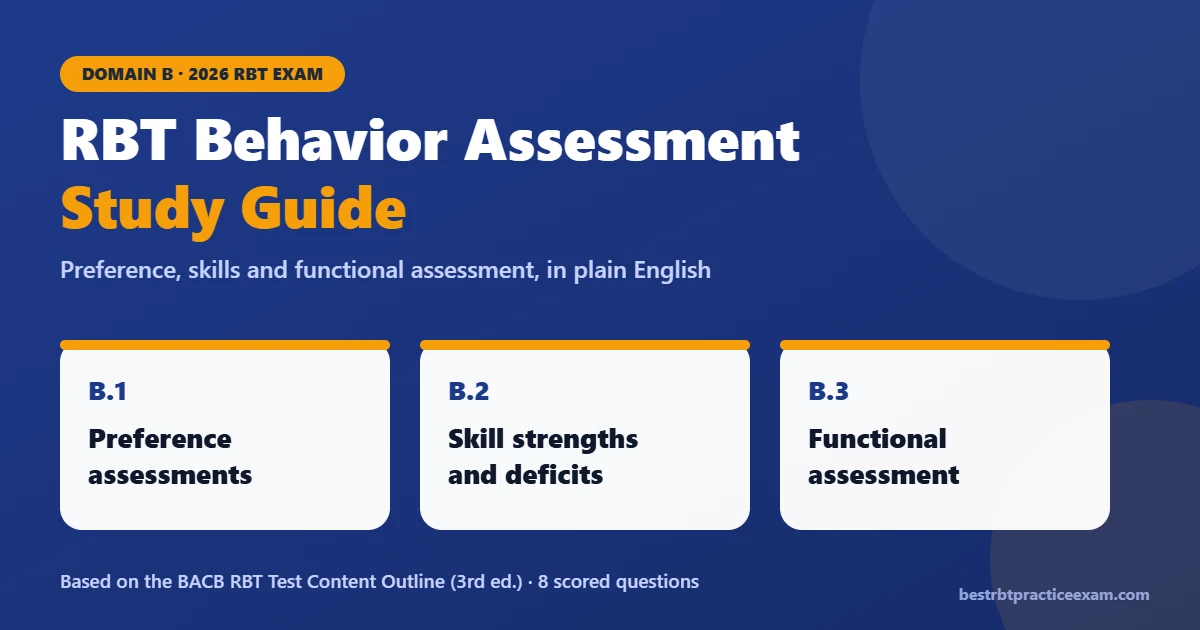
RBT behavior assessment (Domain B) covers three jobs: running preference assessments, helping with skills assessments, and helping with functional assessments. It is 8 of the 75 scored questions on the RBT exam. Almost every question checks one thing: do you know where helping ends and your supervisor’s decision begins?
The One Rule Behind Domain B: You Help, Your Supervisor Decides
Before we get into the three tasks, learn this line well. It answers more Domain B questions than any definition.
In RBT behavior assessment, you are the person in the room collecting clean, honest information. Your supervisor (a BCBA or BCaBA) is the person who picks the assessment, reads the results and decides what they mean. The BACB Test Content Outline says you conduct preference assessments and participate in skills and functional assessments. That word “participate” matters.
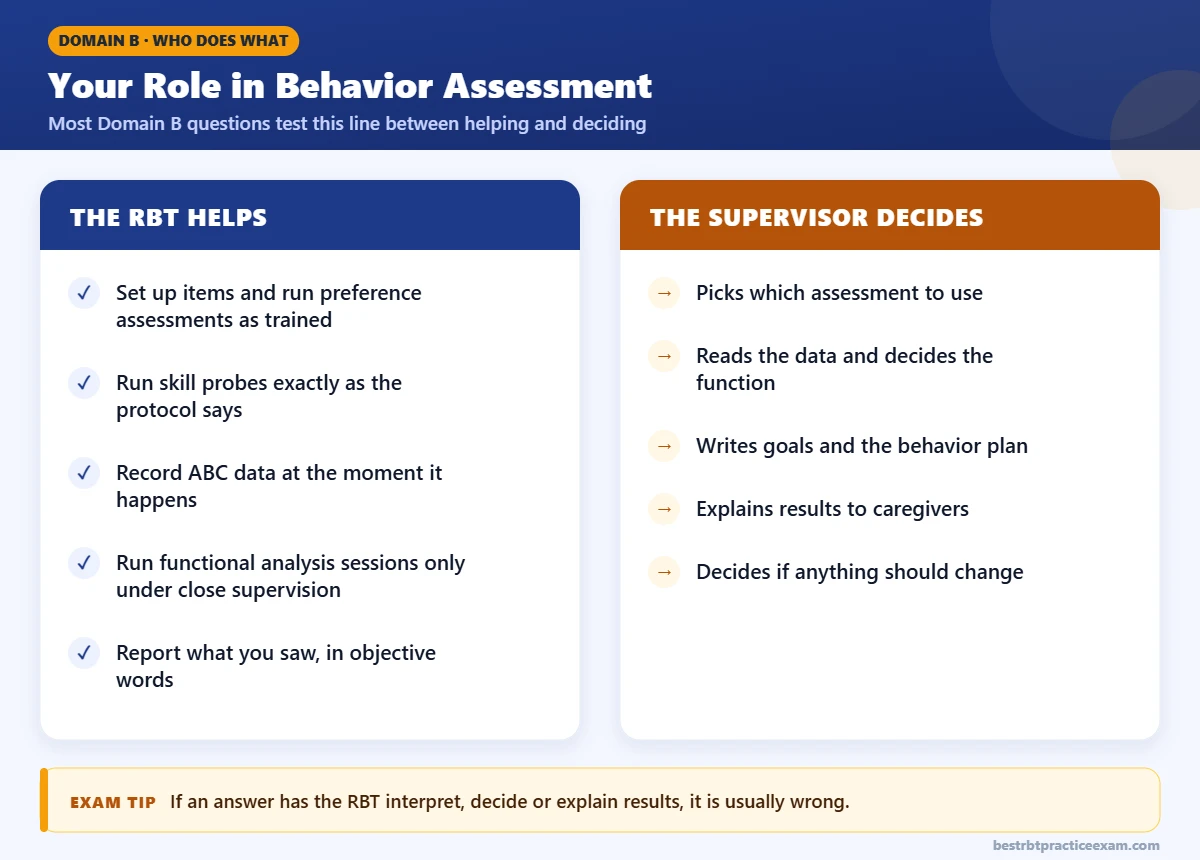
New RBTs often feel they should have an opinion about why a behavior happens. Having a hunch is fine. Writing it as fact, or sharing it with a parent, is not. Your power in assessment is accurate data. That is what lets your supervisor make the right call.
B.1 Preference Assessments: Finding What a Client May Work For
Preference assessments are the part of RBT behavior assessment you will run most often. A preference assessment is a short, planned way to find out which items or activities a client likes most. Teaching goes better when the client is working for something they truly want, so this is often one of the first things you do in a session.
There are two big groups. Indirect methods ask people, such as a parent interview or a short survey. Direct methods let you watch what the client actually chooses. On the exam, direct methods come up most, and these are the ones you will run.
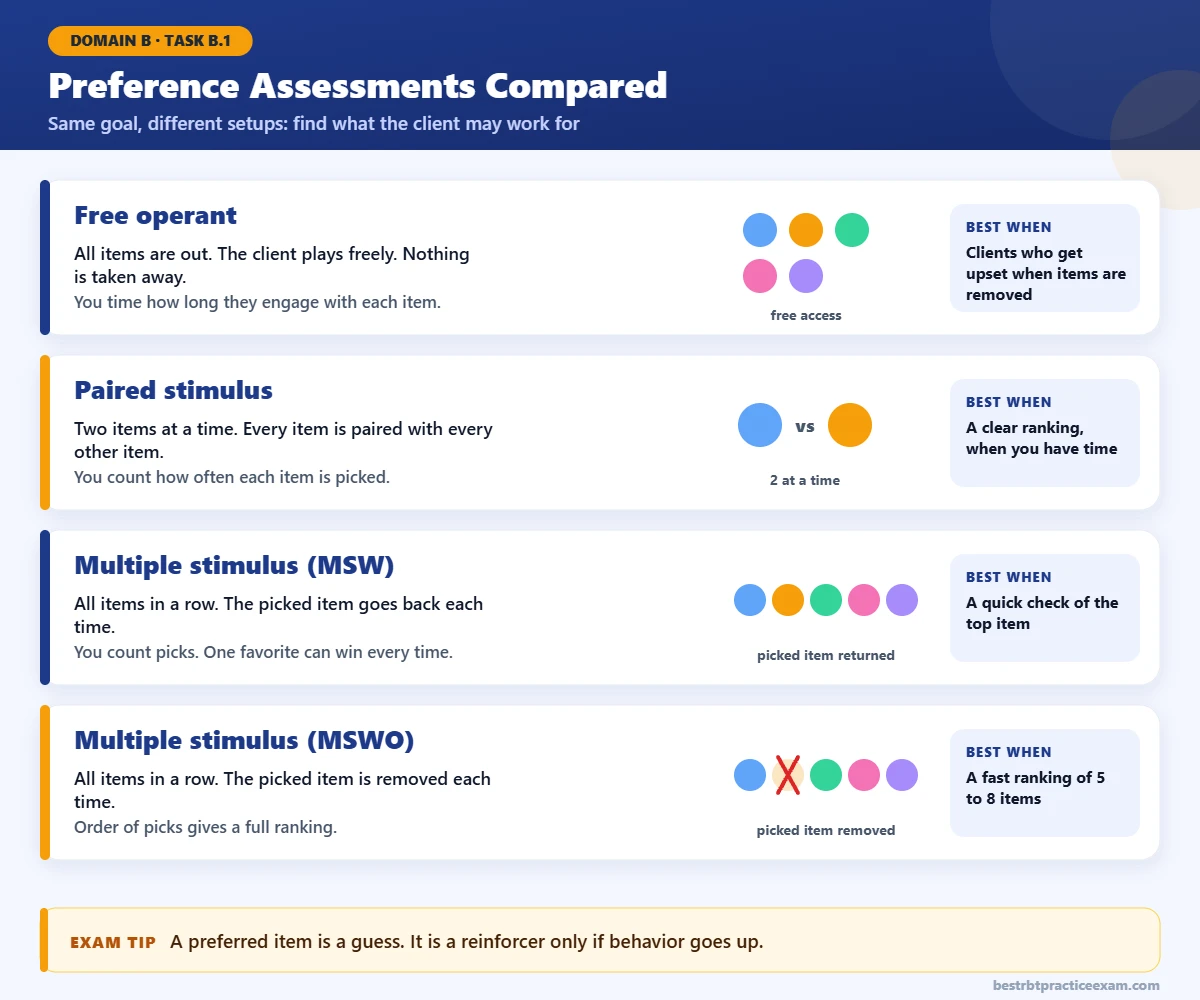
| Method | How you run it | What you record | Watch out for |
|---|---|---|---|
| Free operant | Put several items out and let the client move freely between them. Nothing is taken away. | How long the client engages with each item | It shows the top favorite well, but may not rank the rest clearly |
| Paired stimulus | Offer two items at a time. Each item is paired with every other item, in a mixed order. | Which item is chosen each time | Takes the longest. With 6 items, that is 15 pairs |
| Multiple stimulus with replacement (MSW) | Put all items in a row. After a pick, the chosen item goes back. | How often each item is chosen | One strong favorite can win every trial |
| Multiple stimulus without replacement (MSWO) | Put all items in a row. After a pick, that item is removed and the rest are reshuffled. | The order items are chosen in | Some clients get upset when items are removed |
Preference is not the same as reinforcement
This is the most tested idea in B.1. A preference assessment tells you what a client chooses. It does not prove the item will work as a reinforcer. An item becomes a reinforcer only when giving it after a behavior makes that behavior happen more often. So if a question asks what a preference assessment “proves,” be careful with answers that say “it proves the item is a reinforcer.”
You lay out a car, bubbles, a tablet, play dough and a ball. Your client grabs the tablet first. You remove it, slide the other items around and present them again. Next he picks the car, then bubbles. You write the order: tablet, car, bubbles, ball, play dough. That was an MSWO. You hand the sheet to your supervisor, who decides which items to use during teaching.
You put 6 toys on the table. The child picks the car, and you take the car away before the next round. Which assessment is this?
Show answer
Multiple stimulus without replacement (MSWO). The chosen item is removed each time, so the order of picks gives you a ranking.
B.2 Skills Assessments: Strengths, Deficits and Your Part in Them
Skills assessments are the quieter part of RBT behavior assessment, but they shape every goal you will teach later. A skills assessment shows what a client can already do (strengths) and what they still need to learn (deficits). Your supervisor uses it to choose goals. Your part is to help run it the right way, so the results are real.
Checks skills against a step-by-step list of goals, like a teaching curriculum.
Your job: present each item exactly as writtenCompares the client’s skills with what is typical for their age, such as language or self-care.
Your job: record responses, not your guessesLooks at skills like turn-taking, greetings, sharing and joining play.
Your job: observe and record in the setting askedYour supervisor picks the tool. Common ones in ABA include the VB-MAPP and the ABLLS-R for language and learning skills, and the Vineland for adaptive behavior. You do not need to memorize these tools for the exam. You need to know how to behave while helping with them.
Your supervisor asks you to probe five labeling targets. Your client looks at the picture of a dog, then looks at you, waiting. You want to help. Instead, you wait the time the protocol gives, record “no response,” and move on. That honest “no” is useful. It tells your supervisor exactly where teaching should start.
During a skills probe, the client looks to you for help. The protocol says no prompts. What do you do?
Show answer
Follow the protocol. Do not prompt, record the response as it happened, and continue. If something about the probe seems off, tell your supervisor after the session.
B.3 Functional Assessment: Helping Find Out Why a Behavior Happens
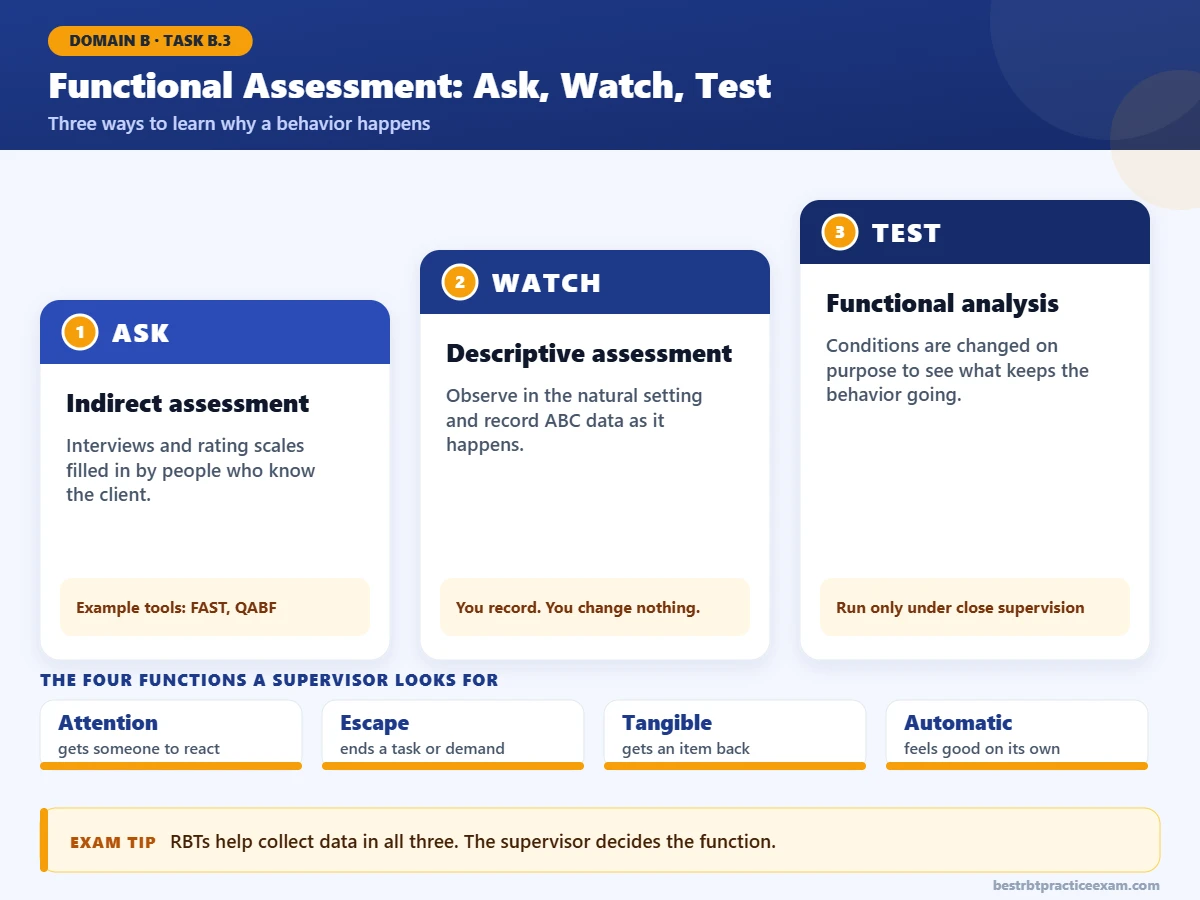
Functional assessment is the part of RBT behavior assessment that gets the most exam questions. It looks for the reason, or function, behind a behavior. Once the function is known, your supervisor can plan a better way for the client to get the same need met. Think of it in three steps: ask, watch, test.
Indirect assessment: asking
People who know the client answer questions, through an interview or a rating scale such as the FAST or the QABF. You might help hand out a form or sit in. You do not score it or decide what it means.
Descriptive assessment: watching and recording ABC data
This is where RBTs do the most. You watch the client in their normal setting and write down what happened right before the behavior (antecedent), the behavior itself, and what happened right after (consequence). You do not change anything. You just record.
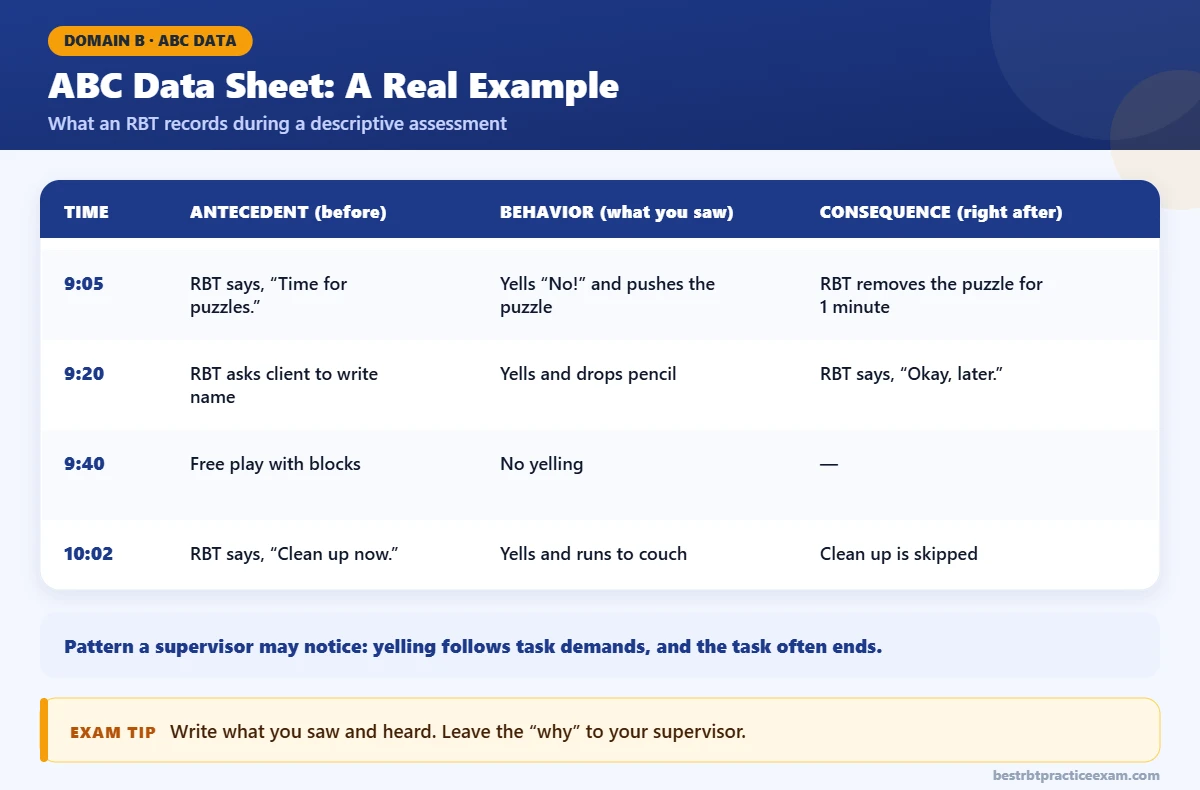
Notice how each line describes only what someone could see or hear. “Yells and drops pencil” is objective. “Got angry because the work was too hard” is a guess. For more on writing clean data, see the Data Collection and Graphing study guide.
Functional analysis: testing on purpose
In a functional analysis, the supervisor sets up short sessions where one thing changes at a time, to see which condition keeps the behavior going. You may be asked to run these sessions, but only with close supervision and exactly as written.
| Condition | What the session looks like | What it tests |
|---|---|---|
| Attention | The adult is busy and gives brief attention only after the behavior | Is the behavior getting attention? |
| Demand (escape) | The adult gives tasks and allows a short break only after the behavior | Is the behavior getting out of tasks? |
| Tangible | A favorite item is held back and given only after the behavior | Is the behavior getting an item? |
| Alone or ignore | No one interacts with the client, and safety is watched closely | Does the behavior happen on its own (automatic)? |
| Play (control) | Free attention and favorite items, no demands | The comparison. Behavior is usually low here |
When a functional analysis session starts, your only job is to run it exactly as your supervisor set it up and keep everyone safe. It can feel strange to let a behavior happen on purpose. That is part of the design, and your supervisor carries the clinical decision. If anything feels unsafe, stop and get your supervisor right away.
Once the function is clear, it shapes the plan you will later follow in behavior reduction. That is why accurate data here matters so much.
You are taking ABC data. A child throws a cup after hearing “no more juice,” and the adult then pours more juice. What goes in the consequence column?
Show answer
“Adult pours more juice.” The consequence is what happened right after the behavior, written exactly as you saw it. Deciding that the function is “tangible” is your supervisor’s job.
How RBT Behavior Assessment Questions Are Written
Domain B has 8 of the 75 scored questions, about 11% of your score. Most of them are short work situations, and they tend to follow three patterns: “what would the RBT do,” “a parent asks you something,” and “which assessment is this.” Here is one of each, written the way the real exam tends to ask.
1. Which of the following would an RBT do during a functional assessment?
- Review all the data and decide the function
- Record observations
- Write the hypothesis for the plan
- Direct the functional analysis
Show answer and why
B. Record observations. Reviewing the data, writing a hypothesis and directing the analysis are the supervisor’s job.
2. A caregiver asks the RBT what the functional assessment results mean. What is the best response?
- Explain the function you think the data shows
- Say the results are private
- Tell them it is a great question and that you will let your supervisor know they want to talk
- Give them a copy of the data sheet to read
Show answer and why
C. RBTs do not interpret or explain assessment results. Passing the question to the supervisor is both kind and correct.
3. Which of these is an indirect assessment?
- A caregiver rating scale about when the behavior happens
- ABC data taken during lunch
- A functional analysis attention condition
- An MSWO with five toys
Show answer and why
A. Indirect means asking people, through an interview or rating scale. ABC data is descriptive, and the attention condition is part of a functional analysis.
Want more like these? The RBT behavior assessment quiz has more questions in the same style.
5 Mistakes I See New RBTs Make in Domain B
- Deciding the function on your own. Even when the pattern looks obvious, the function is your supervisor’s call. On the exam, pick the answer where you record and report.
- Prompting during a skills assessment. Helping feels kind, but it hides what the client really needs to learn.
- Calling a preferred item a reinforcer. Preference is a good guess. Only a behavior increase proves reinforcement.
- Writing feelings in ABC data. “Frustrated” or “wanted attention” are guesses. Write what you saw and heard.
- Answering parents’ assessment questions. Be warm, then hand it to your supervisor. That protects the family and you, and it matches the RBT Ethics Code (2.0).
RBT Behavior Assessment Cheat Sheet
| If you see… | Think… |
|---|---|
| Items stay out, client plays freely | Free operant preference assessment |
| Two items at a time | Paired stimulus |
| Chosen item removed each time | MSWO |
| Chosen item put back | MSW |
| Interview or rating scale | Indirect assessment |
| Recording A-B-C in the natural setting | Descriptive assessment |
| Conditions changed on purpose | Functional analysis |
| “Interpret,” “decide,” “explain results” | Supervisor’s job, not the RBT’s |
Studying from older material? In the RBT Task List (2nd ed.), this area was simply called “Assessment,” with tasks B-1 to B-3. The 3rd edition kept the same three ideas and renamed the domain Behavior Assessment.
RBT Behavior Assessment FAQs
What is behavior assessment on the RBT exam?
It is Domain B of the RBT Test Content Outline (3rd ed.). It covers conducting preference assessments and taking part in skills assessments and functional assessments, always under the direction of a supervisor.
Do RBTs interpret assessment data?
No. RBTs collect and record assessment data accurately. Interpreting the data, deciding the function of a behavior and explaining results to caregivers are the supervisor’s job.
What does an RBT do during a functional assessment?
An RBT may record ABC data during a descriptive assessment, help with interviews or rating scales, and run functional analysis sessions exactly as written under close supervision. The RBT does not choose the assessment or decide the function.
What is the difference between a preferred item and a reinforcer?
A preferred item is one the client chooses in a preference assessment. It becomes a reinforcer only if giving it after a behavior makes that behavior happen more often in the future.
How many Behavior Assessment questions are on the RBT exam?
8 of the 75 scored questions, or about 11%. The exam also includes 10 unscored pilot questions, which can come from any domain.
How this guide was made. Every rule here was checked against official BACB documents, and the preference and functional assessment methods follow well-known research in behavior analysis. Examples are original and based on common RBT session situations.
- BACB RBT Test Content Outline (3rd ed.)
- BACB RBT Handbook
- BACB RBT Ethics Code (2.0)
- Fisher et al. (1992), paired-stimulus preference assessment, Journal of Applied Behavior Analysis
- DeLeon & Iwata (1996), multiple-stimulus without replacement (MSWO), Journal of Applied Behavior Analysis
- Roane et al. (1998), free-operant preference assessment, Journal of Applied Behavior Analysis
- Iwata et al. (1982/1994), functional analysis of self-injury, Journal of Applied Behavior Analysis
Practice content on this site is independent and not affiliated with or endorsed by the BACB.