
How to Become an RBT in 2026: Steps, Cost, Timeline, and the New BACB Rules
Updated October 2026. Every rule, fee, and date below was checked against the BACB’s own RBT Handbook (June 2026 version) and its 2026 transition guidance.
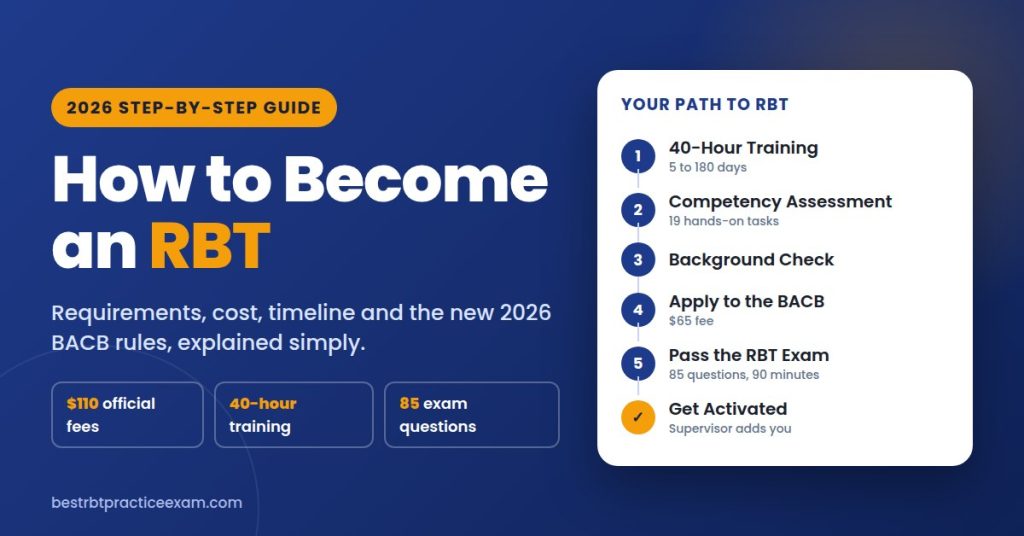
Want to work with kids, help families, and start a career in ABA without a college degree? You can become a Registered Behavior Technician (RBT) with a high school diploma, a 40-hour training course, and $110 in official fees.
Here is the quick answer on how to become an RBT:
- Be at least 18 and have a high school diploma (or GED).
- Finish a 40-hour RBT training course.
- Pass a hands-on skills check called the Initial Competency Assessment.
- Pass a background check and apply on the BACB website ($65).
- Pass the 85-question RBT exam at a Pearson VUE test center ($45).
After you pass, one more step makes you “active”: a supervisor has to add you in the BACB system. This part is easy to miss, so we explain it below.
This guide shows you how to become an RBT, one step at a time, in plain words. You will learn how long it takes, what it really costs, what changed in 2026, and how to do it even if you don’t have a job yet.
What Does an RBT Do?
An RBT is a behavior technician who works one-on-one with clients, most often children with autism. You use applied behavior analysis (ABA) to teach skills like talking, playing, and daily living, and to reduce behaviors that get in the way.
You don’t design the treatment plan yourself. A Board Certified Behavior Analyst (BCBA) or BCaBA writes the plan and supervises you. Your job is to run the plan, collect data, and report what you see. You might work in a clinic, a school, or a family’s home.
The credential comes from the Behavior Analyst Certification Board (BACB). As of July 1, 2026, more than 260,000 people held it, according to BACB certificant data.
RBT Requirements Checklist
Before you spend any money, make sure you meet all of these RBT certification requirements:
| Requirement | What you need | Timing rule |
|---|---|---|
| Age | 18 or older | When you submit your application |
| Education | High school diploma or equivalent (like a GED) | Before you apply |
| Background check | Criminal background check + abuse registry check | Done within 180 days before you pay the application fee |
| 40-hour training | A course that meets the BACB’s 2026 training requirements | Finished in no less than 5 and no more than 180 days |
| Competency assessment | Show your skills to a qualified assessor | Done after training, within 90 days before you apply |
| RBT exam | Pass the 85-question exam | Within 1 year after your application is approved |
Where can you get certified? Right now you can apply if you live in the United States or in Canada (except Quebec and Ontario). Australia is also allowed, but the BACB will stop taking new applications there on January 1, 2027.
Also check your state’s rules. A few states ask behavior technicians for a state license or registration on top of the RBT. Your employer or your state’s health board can tell you if this applies to you.
How to Become an RBT: Step by Step
Here is how to become an RBT, in the order you’ll do each step. Follow these steps and you won’t waste time or money.
Step 1: Complete the 40-Hour RBT Training
The 40-hour course teaches the basics of ABA: how to collect data, teach new skills, handle problem behavior, write session notes, and follow the ethics rules. You can find online, self-paced courses.
Keep these rules in mind:
- You need at least 5 days and no more than 180 days to finish it. You can’t rush it in a weekend.
- The course must say it “is designed to meet the 2026 training eligibility requirement.” Older courses built on the 2nd edition task list are no longer accepted.
- The trainer can’t be your family member, and can’t work for you or under you.
When you finish, download your certificate. You’ll upload it with your application.
Step 2: Pass the Initial Competency Assessment
This is a hands-on skills check with 19 tasks. They cover measurement, assessment, skill acquisition and behavior reduction, and professionalism. A BCBA or BCaBA who has finished the BACB’s 8-hour supervision training is in charge of it. They mark each task as passed when you do it right.
You can show some tasks in a role-play or answer interview questions. But at least 3 of the skill acquisition and behavior reduction tasks must be done with a real client. The assessment can happen in person, live online, or through videos recorded just for the assessment.
Two things changed in 2026. You can no longer pass the measurement part just by answering interview questions; you have to show it. And an assistant assessor now must hold an RBT or higher credential.
Your assessment must be done within 90 days before you apply. If you wait longer, you’ll have to redo it.
Step 3: Pass Your Background Check
You need a criminal background check and an abuse registry check. Both must be done within 180 days before you pay your application fee. If you’re hired first, your employer may run these checks for you. If you’re doing this on your own, your training or assessment provider may offer them.
Step 4: Apply to the BACB
- Create an account in the BACB portal. Use your personal email, not a work email, so you never lose access if you change jobs.
- Upload your training certificate, your competency assessment, and the attestation form.
- Pay the $65 application fee.
- Wait about two weeks for approval.
Step 5: Pass the RBT Exam
Once you’re approved, you have one year to pass the exam. You book it through Pearson VUE and pay $45. The exam has 85 multiple-choice questions, and you get 90 minutes. Only 75 questions count toward your score. The other 10 are test questions the BACB is trying out, and you can’t tell which ones they are.
The questions come from six areas of the RBT Test Content Outline (3rd edition): data collection and graphing, behavior assessment, behavior acquisition, behavior reduction, documentation and reporting, and ethics. We break down how many questions each area has in our guide on how many questions are on the RBT exam.
On test day, bring one valid photo ID with the same name as your BACB account. If you show up more than 30 minutes late, you’ll be turned away and lose your fee.
Didn’t pass? Don’t panic. You can retake it after 7 days, up to 8 times within 12 months. The BACB doesn’t charge a fee for the retake application right now.
Step 6: Get Your Certification Activated
This step is easy to miss. When you pass, your name shows up on the BACB registry within about 24 hours, but your status starts as inactive.
You can only start working as an RBT after an RBT Supervisor or RBT Requirements Coordinator adds you as their supervisee in the BACB portal. So if you get certified before you have a job, plan to find an employer right away.
How Long Does It Take to Become an RBT?
The BACB doesn’t publish an average time. In our opinion, if everything goes smoothly, you can finish in about 1 to 3 months. It depends on how fast you do the training, how quickly you can book an assessor, and when a test date opens near you. The official limits are in the middle column below; the last column is only our estimate.
| Stage | Official rule | Our estimate (opinion, not official) |
|---|---|---|
| 40-hour training | 5 days minimum, 180 days maximum | 1 to 4 weeks |
| Competency assessment | Must be within 90 days before you apply | A few days to a few weeks |
| Application review | About 2 weeks | 2 weeks |
| RBT exam | Must pass within 1 year of approval | 1 to 4 weeks to book and study |
| Activation | After a supervisor adds you | Same day to a few days, if you have a job |
If you want to learn how to become an RBT fast, in our opinion the quickest path is through an employer, because they can set up your assessment and background check for you.
How Much Does RBT Certification Cost?
The official BACB and exam fees add up to $110. Everything else depends on who pays for your training and assessment.
| Cost | Amount | Who pays |
|---|---|---|
| BACB application fee | $65 | You, or your employer |
| Exam appointment (Pearson VUE) | $45 | You, or your employer |
| 40-hour training | No set price; depends on the provider | You, or your employer if they train you |
| Competency assessment | No set price; depends on the assessor | Your employer, or you if you hire an assessor yourself |
| Background check | Varies by state and company | You, or your employer |
All BACB fees are non-refundable. If you need to cancel or move your exam, do it more than 30 days ahead to avoid a fee. Within 48 hours of your test, you can’t cancel at all.
Money-saving tip: some ABA companies hire people who aren’t certified yet. They pay for the training and the assessment, and some even pay you for your training hours. Some employers also pay you back for the exam fees once you pass.
Can You Become an RBT Without an Employer?
Yes. Figuring out how to become an RBT on your own just takes more planning. You can do the training by yourself. The tricky part is the competency assessment, because you need a qualified BCBA or BCaBA to assess you, and the BACB says you, your assessors, and the client’s provider must all work for, or have a contract with, the same organization.
| With an employer | On your own | |
|---|---|---|
| Training | The employer may pay for it | You pick and pay for a course |
| Competency assessment | Done at work, with their BCBA | You hire an assessor or join a program that includes one |
| Background check | Done by the employer | Done through your provider |
| Cost | Depends on what your employer covers | Fees plus training plus assessment |
| After you pass | Your supervisor can add you once you pass | You stay inactive until you get hired |
If you go the solo route, pick a program that includes the competency assessment, and confirm the contract covers you, the assessor, and the client’s provider. Then start applying for RBT jobs while you study, so you’re not stuck with an inactive credential after the exam.
What Changed for New RBTs in 2026?
The BACB made big updates on January 1, 2026. If you read an older guide on how to become an RBT, some of its advice may now be wrong. Here’s what’s new, based on the BACB’s 2026 RBT transition guidance:
- New training standard. Your 40-hour certificate must say it meets the 2026 training requirement. A certificate based on the old 2nd edition task list won’t work for new applications.
- New exam content. The exam now follows the RBT Test Content Outline (3rd edition).
- Stricter competency assessment. No more interview option for the measurement tasks, and assistant assessors must be RBTs or higher.
- Renewal every 2 years. RBTs now recertify every two years instead of every year. They earn 12 professional development units (PDUs) instead of doing a yearly skills check.
How to Prepare for the RBT Exam
Passing the exam is a key step in how to become an RBT. It covers the tasks an RBT does on the job, so you need to know how to use the terms in a real session, not just what they mean.
Here’s the study plan we suggest (our opinion):
- Study the biggest areas first. Behavior acquisition has the most questions (19), then behavior reduction (14), and data collection and graphing (13). Start with our behavior acquisition quiz to see where you stand.
- Learn the terms in plain words. Our free RBT study guide explains each exam area simply, with examples.
- Practice under real time. Take a full, timed RBT practice exam with 85 questions in 90 minutes. Review every answer you missed, then try again a few days later.
What Happens After You Pass?
The last part of how to become an RBT is activation. Once your supervisor activates you, you’re officially an RBT. From then on, you must be supervised every month you provide services:
- At least 5% of your service hours each month must be supervised. Work 100 hours, and at least 5 of them need supervision.
- You need at least 2 face-to-face, real-time meetings with your supervisor each month. Calls and emails don’t count.
- Your supervisor must watch you work with a client in at least one of those meetings, and at least one meeting must be just you and your supervisor.
You also must follow the RBT Ethics Code (2.0). It covers things like keeping client information private and avoiding personal relationships with clients’ families. Keep your supervision records for 7 years.
How Do You Keep Your RBT Certification?
Renewal is changing from every year to every two years. Here’s how it works:
| If you’re… | What you do |
|---|---|
| Renewing in 2026 | One last yearly renewal with a Recertification Competency Assessment. Your next renewal is 2 years later. |
| Between renewals (for example, 2027) | No renewal. Earn and upload professional development units (PDUs) in your BACB account. |
| Renewing in 2028 and after | Complete 12 PDUs before your date, then send your renewal application. No competency assessment needed. |
PDUs can come from training at work led by a BCBA or BCaBA, BACB-approved continuing education events, or college courses with a grade of C or higher. For training at work, each session must have at least 25 minutes of instruction: 25 minutes earns 0.5 PDU and 50 minutes earns 1 PDU, with no rounding up. Reading or studying on your own time doesn’t count as in-service training.
Submit your renewal on time. A late application costs an extra $50.
Common Mistakes to Avoid
Watch out for these slip-ups while you work on how to become an RBT. Each one is based on a BACB rule and can cost you time or money:
- Taking an old training course. If the certificate doesn’t mention the 2026 requirement, it won’t be accepted.
- Letting your assessment expire. You have 90 days after your competency assessment to apply. Plan your application before you book the assessment.
- Using a work email for your BACB account. If you leave that job, you could lose access to your account.
- A name mismatch on test day. The name on your ID must match the name in your BACB account exactly.
- Canceling the exam too late. Within 48 hours of your test, you can’t cancel and you lose the fee.
- Thinking you can work right after passing. You can’t start until a supervisor activates you.
Is Becoming an RBT Right for You?
In our view, being an RBT is rewarding, but it isn’t easy. You’ll work closely with children and families, sometimes during hard moments like tantrums or aggression. You’ll take data during every session and write clear notes.
We think this job is a good fit if you’re patient, calm under stress, and enjoy building a bond with kids. In our opinion, it’s also a useful first step if you’re thinking about becoming a BCaBA or BCBA later.
If that sounds like you, now you know exactly how to become an RBT. Start with a 2026-approved training course, and practice with a full RBT practice test before exam day.
FAQs
Can you become an RBT online?
Mostly, yes. A lot of how to become an RBT happens online. You can take the 40-hour training online, and the competency assessment can be done live online or by recorded video, as long as at least 3 tasks are shown with a real client. The exam, though, is taken in person at a Pearson VUE test center.
Do you need a college degree to become an RBT?
No. When it comes to how to become an RBT, you only need a high school diploma or an equivalent like a GED.
Can you become an RBT at 17?
You can start the 40-hour training at 17 if your provider allows it, but you must be 18 by the time you submit your BACB application. Watch the timing, since your training must be done within 180 days and your assessment within 90 days of applying.
What happens if you fail the RBT exam?
You can try again after waiting 7 days. You get up to 8 attempts within 12 months of your approval. Use the week to review the areas you struggled with before your next try.
Can you work as a behavior technician before you’re certified?
Some ABA companies hire people as behavior technicians while they finish the RBT steps. But you can’t call yourself an RBT, or work as one, until you pass the exam and a supervisor activates your certification.
undefined