
40-Hour RBT Training in 2026: How to Pick a Course the BACB Will Accept
Updated October 2026. Every rule below comes from the BACB’s RBT 2026 40-Hour Training Requirements and Curriculum Outline (March 2026) and the RBT Handbook (June 2026).
Imagine finishing 40 hours of training, applying to the BACB, and finding out your certificate doesn’t count. In 2026, that can happen because the rules for the 40-hour RBT training changed on January 1.
The good news: you can check whether a course meets the rules before you start it. This guide shows you how.
Quick answer
The 40-hour RBT training is the first step to becoming a Registered Behavior Technician. You need at least 40 hours of training, finished in 5 to 180 days, taught under a BCBA or BCaBA. If you apply on or after January 1, 2026, your certificate must say:
“This training program is designed to meet the 2026 training eligibility requirement for RBT certification.”
If that line is missing, the course doesn’t meet the 2026 rules, even if it’s free and online.
What You Learn in the 40-Hour RBT Training
The BACB sets the topics, not the course provider. Every 2026 course must cover eight sections from the BACB’s 2026 training curriculum. The minimum hours below add up to 38. The last 2 hours can go to any section.
| Section | Minimum hours | What it covers |
|---|---|---|
| A. Introduction to ABA | 2 | Reinforcement, the three-term contingency, common functions of behavior, mands and tacts |
| B. Preparing for Service Delivery | 1 | Reading session notes, setting up materials, building rapport and getting the client’s assent |
| C. Data Collection and Graphing | 3 | Operational definitions, measurement methods, updating graphs, reporting changes |
| D. Assisting with Behavior Assessments | 3 | Helping with skill, preference and functional assessments |
| E. Behavior-Change Interventions | 20 | Discrete-trial and naturalistic teaching, prompting, chaining, shaping, token economies, differential reinforcement, extinction, crisis steps |
| F. Documentation and Reporting | 3 | Objective notes, confidentiality, telling your supervisor what affects progress |
| G. Ethics and Professionalism | 5 | The RBT Ethics Code (2.0), multiple relationships, cultural humility, reporting misconduct |
| H. Next Steps in Certification | 1 | Applying, supervision and renewal |
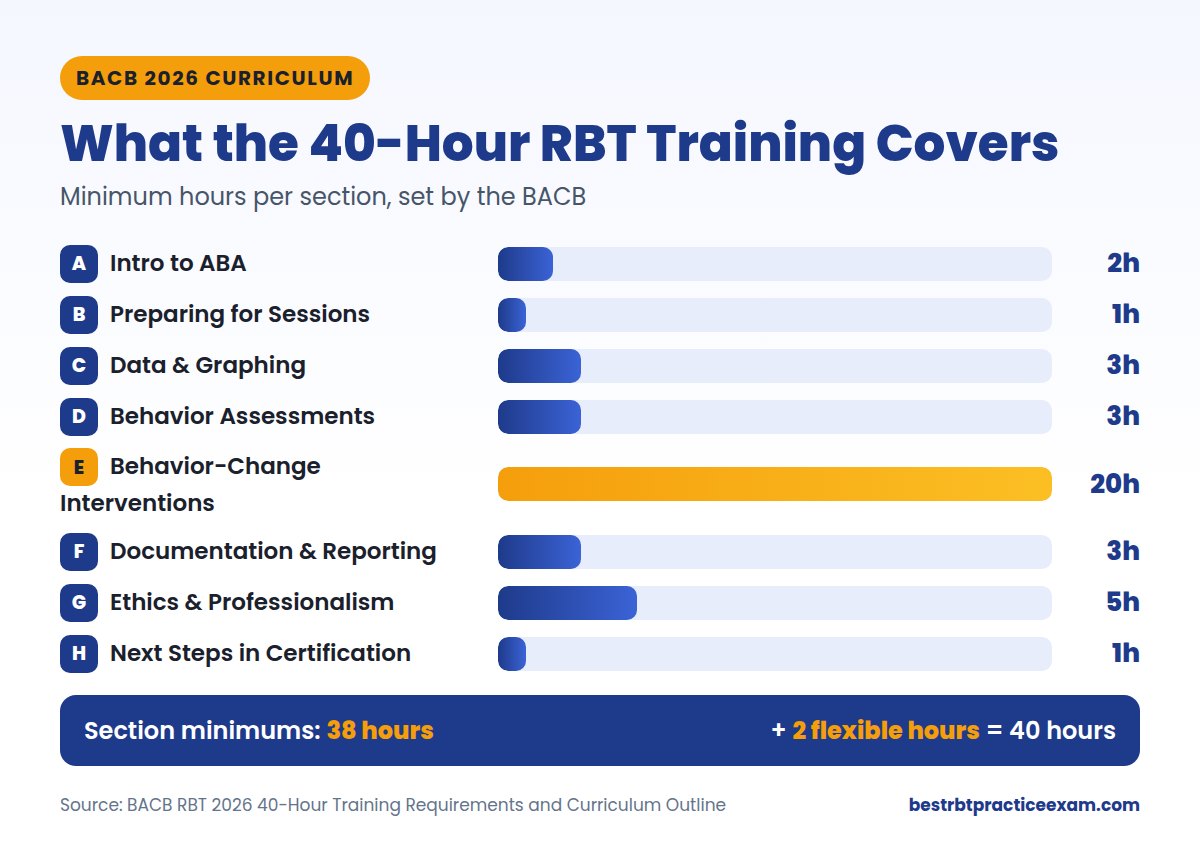
Half of your training time goes to Section E. That matches the exam, where behavior acquisition is the largest area. Our free RBT study guide breaks these same topics down for exam review.
How the Training Must Be Taught
The BACB doesn’t let a course be a pile of PDFs. Here are the rules every provider has to follow:
- Online, in person, or both are all allowed.
- It must use behavioral skills training. That means a mix of lessons, video modeling with good and bad examples, role-play with feedback, quizzes and discussion.
- Reading assignments don’t count toward your 40 hours.
- A qualified trainer must be in charge. The Responsible Trainer must be a BCBA, BCaBA or BCBA-D who has finished the BACB’s 8-hour supervision training. Assistant trainers must hold an RBT or higher.
- The trainer can’t be your relative, can’t work for you, and can’t report to you. Paying them for the course doesn’t count as employing them.
- The provider must be inside the BACB’s service area. Right now you can apply for the RBT from the United States, Canada (except Quebec and Ontario) or Australia. The BACB stops taking new applications from Australia on January 1, 2027.
Will Your Course Count? The 2026 Certificate Checklist
The BACB doesn’t approve, list or recommend training programs. The RBT Handbook says it plainly: the BACB “does not provide 40-hour training, certificates of completion, or training program recommendations.” So checking the course is your job.
In our opinion, the easiest way is to ask the provider for a sample certificate before you sign up. Your final certificate must include all of these:
- Your full name and your BACB ID
- Your start date and end date
- The total time you spent (for example, “40 hours and 15 minutes”)
- The Responsible Trainer’s name, certification number, and signature or branding
- Names and certification numbers of any assistant trainers
- This exact sentence: “This training program is designed to meet the 2026 training eligibility requirement for RBT certification.”
- Followed by: “The training is offered independent of the BACB.”
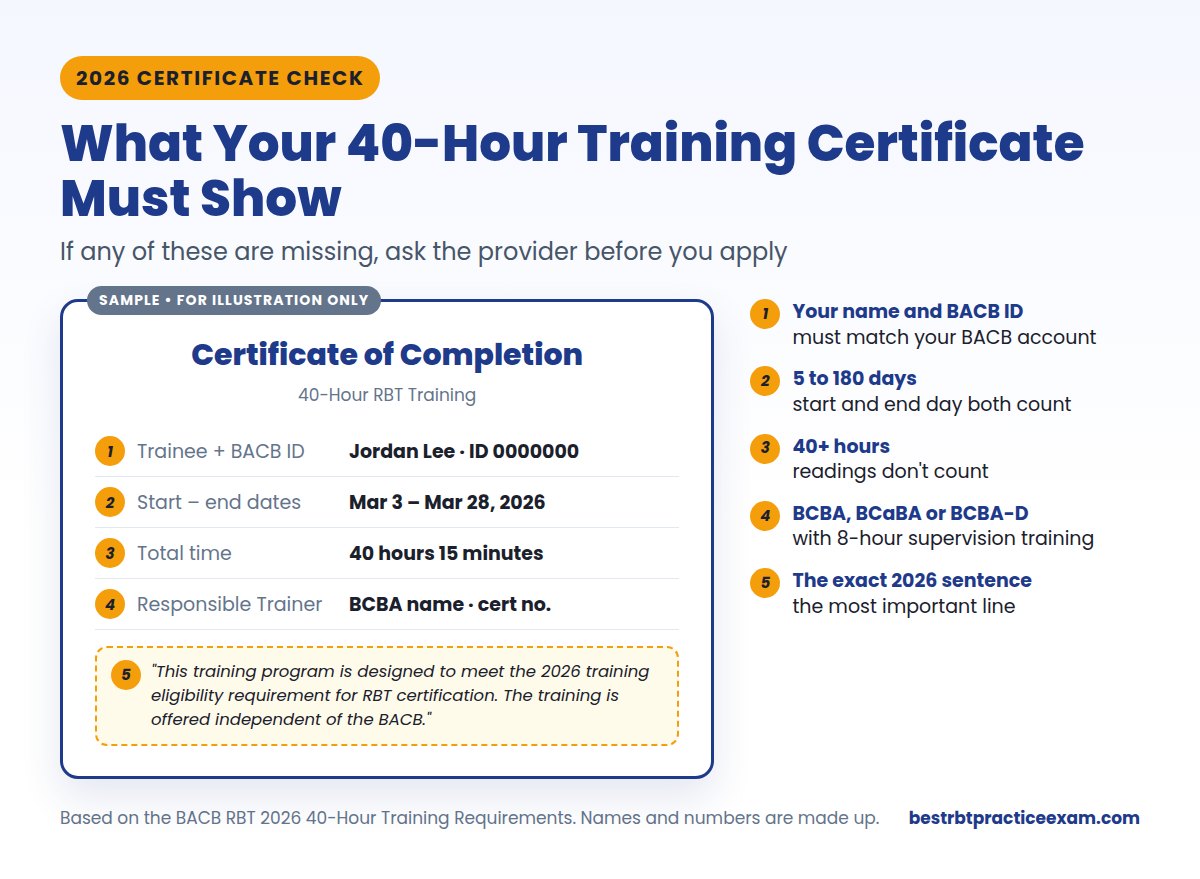
The provider must give you one single certificate that covers the whole training, and you upload that one file with your application. You can also look up the trainer’s certification number on the BACB’s certificant registry to make sure they’re a real, active BCBA or BCaBA.
Finished Your Training Before 2026?
If your certificate says “This training program is based on the RBT Task List (2nd ed.),” it was made for the old rules. For any application sent on or after January 1, 2026, you need the new 2026 training. The BACB’s 2026 RBT requirements also say there’s no short “bridge” course. You have to complete the full 2026 training again.
There’s one exception. If your application was approved before January 1, 2026, it stays valid for 12 months, and you can take the exam during that time under the old rules.
The 5-to-180-Day Rule (and How to Count It)
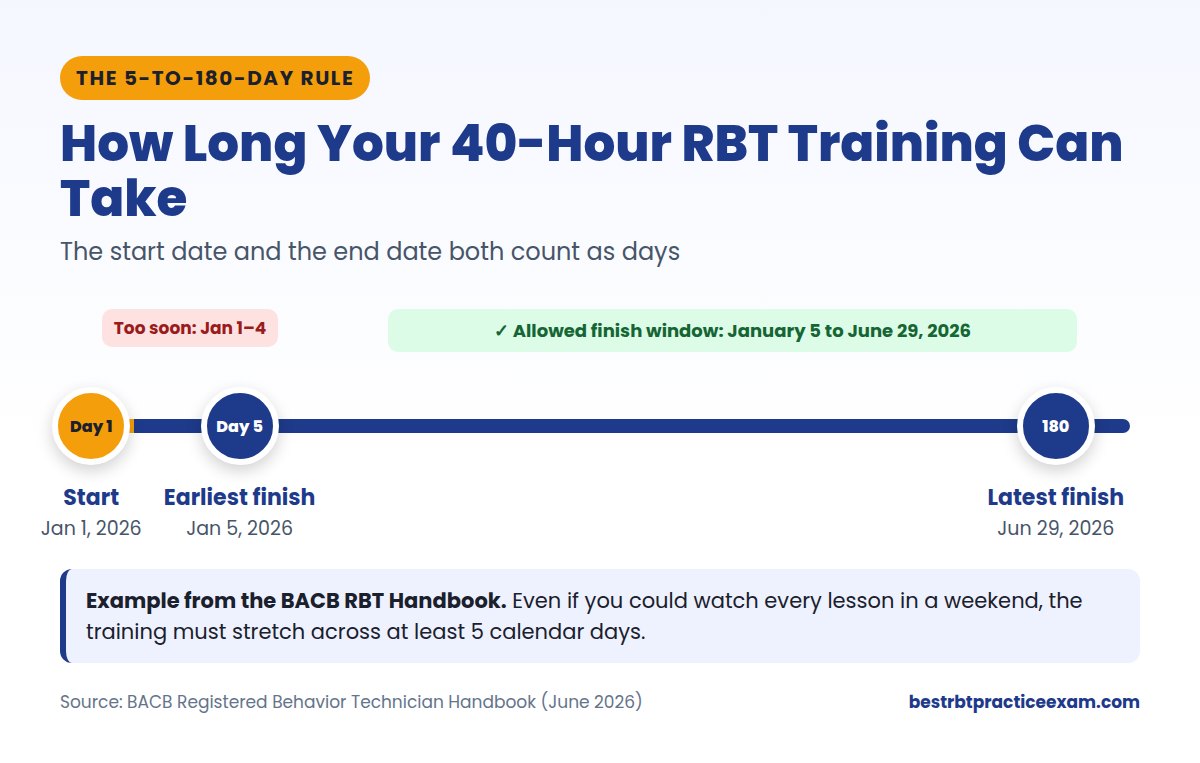
Your 40-hour RBT training must take at least 5 days and no more than 180 days. The start date and the end date both count as days.
Free, Paid or Through an Employer: Your 3 Options
The handbook says your training “may be offered by your employer, a university, or an online training program.” Here’s how the choices compare:
| Option | Cost to you | Competency assessment included? | What to check first |
|---|---|---|---|
| Employer training | Depends on the company; some cover it | Can be done at work afterward | Ask if the certificate uses the 2026 wording |
| Free online course | $0 | Check with the provider | The certificate wording, and when the course was last updated |
| Paid online course or university program | Varies by provider | Some programs include it | Whether the assessment, a BCBA and the background check are part of the price |
Is Free RBT Training Still Worth It in 2026?
It can be, but check the certificate first. One of the most searched free options is the Autism Partnership Foundation’s free RBT training. As of October 2026, its free RBT training page still describes the course as based on the 2nd edition task list and doesn’t mention the 2026 requirement. The course itself may have been updated since that page was written, so contact them and ask to see the 2026 certificate wording before you start.
The same goes for any free RBT training online. A free course saves money only if its certificate is accepted.
Online RBT Training vs Training at a Job
Online RBT training lets you study on your own schedule. But a 40-hour RBT training course only covers the first step. You still need a BCBA or BCaBA to do your competency assessment, and that assessment needs at least 3 tasks shown with a real client.
In our opinion, getting hired by an ABA company first is often the smoothest path for students. The company can provide the training, the RBT competency assessment, the background check and your supervisor in one place. A trainer who works for the company is fine. The rule only blocks trainers who are related to you or who work for you.
How to Choose and Finish Your 40-Hour RBT Training Course: 6 Steps
- Pick your path. Decide whether you’ll train through a job or on your own. If you go solo, plan how you’ll get a competency assessor before you pay for anything.
- Ask for a sample certificate. Compare it with the checklist above. No 2026 sentence means no deal.
- Check the trainer. Look up the Responsible Trainer’s name and certification number on the BACB’s certificant registry.
- Plan your dates. Leave at least 5 days from start to finish, and finish within 180 days.
- Take part, don’t just click through. Quizzes, role-plays and video modeling are part of the training. Reading assignments don’t count toward the 40 hours.
- Check your certificate when you get it. Make sure your name and BACB ID match your BACB account, and the dates and total time look right. You’ll upload this one file with your application.
What Comes After the Training?
Your 40-hour RBT training is the first step. Next, you pass the competency assessment, apply to the BACB, and pass the 85-question exam. Our guide on how to become an RBT walks through every step, fee and deadline.
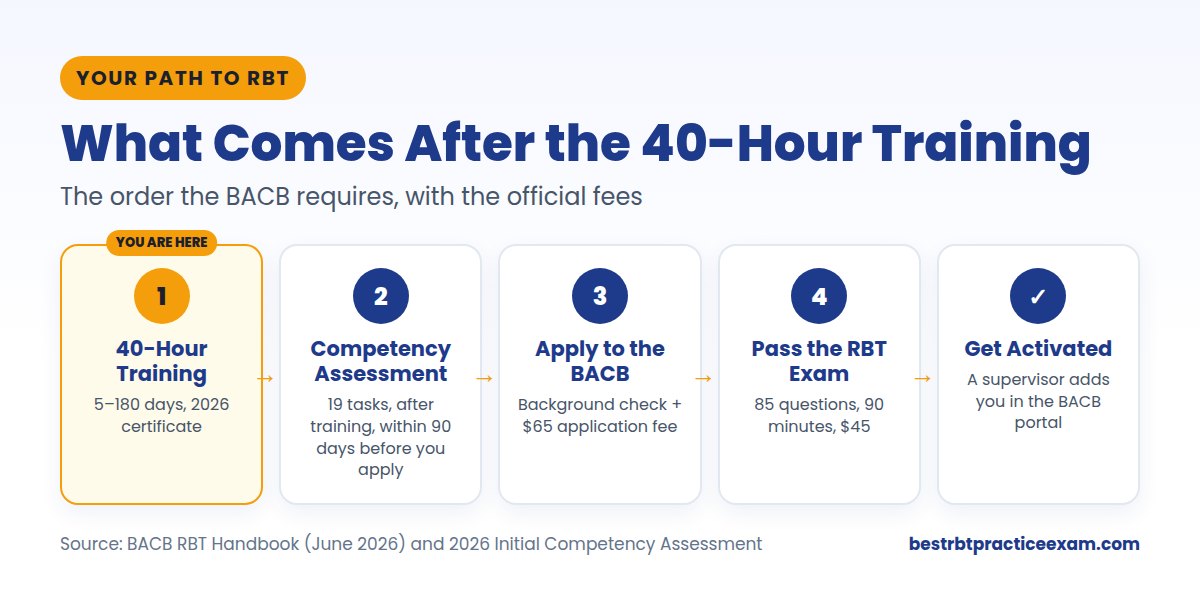
The topics from your training show up again on the exam. While they’re fresh, test yourself with a free, timed RBT practice exam. It shows your score for each content area, so you know what to review before test day.
Just finished your training? See how ready you are for the real exam.
Frequently Asked Questions
Is the 40-hour RBT training free?
It can be. Some ABA companies pay for it when they hire you, and some online courses are free. Before you start a free course, make sure its certificate includes the BACB’s 2026 sentence. Otherwise it won’t count for an application sent in 2026 or later.
Can I do the 40-hour RBT training online?
Yes. The BACB allows online, in-person or mixed training, as long as it uses behavioral skills training like modeling, role-play and quizzes. The competency assessment that comes after it is different: at least 3 of its tasks must be shown with a real client.
Does my 40-hour training certificate from before 2026 still work?
Not for a new application. If you apply on or after January 1, 2026, you need training that meets the 2026 requirements, and there’s no shorter bridge course. The only exception is an application that was already approved before January 1, 2026. It stays valid for 12 months.
Does the 40-hour training include the competency assessment?
Not automatically. They’re two separate requirements, and the competency assessment must happen after you finish the training. Some programs offer both, so check what’s included before you pay.
Can I finish the training in less than 5 days?
No. The BACB requires at least 5 days and no more than 180 days, and both the start date and end date count. Finishing in fewer than 5 days means the training doesn’t meet the requirement.