
The RBT Ethics Code (2.0), Made Simple: 29 Rules Every RBT Must Follow
Updated October 2026. Everything on this page comes from the BACB’s RBT Ethics Code (2.0), the version in effect today. The BACB numbers the standards but does not title them, so the short bold labels below are ours.
Ethics is not just one domain on the RBT exam. It is the rulebook for every session you run, and breaking it can lead to action against your certification.
This guide explains all 29 standards in plain English, shows the numbers you must remember, and tells you how ethics shows up on the exam.
Quick answer
The RBT Ethics Code (2.0) is the BACB’s list of 29 ethics standards that every Registered Behavior Technician and RBT applicant must follow. It has 3 sections, rests on 4 core principles, and has been required since January 1, 2022. For any ethics question, your BACB-required supervisor is your first stop.
What Is the RBT Ethics Code 2.0?
The code is published by the Behavior Analyst Certification Board (BACB). It sets the ethical rules for RBTs and for people applying to become RBTs.
The BACB Board approved it on May 10, 2021, and it became required on January 1, 2022, replacing the 2018 version. The current official RBT Ethics Code PDF is a 2024 update of version 2.0. As of October 2026, the BACB has not announced a newer version on its Ethics Codes page.
- Who it covers: all RBT certificants and RBT applicants.
- Where it applies: every behavior-technician activity, in any setting and in any format, including telehealth.
- Your personal life: only when your personal behavior clearly puts clients, stakeholders, or coworkers at risk.
- No excuses: not knowing or misunderstanding the code is not a defense.
- Other rules still apply: you also follow the law and the rules of groups like your employer or a licensure board.
RBT code vs. BCBA code: BCBAs follow a different document, the Ethics Code for Behavior Analysts. The RBT version is shorter and is built around one idea: you work under a supervisor, so most ethics questions go to your supervisor first.
The 4 Core Principles Behind the Code
The introduction lists four core principles. Every standard grows out of them, so they are a good check when a situation feels unclear.
- Benefit othersYour work should help your clients and the people who support them.
- Treat others with compassion, dignity, and respectEvery client, family member, and coworker deserves care and respect.
- Behave with integrityBe honest, keep your commitments, and act the same way from session to session.
- Ensure your competenceOnly do what you have been trained and checked on, and keep your skills current.
How the RBT Ethics Code Is Organized
The 29 standards sit in three sections. Here is the quick view.
| Section | What it covers | Standards | Remember this |
|---|---|---|---|
| 1. General Responsibilities | Honesty, your role, competence, bias, relationships, and gifts | 12 (1.01 to 1.12) | The $10 gift limit |
| 2. Providing Behavior-Technician Services | How you treat clients, follow the plan, and protect their information | 10 (2.01 to 2.10) | No client details on social media |
| 3. Responsibilities to the BACB and Supervisor | BACB rules, exam honesty, and reporting deadlines | 7 (3.01 to 3.07) | The 24-hour and 30-day deadlines |
The code ends with a glossary that defines terms like client, stakeholder, multiple relationship, and scope of competence.
All 29 RBT Ethics Code Standards in Plain English
Here is every standard, grouped by section. We explain what each one asks you to do. For the exact wording, read the official PDF linked above.
Section 1: General Responsibilities
- 1.01 Honesty and the law: Be truthful, do not encourage others to act dishonestly or illegally, and follow the law and professional rules.
- 1.02 Accountability: Act professionally, own your actions, and work with your supervisor if you cannot keep a commitment.
- 1.03 Your role: Provide services only in a clearly defined role, under close and ongoing supervision.
- 1.04 Supervisor is never your employee: An RBT never employs their own supervisor. RBT trainees may contract for supervision separately.
- 1.05 Honest credentials: Never make false or exaggerated claims about your qualifications, and show current credentials when asked.
- 1.06 Competence first: Provide a service only after your supervisor confirms you can do it, and tell your supervisor about requests outside your skills.
- 1.07 Cultural responsiveness: Look at your own biases and get supervisor-directed training so you can serve people from different backgrounds well.
- 1.08 No discrimination: Never harass or discriminate. Treat everyone fairly and inclusively.
- 1.09 Personal problems: If a personal issue could affect your work, take action to resolve it and document what you did.
- 1.10 Multiple relationships: Avoid them. If one develops, tell your supervisor, work to resolve it, and document it.
- 1.11 Gifts: Do not give or accept gifts worth more than $10 USD, and follow your employer’s rule if it is stricter. An occasional thank-you gift is fine; ongoing gifts that add up are not.
- 1.12 Romantic and sexual relationships: Never with current clients, stakeholders, or supervisors. The code also sets waiting periods for former ones (see the numbers below).
Section 2: Providing Behavior-Technician Services
- 2.01 Do no harm: Act in your client’s best interest, avoid harm, and know and follow mandated-reporting laws.
- 2.02 Follow the plan: Follow your supervisor’s direction and carry out services and documentation accurately.
- 2.03 Professional conduct: Stay professional in all work activities and act on your supervisor’s feedback.
- 2.04 Training before new things: Do not use an unfamiliar intervention or work with an unfamiliar population until you are trained.
- 2.05 Restrictive procedures: Use restrictive or punishment-based procedures only if they are in the documented behavior-change plan and your supervisor has verified your competence.
- 2.06 Route concerns to your supervisor: Direct questions or concerns about your services to your supervisor.
- 2.07 Protect clients: If a client’s legal rights are violated or harm is likely, tell your supervisor, follow policy, document it, and contact authorities when required.
- 2.08 Confidentiality: Protect client and workplace information as required by the BACB, your employer, and the law.
- 2.09 Social media and websites: Never post information that could identify a client.
- 2.10 Sharing client information: Share confidential information only when your supervisor directs it or the law allows it, and only what is needed.
Section 3: Responsibilities to the BACB and Your Supervisor
- 3.01 Follow BACB rules: Meet all BACB and supervisor requirements, including supervision, documentation, and audits.
- 3.02 Fix wrong information: If you gave the BACB inaccurate information, correct it promptly.
- 3.03 Exam honesty: Never cheat or help anyone cheat, and follow BACB and testing-center rules.
- 3.04 Self-report within 30 days: Report events like legal charges, certain investigations, disciplinary actions, or conditions that could affect safe services to the BACB within 30 days.
- 3.05 Intellectual property: Do not misuse BACB materials or other people’s work.
- 3.06 Share BACB notices: Give your supervisor any BACB notice or required action right away and respond together.
- 3.07 Watch your account: Check your BACB account regularly (for example, monthly) and tell your supervisor within 24 hours of any change in your certification status.
The Numbers in the Code You Must Remember
Most standards describe behavior, but a few set hard limits and deadlines. In our opinion, these six are the easiest points to lock in before exam day.
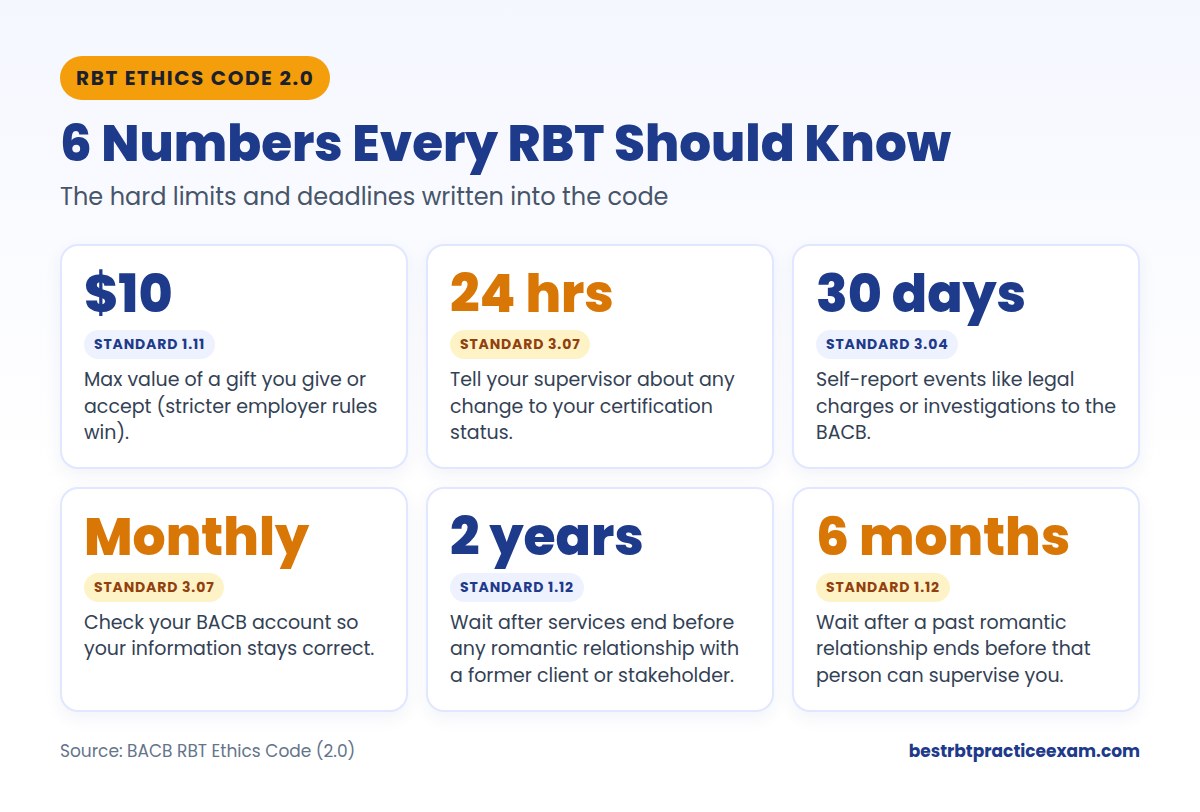
- $10: the gift limit (1.11).
- 24 hours: to tell your supervisor about a certification status change (3.07).
- 30 days: to self-report qualifying events to the BACB (3.04).
- Monthly: the example the code gives for checking your BACB account (3.07).
- 2 years: after services end before a romantic relationship with a former client or stakeholder (1.12).
- 6 months: after a past romantic relationship ends before that person can supervise you (1.12).
What Changed From the 2018 Code?
The BACB revised the code after surveying 6,049 RBTs and 1,729 supervisors and working with 13 subject-matter experts. Here is what changed, based on the BACB’s crosswalk between the two codes.
| What changed | 2018 code | Ethics Code 2.0 |
|---|---|---|
| Number of standards | 31 | 29 |
| Sections | Original names and order | Renamed and reorganized into 3 sections |
| Removed standards | 2.06, 3.06, and 3.08 | Now covered by other standards |
| New standards | None | 7 new: 1.04, 1.07, 2.03, 2.05, 2.06, 3.06, 3.07 |
| Required since | 2018 | January 1, 2022 |
In our opinion, the new standards that matter most in daily work are 2.05 (restrictive procedures), 3.07 (the 24-hour status report), and 1.07 (cultural responsiveness).
What to Do When You See an Ethics Problem
The code says that when you suspect an ethics violation, you first try to resolve it by bringing it to your supervisor. The full order looks like this:
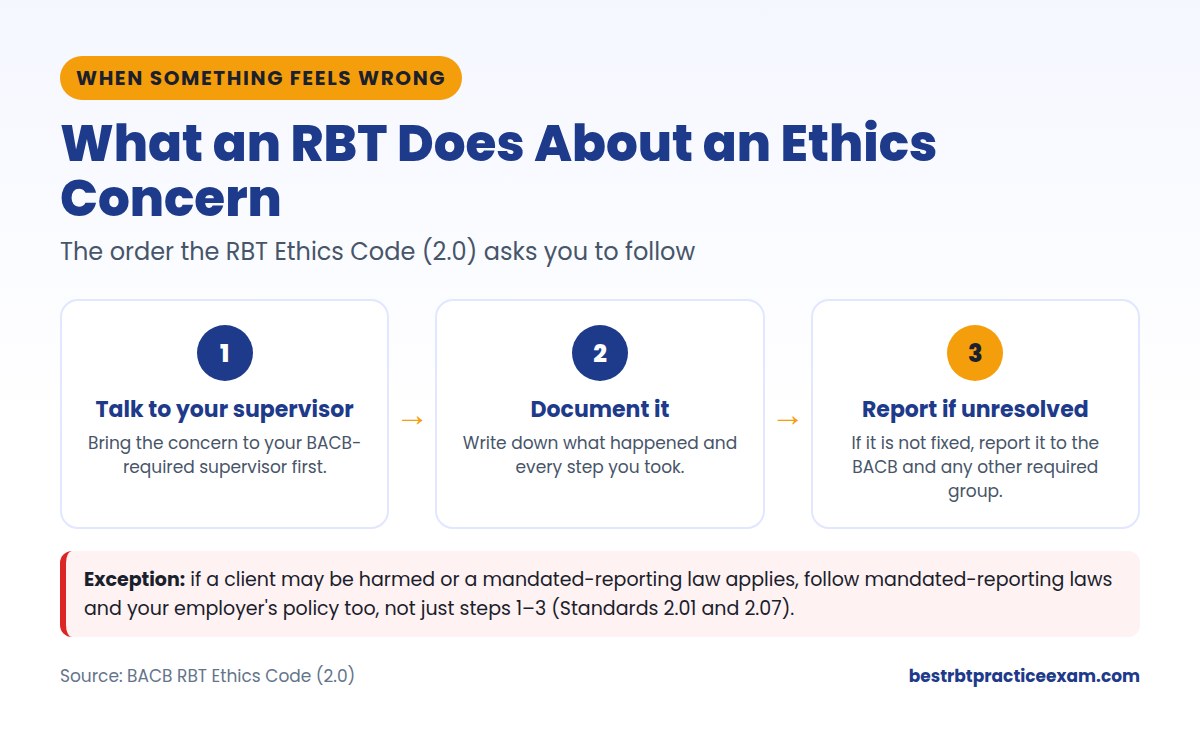
- Talk to your supervisor. Bring the concern to your BACB-required supervisor first.
- Document it. Write down what happened and every action you took.
- Report if it is not resolved. Report it to the BACB and any other required group.
Safety comes first. If a client may be harmed or their legal rights are violated, standards 2.01 and 2.07 also require you to follow mandated-reporting laws and your employer’s policy, and to contact authorities when required.
Example
A parent offers you a $50 gift card after a great month. Under standard 1.11, you politely decline because it is over the $10 limit. In our opinion, it is also smart to tell your supervisor so it is on record.
How the RBT Ethics Code Shows Up on the Exam
On the 3rd edition RBT task list (the Test Content Outline), ethics is Domain F. It has 10 tasks and 11 of the 75 scored questions, about 15% of your score.
In our opinion, you do not need to memorize standard numbers. Focus on what each rule asks you to do, because ethics questions test how you would act in a situation. Here is our 3-step plan:
- Read the 29 standards above once, then skim the official PDF.
- Learn the six numbers ($10, 24 hours, 30 days, monthly, 2 years, 6 months).
- Practice scenarios in the RBT ethics quiz, then review weak spots in our RBT ethics study guide for Domain F.
Know the rules but freeze on scenario questions? Practice them before exam day.
Frequently Asked Questions
What is the RBT Ethics Code 2.0?
It is the BACB’s current set of ethics rules for Registered Behavior Technicians and RBT applicants. It has 29 standards in 3 sections, is built on 4 core principles, and has been required since January 1, 2022.
How many standards are in the RBT code of ethics?
There are 29 standards: 12 in Section 1 (General Responsibilities), 10 in Section 2 (Providing Behavior-Technician Services), and 7 in Section 3 (Responsibilities to the BACB and Supervisor). The 2018 version had 31.
What is the gift limit for RBTs?
Standard 1.11 says RBTs do not give or accept gifts worth more than $10 USD. If your employer has a stricter rule, you follow the stricter rule.
Is the RBT Ethics Code the same as the BCBA ethics code?
No. BCBAs and BCaBAs follow the Ethics Code for Behavior Analysts. RBTs follow the RBT code, which is shorter and is written around working under a BACB-required supervisor.
How many ethics questions are on the RBT exam?
Under the 3rd edition RBT Test Content Outline, the Ethics domain (Domain F) has 10 tasks and 11 of the 75 scored questions, which is about 15% of your score.