
How Many Questions Are on the RBT Exam? (2026 Guide)
Last updated: October 2026 · Checked against the BACB RBT Handbook (updated June 2026)
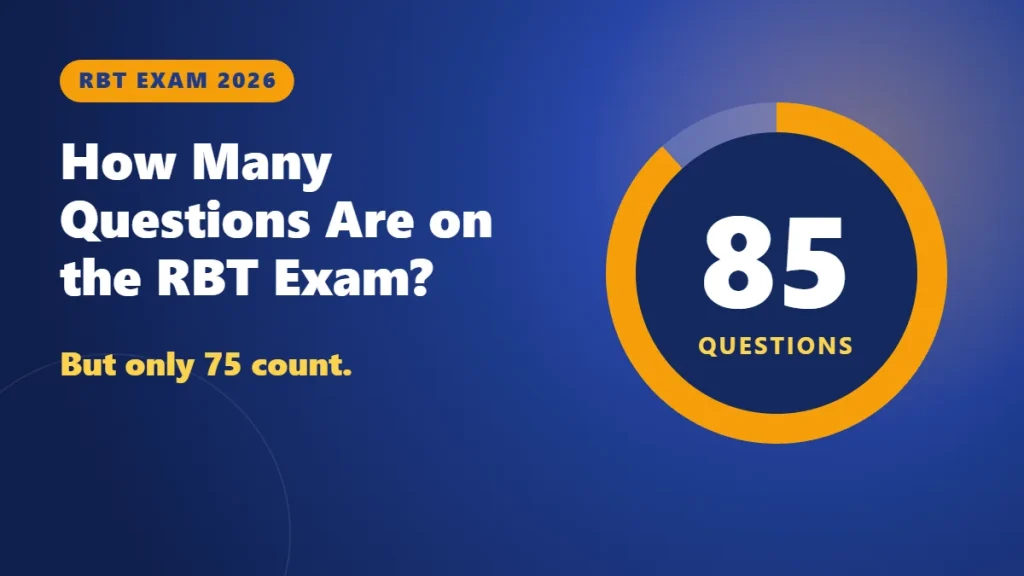
If you are asking how many questions are on the RBT exam, the answer is 85. But only 75 of them count toward your result. The other 10 are new questions the BACB is testing for future exams. Once you know this, and how the 90 minutes really work, you can practice the right way and walk in calm.
The RBT exam has 85 multiple-choice questions: 75 scored and 10 unscored. You get 90 minutes. Each question has 4 answer choices and only 1 correct answer.
The RBT Exam at a Glance (2026)
Why 85 Questions but Only 75 Count
This is the part most students miss when they look up how many questions are on the RBT exam. The total is 85, but your result depends only on 75.
One more thing worth knowing: the number of questions did not change when the exam moved to the 3rd Edition in 2026. It was 85 before and it is 85 now. What changed is the content behind those questions.
The BACB adds 10 unscored questions to try out new items before they are used on real exams. This keeps future exams fair and consistent.
The key point is this: you cannot tell which questions are unscored. They look exactly like the rest. So if a question feels odd or much harder than the others, it may not even count. Give it your best answer and move on. Don’t let one strange question shake your focus.
How the 75 Scored Questions Are Split
Since January 1, 2026, the exam has been based on the BACB RBT Test Content Outline (3rd ed.). It splits the scored questions across 6 domains.
| Domain | Scored questions | Share | Weight |
|---|---|---|---|
| A. Data Collection and Graphing | 13 | 17% | |
| B. Behavior Assessment | 8 | 11% | |
| C. Behavior AcquisitionBiggest | 19 | 25% | |
| D. Behavior Reduction | 14 | 19% | |
| E. Documentation and Reporting | 10 | 13% | |
| F. Ethics | 11 | 15% |
Behavior Acquisition alone is a quarter of your score. Expect plenty of questions on discrete-trial teaching, prompting, shaping, and chaining. Ethics also grew in the 3rd Edition, from 5 tasks to 10, so don’t save it for the last day.
Weak in one area? Practice it on its own:
What 75 Scored Questions Mean for Each Task
Here is something most guides skip when they explain how many questions are on the RBT exam. The 3rd Edition outline has 43 tasks, but only 75 questions are scored. That works out to fewer than 2 questions per task on average. So you cannot skip a task and hope it won’t show up, and no single task can carry you either.
| Domain | Scored questions | Tasks | Questions per task |
|---|---|---|---|
| A. Data Collection and Graphing | 13 | 8 | ~1.6 |
| B. Behavior AssessmentMost per task | 8 | 3 | ~2.7 |
| C. Behavior Acquisition | 19 | 11 | ~1.7 |
| D. Behavior Reduction | 14 | 7 | ~2.0 |
| E. Documentation and Reporting | 10 | 4 | ~2.5 |
| F. Ethics | 11 | 10 | ~1.1 |
Two patterns stand out. Behavior Assessment has only 3 tasks but 8 questions, so each Assessment task is worth almost 3 questions. Ethics is the opposite: 10 tasks share 11 questions, so you need a light but complete review of every Ethics task rather than a deep dive into one or two.
How the 90 Minutes Really Work
Not all 90 minutes are for answering. The clock also covers the terms and conditions, a short navigation tutorial, and screen loading. So your real answer time is a little less than it looks.
Two things catch people off guard:
- The clock keeps running during breaks. If you step out, that time comes out of your 90 minutes.
- About 1 minute per question is a safe pace. When roughly 45 minutes have passed, you should be near question 45.
Most questions are short work scenarios. Something happens in a session, and you choose what the RBT should do or which concept fits. A simple habit that helps: read the last sentence first, so you know what is being asked before you read the story.
Another habit that saves points: stay inside the RBT role. When one answer has the RBT designing an assessment, writing a new plan, or changing a procedure on their own, it is usually wrong. On the real exam, the right move is often to follow the plan as written and tell your supervisor.
How Many Questions Do You Need to Get Right?
Once you know how many questions are on the RBT exam, the next worry is how many you need right. There is no fixed number, and this is where many websites get it wrong.
The BACB sets the passing point with the modified Angoff method. A panel of experts looks at every question and estimates how likely a just-qualified RBT would be to answer it correctly. The cut score is built from those estimates. Since each exam version has different questions, the number you need right can shift slightly from one version to another. You only get a pass or fail result, not a percentage.
Watch out: Claims like “you can miss 15 questions” or “you need 200 out of 250” do not come from the BACB. The BACB does not publish a passing number.
This is not a BACB rule, but it is the target we recommend: score 80% or higher in every domain on your practice tests before you book. A good total can hide one weak domain, and that weak domain can cost you on test day.
What Happens After the Last Question
- You see pass or fail on screen at the test center as soon as you finish.
- The BACB confirms by email, and the result shows in your BACB account in about a week.
- If you don’t pass, your score report lists the RBT tasks where you answered items incorrectly. That tells you exactly what to study.
- A retake application appears in your BACB account within 48 hours. You must wait 7 days, and you get up to 8 attempts within 12 months of your first approval. Each attempt costs $45 at Pearson VUE.
Passing the first time really matters. According to the BACB annual data, 75% of first-time test takers passed in 2025, but only 38% of people retaking the exam did.
Before Test Day: The ID Mistake That Can Cost You
Your ID must be government-issued, original, current, and show both your photo and signature. A photocopy or a digital ID on your phone will not be accepted. Check it the week before, not the morning of. You can review the full rules in the RBT Handbook and book your seat through Pearson VUE.
How to Practice for an 85-Question Exam
Knowing how many questions are on the RBT exam is only half the job. The other half is building the focus to answer all 85 in one sitting without rushing the last 20. Keep in mind that a practice score is a guide, not a promise. Real exam questions are written and reviewed by the BACB, so use practice tests to find weak spots, not to predict your exact result.
Check your level first. Take the 75-question RBT practice exam to see how you’d score on the part that counts.
Fix weak domains. Read that domain in the RBT study guide, then take its topic quiz.
Rehearse the real thing. In your final week, take the full 85-question practice exam in one sitting with a 90-minute timer.
Frequently Asked Questions
How many questions are on the RBT exam in 2026?
85 multiple-choice questions. 75 are scored, and 10 are unscored pilot questions that do not affect your result.
How long do you get for the RBT exam?
90 minutes. This also includes the terms, a short tutorial, and load time, and the clock does not stop for breaks.
What score do you need to pass the RBT exam?
The BACB does not publish a fixed number or percentage. It sets the cut score with the modified Angoff method, and you get a pass or fail result only.
Can I take the RBT exam online from home?
No. You take it in person at a Pearson VUE test center in the United States, Canada (except Quebec and Ontario), or Australia until January 1, 2027.
How many times can I retake the RBT exam?
Up to 8 attempts within 12 months of your first application approval, with at least 7 days between attempts.
Sources: BACB RBT Handbook (updated June 2026), BACB Examination Information, BACB Recent and Upcoming Changes, and BACB annual data. This site is an independent study resource and is not affiliated with the BACB. Always check bacb.com for the latest rules before you apply.
