
RBT Behavior Acquisition Study Guide 2026
Behavior acquisition is a critical domain in the 2026 RBT exam. It tests how RBTs assist in teaching new skills using DTT, NET, chaining, shaping, reinforcement schedules, prompt fading, and generalization. This guide uses real session examples, visual aids, exam tips, and common mistakes to help students master the topic efficiently.
What is a Skill Acquisition Plan? (Target behavior, Mastery criteria)
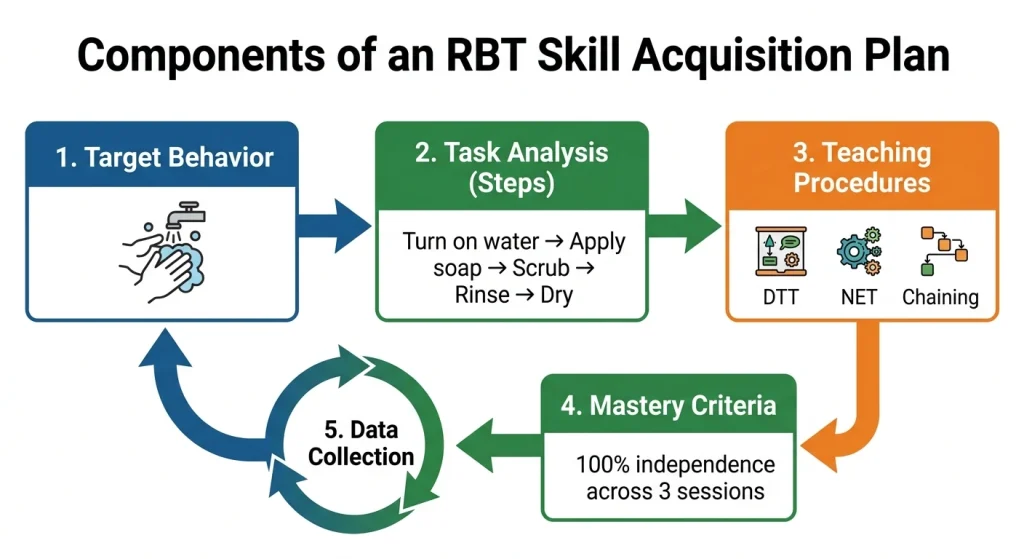
A skill acquisition plan defines the target behavior, teaching steps, and mastery criteria.
Example: Target: Handwashing; Steps: Turn on water → Apply soap → Scrub → Rinse → Dry; Mastery: Completes steps independently across three sessions.
Exam relevance: Questions may test how an RBT collects data or tracks progress under supervision. RBT implements the plan; supervisor approves mastery.
According to the BACB RBT 3rd Edition Test Content Outline, Domain C includes DTT, NET, Chaining, and Shaping tasks for the 2026 exam.
Preparing for the Session (Materials, Reinforcers)
Before sessions, gather all materials and verify reinforcers.
| Item | Purpose | Notes |
|---|---|---|
| Task cards | Structured DTT steps | Pre-organized sequence |
| Reinforcer | Motivation | Ensure learner preference and safety |
| Timer | Prompt timing | Check the device before the session |
| Data sheet | Track responses | Use objective descriptions |
Exam tip: Always check materials and reinforcers per the supervisor’s plan.
Key Teaching Procedures
Discrete Trial Teaching (DTT)
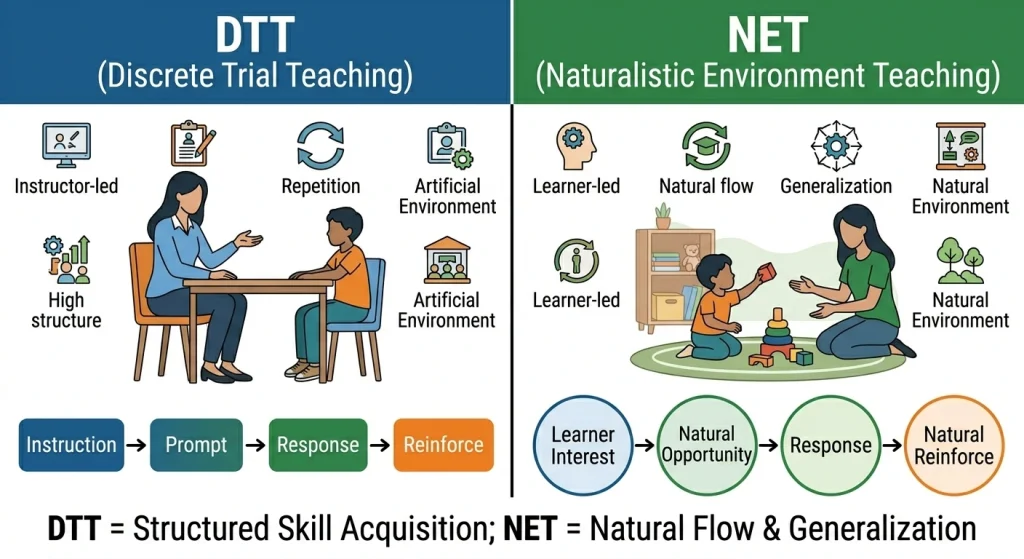
DTT breaks a skill into small, teachable steps. Each trial: Instruction → Prompt → Response → Reinforcement.
Example: Teaching a learner to identify colors: Show red card → Prompt if needed → Learner points → Reinforce.
Exam tip: RBT collects data; do not modify steps independently.
Naturalistic Environment Teaching (NET)
NET occurs in natural environments using the learner’s interests.
Example: Learner asks for a toy during free play; RBT reinforces correct requests.
Exam tip: Record observable responses objectively.
Chaining (Forward, Backward, Total Task)
- Forward Chaining: Teach first step → add subsequent steps
- Backward Chaining: Teach last step → add preceding steps
- Total Task: Complete skill in each trial with prompts as needed
Example: Handwashing skill sequence.
Key Difference (Shaping vs Chaining):
- Shaping: Gradual changes in behavior approximation
- Chaining: Linking separate steps to form a complete task
Shaping
Shaping reinforces successive approximations toward a target behavior.
Example: Teaching “hello”: start with acknowledgment → partial vocalization → full word.
Exam tip: Reinforce observable steps only.
Prompting and Prompt Fading (The Hierarchy)
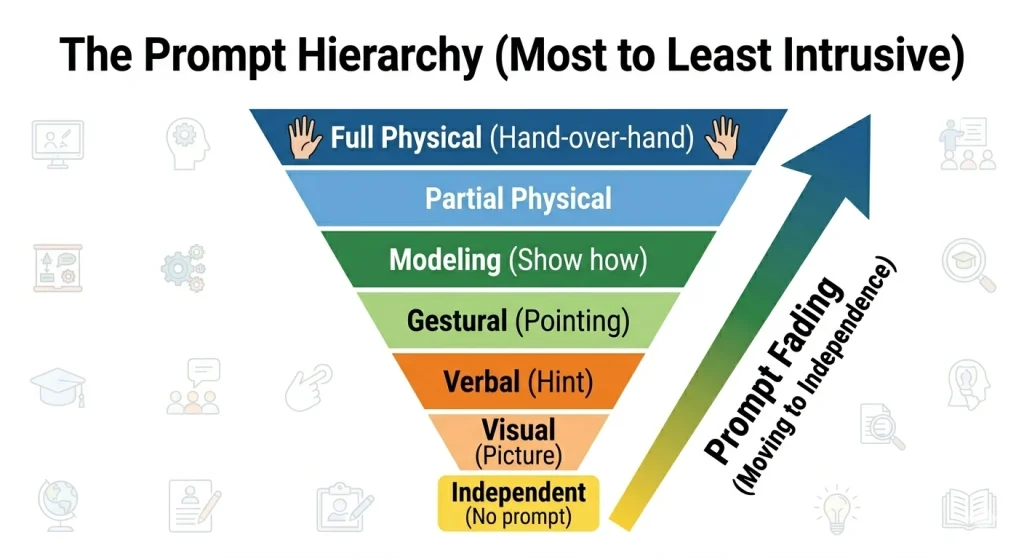
Prompt Hierarchy (Most to Least Intrusive):
- Full Physical (Hand-over-hand)
- Partial Physical
- Modeling (Show how)
- Gestural (Pointing)
- Verbal (Hint)
- Visual (Picture)
- Independent (No prompt)
Exam tip: Questions may ask Most-to-Least (MTL) vs Least-to-Most (LTM). RBT must follow the hierarchy.
Discrimination Training (Teaching the Difference)
Helps learners respond differently to stimuli.
Example: Teaching red vs blue blocks. RBT presents SD, records response, and reinforces correct responses.
Stimulus Control Transfer Procedures
RBT assists in transferring control from prompts to natural cues.
Example Flow: SD → Prompt → Response → Reinforce → Fade
Exam tip: Follow the procedure exactly; do not modify independently.
Generalization and Maintenance
| Type | Example |
|---|---|
| Stimulus Generalization | Calling all four-legged animals “dog” |
| Response Generalization | Saying “Hi,” “Hello,” or “Hey” to greet someone |
| Setting | Classroom, playground |
| People | Peer, teacher, parent |
| Materials | Blocks, cards |
| Time | Daily or weekly sessions |
Skill Acquisition Quiz for practice on generalization.
Reinforcement (Continuous vs Intermittent + Big 4 Schedules)
- Continuous (CRF): Reinforce every correct response → faster acquisition
- Intermittent: Reinforce after some responses → better maintenance
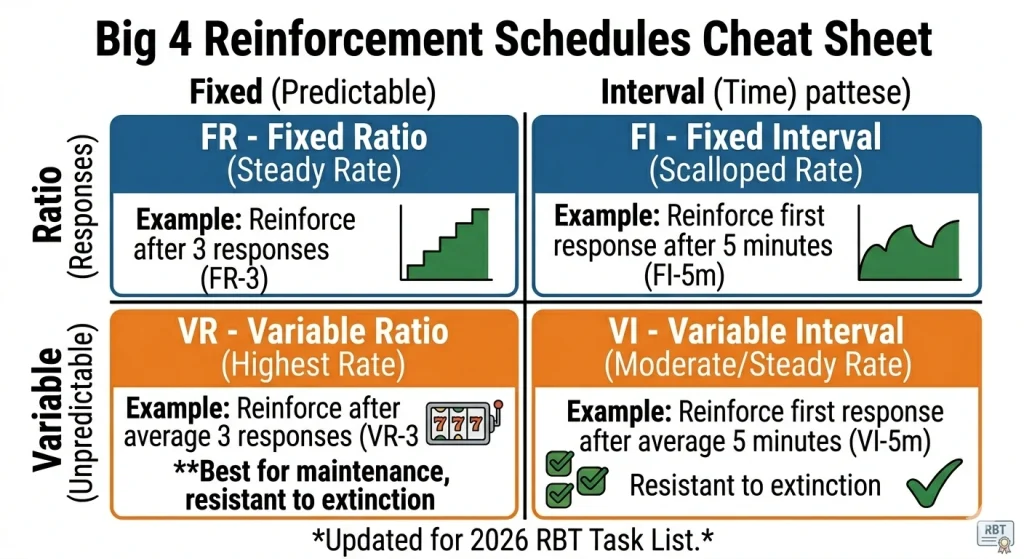
Big 4 Reinforcement Schedules:
| Schedule | Example | Notes |
|---|---|---|
| FR | Reinforce after 3 responses | Steady response rate |
| VR | Reinforce after variable responses | Best for maintenance, resistant to extinction |
| FI | Reinforce after a variable time | Predictable |
| VI | Reinforce after variable time | Reinforce after a set time |
Example Sessions & Common Exam Mistakes
Example 1: DTT pointing to colors; RBT records responses, follows steps.
Example 2: NET toy request; RBT records requests objectively.
Example 3: Chaining handwashing; record prompts, reinforcement.
Common mistakes:
- Deciding mastery or function independently
- Changing procedure without a supervisor
- Subjective notes (“lazy,” “angry”)
Recommended Study Resources & Quizzes
- RBT Acquisition Quiz
- RBT Measurement Study Guide
- Full RBT Study Guide 2026