
RBT Behavior Reduction Study Guide 2026: Clear Examples & Tips
Behavior reduction is a critical domain in the 2026 RBT exam, focusing on reducing challenging behaviors safely and effectively. This guide explains functions of behavior, differential reinforcement, extinction, proactive strategies, and safe RBT-assisted procedures. Real session examples, exam tips, minor callouts, and common mistakes help students learn and apply strategies confidently.
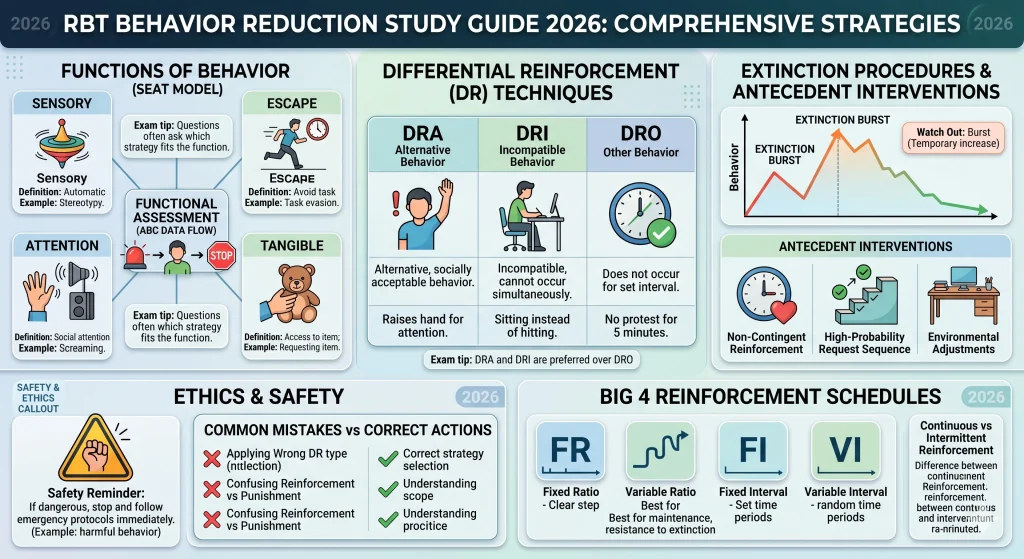
What is Behavior Reduction?
Behavior reduction systematically decreases problem behaviors that interfere with learning, safety, or social interaction. RBTs implement strategies under supervision, ensuring ethical and safe practices.
Example: A learner hits peers when denied access to a toy. The RBT implements behavior reduction strategies under supervision while collecting objective data.
Functions of Behavior
Understanding the function of behavior helps select the correct reduction strategy.
| Function | Example | Why it Matters |
|---|---|---|
| Escape | Learner avoids tasks | Choose replacement behavior like hand-raising |
| Attention | The learner avoids tasks | Reinforce alternative communication behavior |
| Tangible | Learner cries for item access | Replace with appropriate requesting behavior |
| Automatic | Learner engages in stereotypy | Implement safe replacement behavior |
Exam tip: Questions often ask which strategy fits the function.
Differential Reinforcement
Differential reinforcement is a primary method to reduce problem behavior safely.
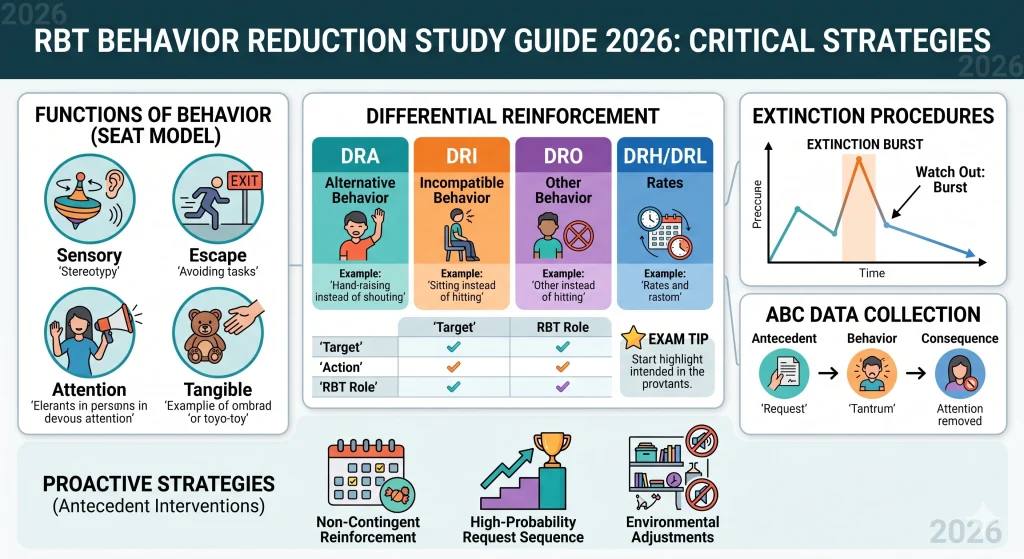
DRA (Differential Reinforcement of Alternative Behavior)
Reinforce an alternative, socially acceptable behavior.
Example: Learner raises a hand instead of shouting.
DRI (Differential Reinforcement of Incompatible Behavior)
Reinforce behavior that cannot occur simultaneously with problem behavior.
Example: Reinforce sitting in a chair instead of standing and hitting.
DRO (Differential Reinforcement of Other Behavior)
Reinforce when problem behavior does not occur during a set interval.
Example: Learner avoids vocal protest for 5 minutes → reinforce.
DRH / DRL (High / Low Rates)
- DRH: Increase desired behavior frequency
- DRL: Reduce problem behavior frequency
Extinction Procedures
Extinction reduces problem behavior by removing reinforcement.
Example: Learner hits peer for attention → ignore hitting, reinforce alternative communication.
Callout Box:
Watch Out: Extinction Burst
Problem behavior may temporarily increase in frequency or intensity before reducing. RBT should remain calm and follow the plan exactly.
Exam tip: RBT does not independently interpret function; follow supervisor instructions.
Proactive Strategies (Antecedent Interventions)
Behavior reduction is not only reactive; preventive strategies are essential.
Key Proactive Interventions:
- Non-Contingent Reinforcement (NCR): Reinforce a schedule independent of behavior.
- High-Probability Request Sequence: Present 2–5 easy requests before the target task to increase compliance.
- Environmental adjustments: Reduce triggers or distractions.
Exam tip: These strategies prevent problem behavior and are often scenario-based questions.
Response Cost and Safe Punishment Procedures
- RBT’s role is limited; it only implements if trained and directed.
- Response Cost Example: Remove tokens for unsafe behavior.
- Reinforcement-based strategies are preferred.
Exam tip: Focus on differential reinforcement + extinction for exam scenarios.
Functional Assessment for Behavior Reduction
RBT collects ABC data:
- Antecedent: What occurs before behavior
- Behavior: Observable, measurable response
- Consequence: What occurs after the behavior
Exam tip: Objective data only; supervisor interprets behavior function.
Ethics & Safety
Line to add in the Example Sessions section:
Safety Reminder: If behavior becomes dangerous (harmful to self or others) and is not covered in the plan, stop the procedure and follow emergency safety protocols immediately.
Example Sessions & Common Exam Mistakes
Scenario 1: Attention-seeking behavior
- The learner screams for adult attention
- RBT reinforces hand-raising (DRA), ignores problem behavior
- Records objective data
Scenario 2: Escape behavior
- The learner leaves the table to avoid the task
- RBT reinforces alternative behavior (DRA)
- Follows supervisor-approved plan
Common mistakes:
- Selecting the wrong differential reinforcement type
- Applying extinction incorrectly
- Confusing reinforcement vs punishment
- Acting beyond the RBT scope
Reinforcement Strategies Integration
- Continuous vs Intermittent Reinforcement
- Big 4 Schedules: FR, VR, FI, VI
- VR: Best for maintenance; high resistance to extinction
Recommended Quizzes & Resources
- RBT Behavior Reduction Quiz
- ABC Data Measurement Guide
- BACB RBT 3rd Edition Test Content Outline
- RBT Handbook (BACB)