
RBT Behavior Assessment Study Guide for Students Who Need Clear Examples
RBT behavior assessment is the part of the 2026 RBT exam that checks whether you understand preferences, skill assessments, ABC data, and the RBT’s support role during functional assessment. The BACB 3rd Edition Test Content Outline says the RBT exam includes 75 scored questions and 10 unscored pilot questions, and the Behavior Assessment has 8 questions, or 11% of the scored exam.
Many RBT students lose marks in this area because the answer choices look close. One option may ask the RBT to collect data, while another option may ask the RBT to decide the function of the behavior. The safer exam answer usually keeps the RBT inside the role of following supervisor direction, collecting objective information, and reporting what happened.
What Behavior Assessment Means in ABA
Behavior assessment means collecting information about a learner’s skills, preferences, behavior patterns, and environment. The team uses this information to understand what the learner can already do, what skills need teaching, and what may be related to challenging behavior.
An RBT does not create the full assessment plan alone. An RBT follows the procedure given by a supervisor, records accurate data, and shares clear notes. The BACB RBT Handbook explains that RBTs are not independent practitioners and must receive ongoing supervision to practice.
Think of assessment as the information-gathering step. The supervisor uses the data to make clinical decisions, while the RBT helps collect the information correctly.
What the 2026 RBT Exam Tests
The official 2026 Behavior Assessment domain includes three main tasks. RBTs need to know how to conduct preference assessments, participate in assessments of skill strengths and deficits, and participate in components of functional assessment procedures.
| Exam Area | What It Means |
|---|---|
| Domain B | Behavior Assessment |
| Exam Weight | 8 questions, 11% |
| Official Tasks | B.1, B.2, B.3 |
| Student Focus | Preferences, skill assessments, ABC data, and functional assessment support |
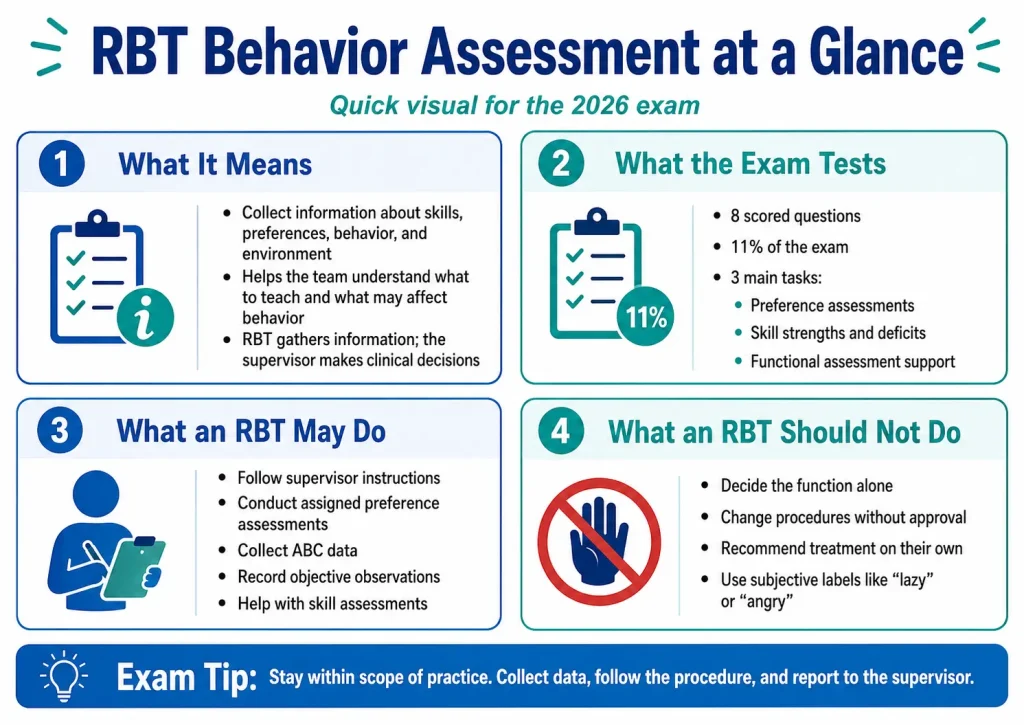
Most questions in this area give you a short client situation and ask what the RBT should do next. Your job is to pick the answer that follows training, supervision, objective data collection, and the written procedure.
RBT Role During Assessment
RBT behavior assessment questions often test the scope of practice. The exam wants to know whether you understand the difference between helping with an assessment and making decisions alone.
What an RBT May Do
An RBT may run assigned preference assessments after proper training. The RBT may prepare materials, present items, collect data, summarize choices, and tell the supervisor what happened.
An RBT may also help with skill assessments. For example, the supervisor may ask the RBT to run a few tasks, record correct and incorrect responses, or observe how a learner interacts during a social activity.
The 2026 RBT training curriculum also lists “Assisting with Behavior Assessments” as a 3-hour training area. That section includes skill-based, preference, and functional assessments, along with preparing materials, collecting data, presenting stimuli, documenting environmental variables, and helping with data summaries.
What an RBT Should Not Do
An RBT should not design an assessment without direction. An RBT should not decide the function of behavior alone, change the assessment steps, or tell caregivers what treatment plan should be used.
When the procedure is unclear, the best action is to ask the supervisor. Guessing is not safe, and changing the procedure can make the data less useful.
Preference Assessments
A preference assessment helps identify items, activities, foods, toys, or social attention a learner may like. These choices may help the team find possible reinforcers.
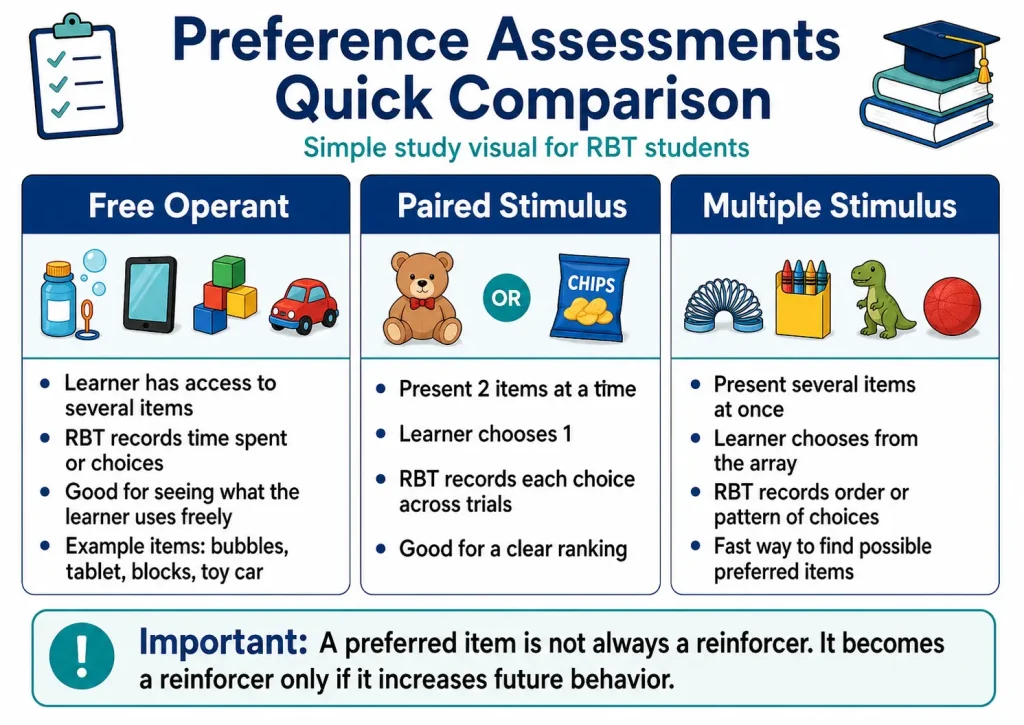
The official outline gives examples such as multiple stimulus, paired stimulus, and free operant preference assessments.
Free Operant Preference Assessment
A free operant assessment gives the learner access to several items or activities. The RBT watches what the learner picks, touches, uses, or stays near.
Example: A learner has access to blocks, bubbles, a tablet, and a toy car. The learner spends most of the time with bubbles and the tablet. The RBT records the time or choices instead of guessing what the learner likes.
Paired Stimulus Preference Assessment
A paired stimulus assessment presents two items at a time. The learner chooses one item, and the RBT records that choice.
Example: The RBT shows a ball and a puzzle. The learner picks the ball. Later, the ball is paired with other items to see whether the choice stays strong across trials.
Multiple Stimulus Preference Assessment
A multiple stimulus assessment presents several items at once. The learner chooses from the group, and the RBT records the order or pattern of choices.
Example: The RBT places five items on the table. The learner chooses crayons first, then a toy train, then a snack. The data helps the supervisor see which items may be worth testing during teaching.
Preference Is Not the Same as Reinforcement
Students often miss this point on practice questions. A preferred item is something the learner chooses or seems to like. A reinforcer is something that increases future behavior.
Example: A learner may pick a toy car during a preference assessment. That toy car is only a reinforcer if it helps increase a target behavior, such as completing work or using a communication response.
Skill Strengths and Deficits Assessment
Skill assessment helps the team see what the learner can already do and what still needs teaching. In the 2026 outline, this includes curriculum-based, developmental, and social skills assessments.
Curriculum-Based Assessment
A curriculum-based assessment looks at learning or program-related skills. These may include matching, reading, writing, counting, labeling objects, or following classroom routines.
Example: The supervisor asks the RBT to present letter cards. The learner names 6 out of 10 letters correctly. The RBT records the score without adding an opinion.
Developmental Assessment
A developmental assessment looks at skills linked to daily growth and functioning. These may include communication, play, motor skills, dressing, feeding, or toileting.
Example: The RBT observes whether the learner asks for help, imitates actions, or uses simple words during a session. The RBT records what happened and reports it to the supervisor.
Social Skills Assessment
A social skills assessment looks at how the learner interacts with other people. Skills may include greeting, sharing, waiting, turn-taking, asking questions, or playing with peers.
Example: During a group activity, the RBT records whether the learner responds when another child says hello. The note should describe the response, not label the learner as friendly or unfriendly.
Functional Assessment Procedures
Functional assessment looks at why a behavior may be happening. Common behavior functions include attention, escape, access to items or activities, and automatic reinforcement.
An RBT should understand these functions for the exam, but the RBT does not make the final clinical decision alone. The RBT collects data, follows directions, and reports patterns to the supervisor.
Descriptive Assessment
A descriptive assessment uses observation in the natural setting. The RBT may record what happens before the behavior, what the behavior looks like, and what happens after.
Example: A worksheet is placed on the table. The learner pushes the worksheet away and cries for 2 minutes. The adult removes the worksheet. The RBT records those facts and gives the data to the supervisor.
Functional Analysis
A functional analysis is more controlled. It may involve changing conditions to test why behavior happens. This should happen only under qualified clinical direction.
An RBT may help if trained and supervised. An RBT should not set up, change, or interpret a functional analysis alone.
ABC Data in Assessment
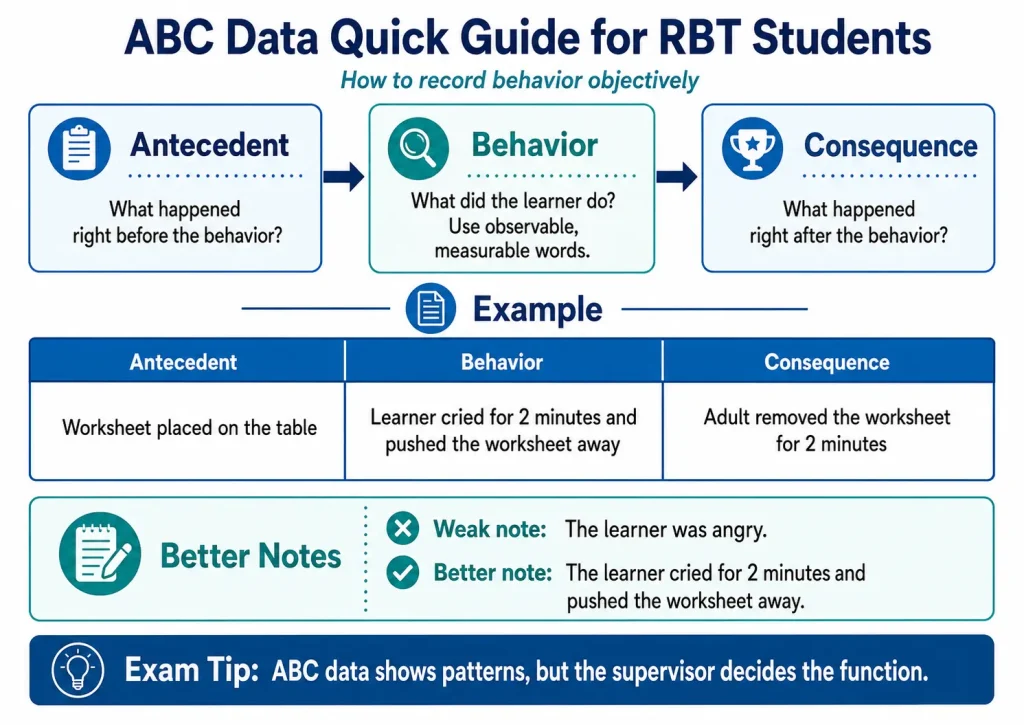
ABC data means antecedent, behavior, and consequence. This is one of the most important parts of the RBT assessment because it shows what happened around the behavior.
If ABC terms still feel confusing, review the RBT Measurement Study Guide before taking the RBT Assessment Quiz.
Antecedent
The antecedent is what happened before the behavior. It may be an instruction, a denied item, a transition, a loud noise, a demand, or another event.
Example: The teacher gives a math worksheet. That worksheet demand is the antecedent.
Behavior
The behavior is what the learner did. It should be written in clear, observable words.
Weak note: The learner was angry.
Better note: The learner cried for 2 minutes and pushed the worksheet off the table.
Consequence
The consequence is what happened after the behavior. It may be attention, a break, access to an item, removal of a task, or no clear change.
| The tablet was removed | The learner threw a pencil | A worksheet was given | Record and report |
| Peer took the toy | The learner threw a pencil | The parent gave the tablet back | Record what happened |
| Peer took toy | The learner hit a peer’s arm | Staff blocked and redirected | Peer took the toy |
ABC data may show a pattern, but the RBT should not jump to a final function without the supervisor.
Common Exam Mistakes to Avoid
Assessment questions are often easy to read but tricky to answer. These mistakes are common in RBT behavior assessment practice questions.
Mistake 1: Deciding the Function Alone
A question may show that a learner escapes work after throwing materials. The RBT may notice the pattern, but the RBT should still collect data and report it.
Best exam thinking: The supervisor decides the function after reviewing enough data.
Mistake 2: Changing the Procedure
The RBT should not change steps because the learner seems bored or upset. If the assessment needs to stop or change, the RBT should follow the plan or contact the supervisor.
Best exam thinking: Follow the written procedure unless safety or supervisor direction says otherwise.
Mistake 3: Writing Subjective Notes
Words like lazy, rude, aggressive mood, upset, or manipulative can make data weak. The RBT should write what can be seen or counted.
Better note: The learner screamed for 45 seconds and dropped to the floor.
Mistake 4: Treating Preference as Proof
A learner choosing an item does not prove that the item will increase behavior. The item still needs to be tested in teaching or behavior-change procedures.
Best exam thinking: Preference may suggest a possible reinforcer, not prove one.
Mistake 5: Giving Caregiver Advice Alone
A caregiver may ask what the behavior means or what they should do at home. The RBT should stay respectful and refer treatment questions to the supervisor.
Best exam thinking: Answer within role limits and involve the supervisor.
Real Study Examples
Examples make this topic easier because the exam often uses real session situations.
Preference Assessment Example
The supervisor asks the RBT to run a paired stimulus assessment. The RBT presents two items, waits for a choice, gives brief access to the chosen item, and records the selection.
What the RBT records: item pairs, learner choices, and any notes required by the procedure.
Skill Assessment Example
The supervisor asks the RBT to check whether the learner follows one-step directions. The RBT gives the instruction, waits for the response, and records correct or incorrect responses.
What the RBT avoids: changing the instructions, giving extra help not listed in the procedure, or deciding new goals alone.
Functional Assessment Example
A learner leaves the table every time writing work starts. The RBT records the demand, the leaving behavior, and what the staff does after the learner leaves.
What the supervisor reviews: the ABC pattern, setting events, environmental variables, and other data before making decisions.
Quick Study Checklist
Use this checklist before you move to practice questions.
| Study Point | Check |
|---|---|
| I know the 3 Behavior Assessment tasks | Yes / No |
| I can explain free operant, paired stimulus, and multiple stimulus assessments | Yes / No |
| I know preference is not always reinforcement | Yes / No |
| I can identify antecedent, behavior, and consequence | Yes / No |
| I can describe behavior in objective words | Yes / No |
| I know what an RBT may and may not do | Yes / No |
| I know when to ask the supervisor | Yes / No |
After this page, take the RBT Assessment Quiz to check your understanding of preference assessments, ABC data, skill assessments, and functional assessment support. You can also return to the full RBT Study Guide to review the other exam domains.